The most repeated piece of advice about HIPAA compliance for telehealth is also the least useful: pick a HIPAA-compliant video platform, sign a business associate agreement, and consider the job finished. That answers a purchasing question. It doesn't answer the question an investigator asks after a breach, which is who could see the data, for how long, and what written evidence shows anyone assessed the risk beforehand.
A video tool protects one room in a much larger building. Intake answers, identity documents, message threads, prescription transmissions, payment records, monitoring readings, recordings and backups all carry the same kinds of patient detail, and most of them sit outside the app that gets all the attention. A vendor can hand you a perfect encryption statement and still leave your intake quiz on a form builder nobody reviewed.
The test I would apply to any telehealth program is simple. Can you produce a document that names every place patient data goes, who can open it, how long it stays, and what you decided to do about each risk? If the answer is a link to a vendor's trust page, you have a marketing claim, not a compliance program.
Where HIPAA Applies in a Telehealth Visit
Think of a telehealth visit as a chain of rooms rather than a single appointment. Intake is the lobby where a patient first hands over health history, medications and allergies. Identity verification is the front desk. The video call is the consulting room. Prescriptions, messages, payments, monitoring readings and backups are the back offices and the basement. Each door needs its own lock, and the lock that fits the consulting room rarely fits the basement.
That chain is where HIPAA compliance for telehealth lives. Protected health information (PHI) moves along every link, and the Privacy, Security and Breach Notification Rules follow it into each one. A program that secures the video session and leaves intake answers in a shared spreadsheet has locked one door and propped open the rest.
Use this table as the reference for the safeguards described throughout.
| Data pathway | Protected health information involved | Required safeguard |
|---|---|---|
| Intake questionnaire | Health history, medications, allergies, weight goals | Encrypted storage and role-limited access |
| Identity verification | ID documents, date of birth | Secure upload and short retention |
| Video visit | Audio, video and clinical discussion | Encrypted session and no unapproved recording |
| Provider messaging | Symptoms, dosing questions | Encrypted channels, unique user IDs and audit logs |
| Prescriptions and pharmacy transmission | Drug names, doses, patient identifiers | Secure transmission and a business associate agreement with the pharmacy |
| Payment records linked to care | Billing codes, card and account data tied to treatment | Segregated access and vendor agreements |
| Remote monitoring | Weight, blood pressure and device readings | Device authentication and secure transfer |
| Recordings and transcripts | Full visit content | Recording off by default, encryption and short retention |
| Backups | Copies of all of the above | Encryption, access controls and tested restoration |
The table matters because each row fails in a different way. A leaked intake form exposes a patient's medication list before they ever meet a clinician. A well-encrypted video call paired with unencrypted backups exposes the whole patient population the day a storage volume is misconfigured.
Telehealth became a mainstream channel fast enough that governance had to catch up in public. The HHS study of Medicare telehealth use reported by CMS recorded fee-for-service visits rising from roughly 840,000 in 2019 to 52.7 million in 2020, a 63-fold increase. The HHS Office for Civil Rights responded with enforcement discretion for certain remote communication technologies, letting providers use widely available video tools in good faith without the immediate threat of penalties.
That discretion lowered penalty risk for specified tools during the emergency. It never suspended the Privacy, Security or Breach Notification Rules, and it's no longer in force. Every pathway in the table is squarely inside the rules today.
Why Breach Trends Demand Ongoing Controls
Breach reporting shows why an encrypted platform is a starting point rather than an answer. HHS recorded 663 breaches involving unsecured protected health information during 2024, affecting approximately 242.9 million individuals, according to its breach report to Congress. Healthcare providers accounted for 505 of those 663 reports, or 76%, alongside 30,256 new HIPAA complaints and 730 compliance reviews at the Office for Civil Rights.
The pattern behind those numbers is the part that should worry a telehealth operator. The same report cites an analysis of HHS breach data showing large reported breaches rising from 216 in 2010 to 566 in 2024, while hacking or information technology incidents climbed from 4% of breaches in 2010 to 81% in 2024. Theft of a laptop used to be the classic healthcare breach. Now the typical incident is an attacker reaching a system through a weak account or an unpatched vendor.
For a virtual care program, the information lifecycle runs through a predictable sequence, and each stage carries its own control:
- Collection: intake questionnaires, identity uploads and consent signatures, all of which need encrypted storage and a retention limit.
- Authentication: unique user IDs for staff, multifactor sign-in where available, and patient identity checks before clinical detail is shared.
- Transmission: the video session itself, plus any messaging that happens around it.
- Storage: clinical notes, dosing records, prescriptions and payment data.
- Exchange: pharmacy transmissions, laboratory orders, shipping notifications.
- Deletion or retention: deciding what goes, when, and proving it happened.
A single encryption toggle covers one stage of that list. The rest need documented controls, which is why risk analysis, least-privilege access, workforce training, audit logging, incident response and signed business associate agreements are foundational rather than optional extras. For a wider view of how encryption, retention schedules and vendor contracts fit together across a healthcare organization, AIDictation's 2026 patient data protection overview covers the controls that tend to appear in audit findings.
The breach number that matters isn't the total. It's the share that started with a system nobody classified as handling patient data.
How to Run a Telehealth Risk Analysis
A telehealth risk analysis is a documented process, not a security badge for a video platform. Under the HIPAA Security Rule, covered entities must assess risks to the confidentiality, integrity, and availability of electronic protected health information (ePHI), then implement reasonable and appropriate safeguards. The HHS guidance on HIPAA and audio-only telehealth discusses that obligation in the audio-only context. The same risk-based approach helps teams assess video, messaging, and prescribing workflows.
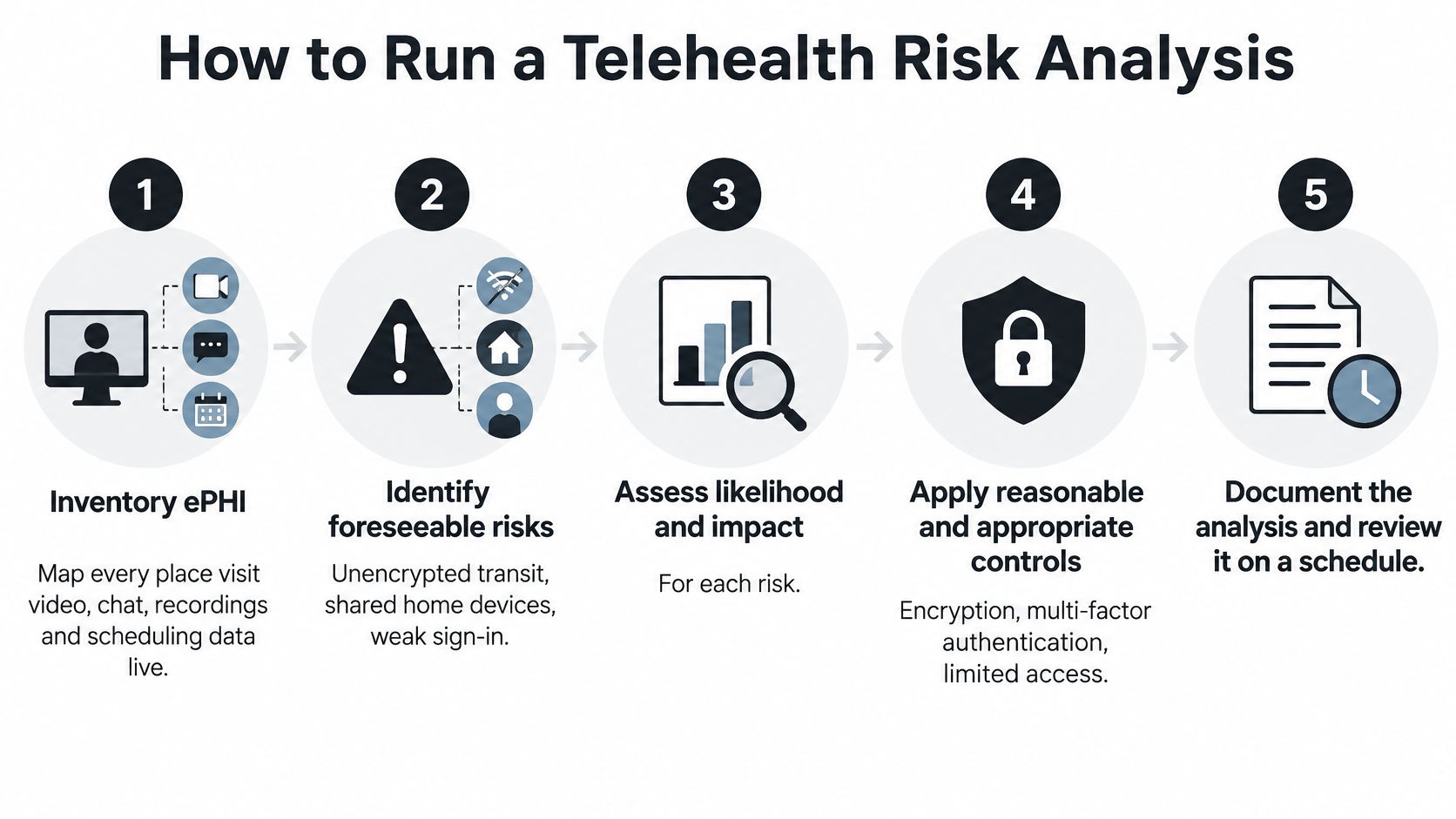
The analysis should guide decisions about what to protect, where controls are needed, and how to document those choices. Work through the following steps.
-
Inventory every ePHI pathway. Include intake questionnaires, identity checks, video visits, provider messaging, medication and dosing records, pharmacy transmissions, remote monitoring, recordings or transcripts, backups, and staff or vendor access. If a pathway is missing from the inventory, it cannot be assessed or assigned a control. Backups and vendor accounts deserve particular attention because copies of data can remain outside the systems staff use every day.
-
Map data flows and retention periods. For each pathway, record where information originates, which systems it passes through, who can access it, and when it is deleted. Set a retention period and name who is responsible for applying it. Otherwise, recordings and other session data may persist because no one owns the deletion decision.
-
Identify threats. Consider how information could be intercepted in transit, accessed without authorization after storage, or exposed through weak authentication. Assess each pathway, not just the video application. A video service's protections do not automatically cover connected messaging, storage, or other tools.
-
Rate likelihood and impact for each risk. A leaked intake form and a leaked backup may have different consequences. Use the ratings to prioritize fixes when resources are limited. Marking every risk high makes priorities hard to distinguish; marking everything low can leave serious exposure unaddressed.
-
Choose controls and document the reasoning. Options include unique user IDs, automatic logoff, least-privilege access, regular audit-log review, encryption in transit and at rest, and disabling recording unless there is a clinical reason. The CloudOrbis HIPAA risk assessment checklist can help organize the inventory and ratings.
-
Document decisions, training, and incident response. Identify vendors that handle ePHI, such as video, messaging, cloud hosting, analytics, and pharmacy technology providers. Where HIPAA requires a business associate agreement, document the agreement and the services it covers. Keep training records and an incident response plan that staff can follow.
-
Reassess after a change. A new vendor, feature, or data pathway can alter the risks and controls. For example, adding an AI scribe, text reminder service, or progress-tracking integration calls for an updated review. Record when the analysis was revisited and what changed.
The evidence an auditor asks for
Keep the inventory, risk ratings, control decisions, training records, applicable signed agreements, and review date together. The record should show why risks were prioritized and how safeguards address them. A concise analysis with clear decisions is more useful than a long template with empty sections.
Safeguards for Transit, Storage and Access
Encryption and authentication get lumped together in most telehealth conversations, which is why so many programs end up with one strong control and two missing ones. I find it clearer to design for three separate failure modes: a locked car, a locked garage and a locked key cabinet. Each protects against a different thief, and each can fail without the others noticing.
The image below captures the split. Encryption of data in transit is the locked car, securing the information while it's moving. Encryption at rest is the locked garage, protecting stored records when a storage volume or cloud account is exposed. Administrative access controls and multifactor authentication are the key cabinet, stopping a stolen password from opening everything else.
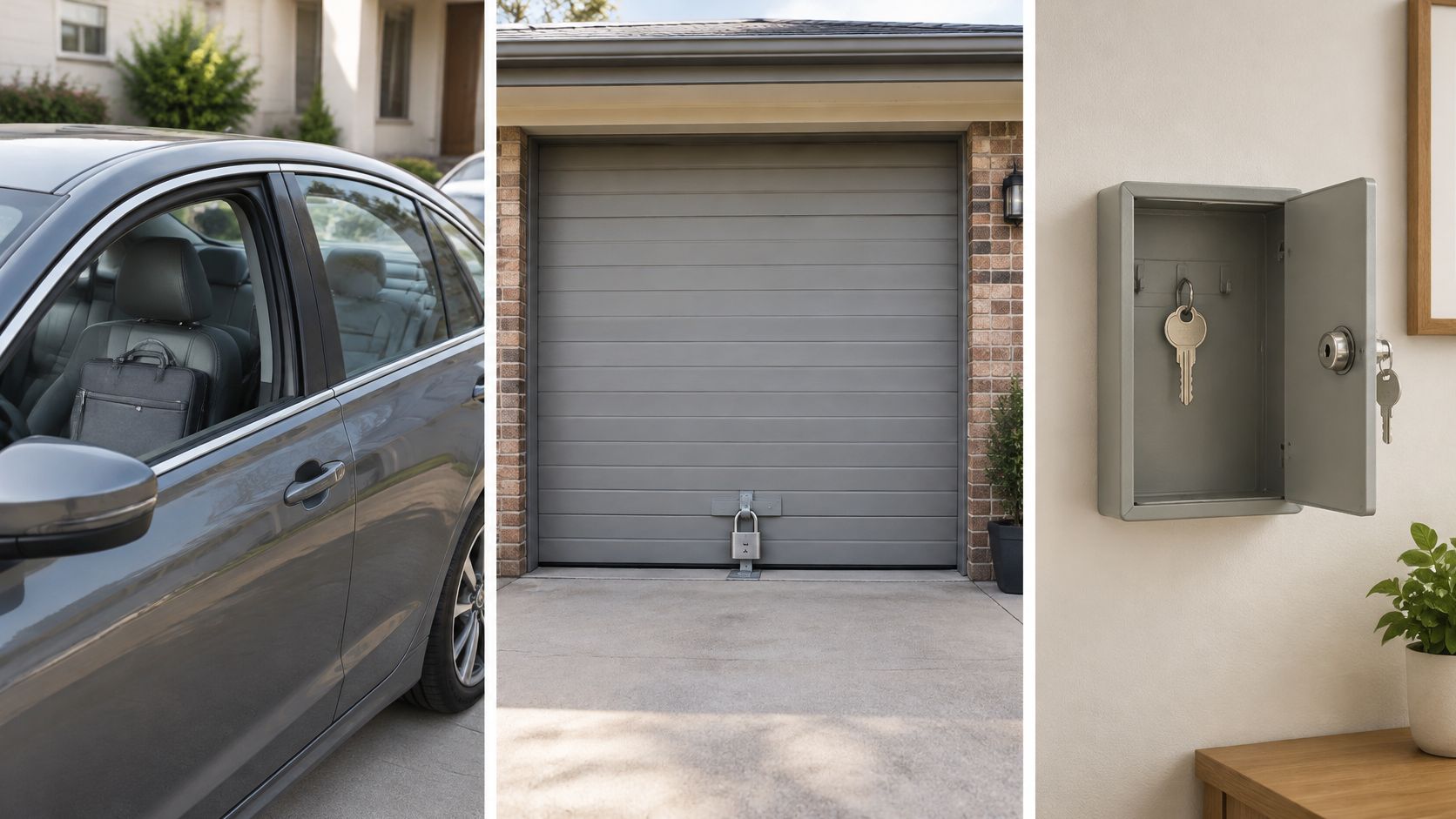
Data in transit. HHS recommends encrypted connections for telehealth, and TLS-protected video and messaging reduce interception risk while data crosses a network, including a patient's home Wi-Fi. The failure here is usually invisible until it isn't: a legacy integration that still negotiates an old protocol, or an embedded widget on a marketing page that posts intake answers somewhere unencrypted.
Data at rest. Encryption protects stored questionnaires, clinical notes, prescription data, recordings and backups if storage media or a cloud account is exposed. HHS's guidance on telehealth privacy and security also recommends password-protected and encrypted devices and current security software, which matters in a distributed workforce where clinicians log in from laptops and phones.
Administrative access. Multifactor authentication reduces the likelihood that a stolen password alone opens a clinician or administrator account. Combined with role-based access, it limits how far an attacker can travel after the first credential falls. Providers may need clinical and dosing data, while support staff may only need scheduling or shipping details. Audit controls should record access, changes, exports and administrative actions, because logs are the only way to answer what happened after a suspicious login.
Practical rule: if a staff member can open a record they don't touch in a normal week, that permission is a finding waiting to be written up.
Session recordings and transcripts deserve separate treatment. HHS advises assessing whether they're created or stored, whether unauthorized parties could access them, and whether encryption and authentication protect them. For a GLP-1 telehealth workflow, the workable defaults are recording off unless a clinician requests it, explicit consent when it's needed, restricted downloads, automatic logoff, credential rotation, tested account recovery, and an independent security evaluation covering authentication, authorization, encryption and data management. For a closer look at how those layers connect in practice, these data security measures for telehealth programs break down the control stack by function.
Privacy Gaps Outside the Video Call
A patient joins a visit from a shared kitchen while a family member listens from the next room. The clinician reviews a medication list on screen, and twenty minutes later the patient has a screenshot of it in a text thread that also includes a pharmacy receipt. Nothing in that sequence touches the video platform's encryption, and all of it is a privacy event.
This is the assumption I'd challenge hardest: that a compliant video tool makes a compliant telehealth program. HHS's getting started guidance for telehealth providers frames compliance as an operational process rather than a product attribute. It asks providers to use private locations where possible, obtain informed consent, confirm the identity of the patient and everyone present, document how data is collected, stored and transferred, and regularly test or update equipment.
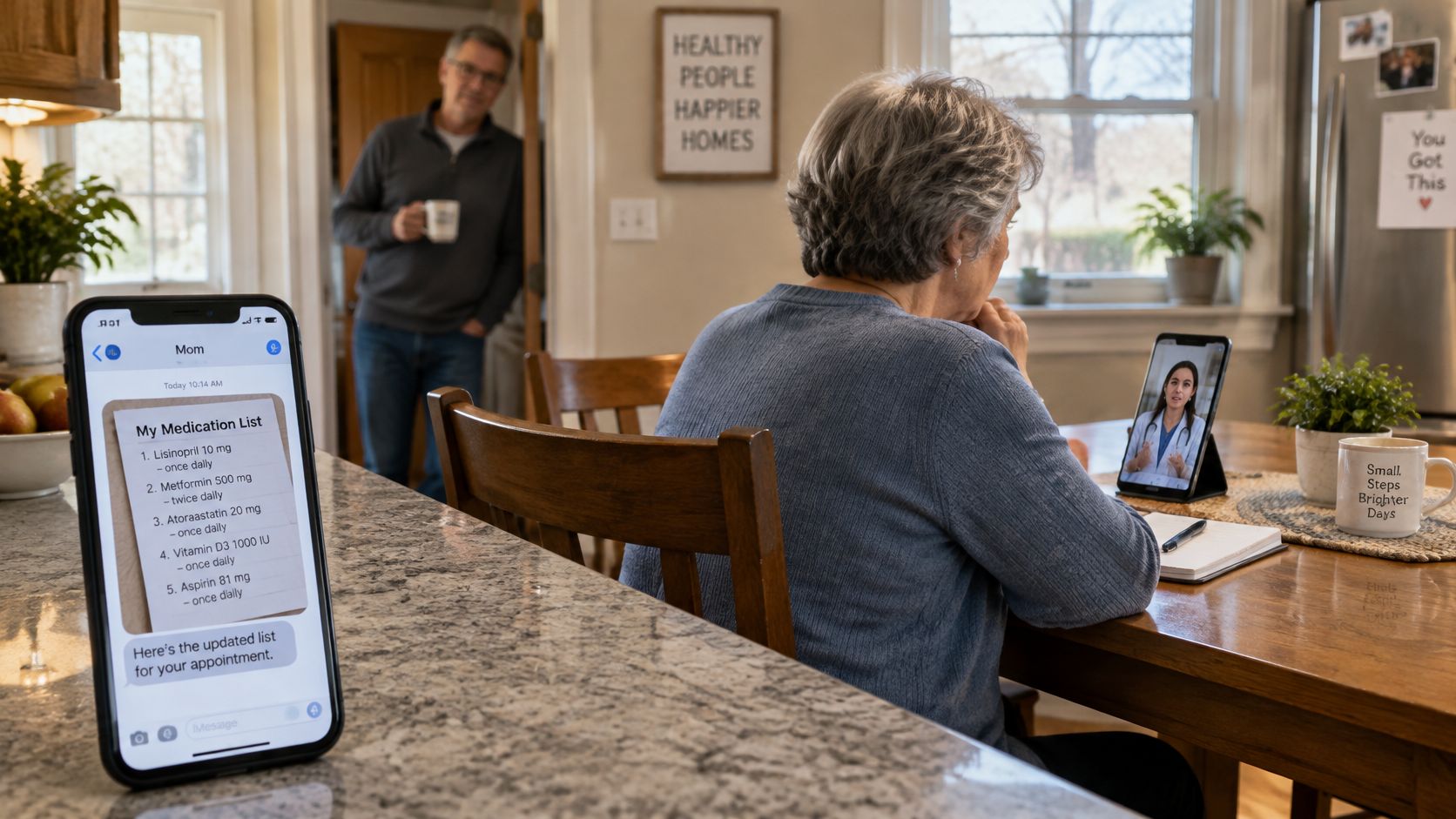
The patient-side workflow is where most written programs go quiet. Consider what a real week looks like: a follow-up question sent by text, a voicemail left with dosing details, an asynchronous portal message with an attached photo, a screenshot forwarded to a spouse, a home scale that syncs readings to an app. HHS recognizes asynchronous telehealth as communication occurring at different points in time, which means the controls have to cover the space between appointments, not just the appointment.
A few practical habits close most of that gap:
- Start every visit with a location check. Ask whether the patient is somewhere private and whether anyone else can hear. If not, offer to reschedule or move to messaging.
- Confirm who's in the room. The patient and anyone present should be identified before clinical detail is discussed, and the patient should agree to that person's presence.
- Set the messaging channel explicitly. Tell the patient which channel is monitored, which isn't, and what not to send by text.
- Explain accidental disclosure before it happens. Describe what to do if a message reaches the wrong person, including who to contact and what the provider will do next.
For patients, the useful question is whether telehealth is just a video call or something wider. This explanation of whether telehealth is just a video call walks through the asynchronous pieces that carry the same data.
"HIPAA compliant" is a description of a program, not a property of a product. A vendor can be compliant and your workflow can still leak.
What patients deserve in plain language is a short list: what's shared, with whom, and what happens after an accidental disclosure, including the reporting procedure and the timeline for telling them. That list is more protective than any consent form clause buried on page four.
Vendor Oversight Beyond the BAA
A signed business associate agreement is necessary and it proves very little. A BAA is a promise about how a vendor will handle data; it says nothing about whether the vendor performs risk analysis, limits internal access, audits logs, tests incident response, patches systems or verifies its own subcontractors. Treating the contract as proof of security is the most common false reassurance I see in telehealth procurement.
The scale of the exposure is visible in breach reporting. A 2025 industry analysis cited in the Indiana IECC annual cybersecurity healthcare report counted more than 57 million patients affected across 642 large breaches, with average breach costs of $10.93 million. The same reporting notes that hacking and other IT incidents accounted for more than 80% of large healthcare breaches, and that covered entities often rely on vendors' "good faith assurances" without investigating their controls, workforce training or communication security.
For a GLP-1 telehealth service, the vendor chain is longer than many expect. It includes the online intake quiz, provider video, messaging, electronic prescribing, pharmacy fulfillment, shipping notifications, payment processing and progress tracking. Each of those touches patient data, and each is a place where a badge on a website substitutes for a question nobody asked. If you're evaluating a platform, this guide to what to check in a HIPAA-compliant telehealth platform covers the controls to look for beyond the certificate.
A vendor transparency checklist
Ask these in writing and keep the answers on file:
- Who handles the data? Name every party that touches PHI, including subcontractors and hosting providers.
- What does each one receive? A video vendor shouldn't need billing data, and a shipping vendor shouldn't need diagnoses.
- How long is it kept, and how is it deleted? Vague retention language is the most common non-answer.
- How would I be told about a breach? Look for a notification commitment, not a promise to "comply with applicable law."
- Are subcontractors bound by the same terms? Flow-down language is where assurances tend to stop.
- What's HIPAA and what's ordinary cybersecurity? The two overlap but aren't identical, and a vendor that blurs them usually can't produce evidence for either.
If you want to see what those answers look like when they're specific, PatientNotes explains how encryption, audit logs and access controls map to real vendor requirements in clinical documentation tools.
A list of written answers to six questions tells you more than the phrase "256-bit encryption," which describes a cipher and not a program. Encryption without access logging, retention limits and a tested response plan is a lock on a door with no frame around it.
Patient Rights and Complaint Routes
Patients keep real, usable rights under HIPAA when care happens over video, and most never hear about them. Knowing the list changes what you can ask for, and it changes how quickly a provider responds when something goes wrong.
Access. A patient can request copies of records the provider holds, including visit notes, prescriptions and messages exchanged through the portal. Providers must respond within the deadline the Privacy Rule sets, with a narrowly limited extension, and they can't ignore a request because it's inconvenient.
Amendment. If a record is inaccurate, a patient can ask for a correction, and the provider has to respond in writing. A refusal is allowed in defined circumstances, but the request and the response become part of the record.
Accounting of disclosures. A patient can ask who received their information outside treatment, payment and health care operations. This is the right that surfaces a vendor relationship nobody explained.
Restrictions and confidential communications. A patient can ask that certain information stay private, or that messages go to a specific phone number or address rather than a shared family account. Providers aren't obligated to grant every restriction, but reasonable requests for confidential communication deserve a real answer.
Notice of Privacy Practices. The provider must give a notice describing how PHI is used and disclosed. In telehealth it often arrives as a link at intake and gets clicked past, which is exactly why the substantive points belong in the visit conversation too.
Where to take a complaint
Start with the provider's privacy officer. That's the fastest route to a correction, and it creates a dated record of when you raised the issue. If the response doesn't resolve it, a patient can file a complaint with the HHS Office for Civil Rights, which handles HIPAA complaints and resolves them through voluntary corrective action, technical assistance or, in some cases, settlement.
Keep dated copies of messages, portal exchanges and any letters. State privacy laws may add protections beyond HIPAA, particularly around consent, recording and minors, so a complaint can sometimes run on two tracks at once.
Questions and Pre-Visit Checks Before Sharing Data
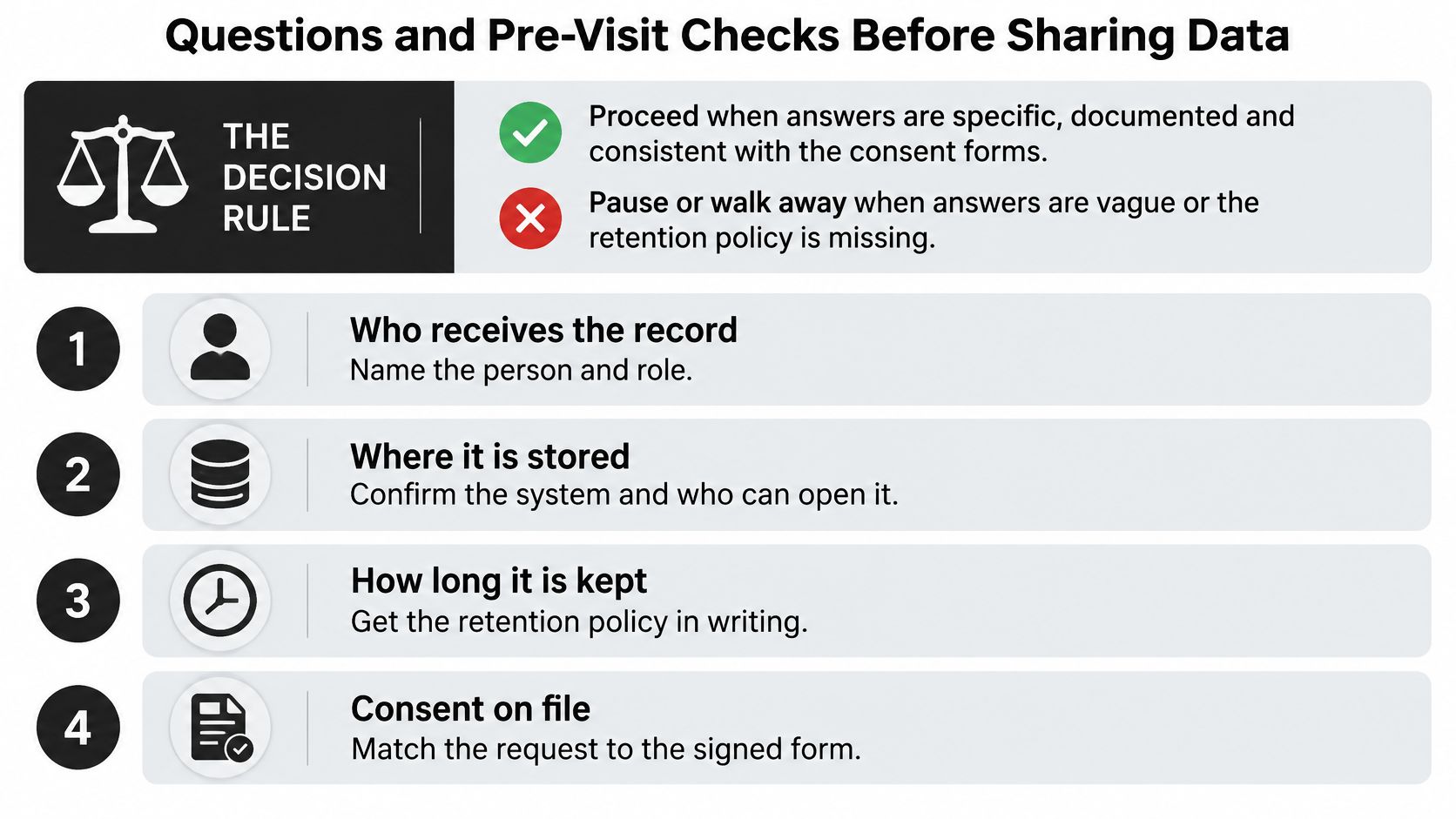
Deciding whether to hand over health information to a telehealth provider doesn't require technical knowledge. It requires specific answers. Patients should proceed when the answers are documented, concrete and consistent with the consent forms they're asked to sign, and pause when the answers are vague, the retention policy is missing or the vendor list can't be produced.
Decision rule: specificity is the signal. A provider who names roles, states retention periods and commits to a notification timeline has done the work. A provider who repeats the phrase "HIPAA compliant" without detail has answered a different question.
Eight questions cover most of the risk:
- Who on the care team can see my intake answers? A good answer names roles and explains why each needs access.
- Is my video visit recorded, and where does the file live? Recording by default, or storage in someone's personal drive, is a red flag.
- How is my identity verified before a prescription is issued? Look for a described verification step, not an assurance.
- How long do messages, photos and monitoring data stay on file? A number of months or years is an answer. "As long as necessary" isn't.
- Which vendors receive my data, and will you sign agreements with each? Ask for the categories: video, messaging, pharmacy, payments, hosting.
- What happens after a breach, and how will I be told? There should be a channel and a commitment, not a statement of intent.
- Do you verify that your providers hold active licenses in my state? Licensure is a compliance question with a yes or no answer.
- Can I read the consent forms before I share anything? Refusal here is the loudest answer of all.
Before the first appointment, read the telehealth consent, the medication consent, the HIPAA notice and the terms of service in full, and put the eight questions in writing by email so the answers are dated. A provider who won't answer them in writing has already told you how a records request will go.
Weight Method is one program that publishes this kind of detail about its own workflow. Patients electronically sign consents for telehealth, medication, HIPAA and terms before a visit, identity is verified and eligibility confirmed before any prescribing, and medical data is encrypted in transit and at rest under strict access controls. Apply the same eight questions to us that you'd apply anywhere else, and compare the written answers.
Weight Method runs a US telehealth weight loss program built around FDA-approved GLP-1 medications, with a free online assessment, a video visit with a licensed provider, and medication shipped to your door if treatment is approved. The privacy questions above are the ones to ask any virtual care provider, and we answer them in writing before you share a single health detail, from electronic consents to encrypted data in transit and at rest. Start with the assessment at Weight Method and read the consent documents before your first visit.