Fasting-based diets produced just 0.94 kg more short-term weight loss than continuous calorie restriction in a 2024 meta-analysis published in Nutrients, a difference the authors described as modest and not clinically significant. That reframes the calculation: you don't need a clever eating schedule as much as an intake you can follow, measure, and adjust.
Learning how to figure calories to lose weight means estimating what maintains your weight, choosing a reasonable reduction, and checking what happens. Your first target is a test, not a promise. Sometimes you'll need to adjust it downward as your needs change. During appetite-suppressing treatment, you may need help eating enough instead.
Calculate Your Daily Calorie Target
-
Collect your starting information. Write down your age, sex, height, current weight, and usual activity. Describe your normal week, including desk time, commuting, household movement, and exercise. Don't choose an active category based on the workout you hope to start.
-
Estimate maintenance calories. Maintenance means the intake that approximately keeps your current weight stable. Use the NIH Body Weight Planner rather than choosing a calorie allowance from someone else's diet.
-
Enter a realistic goal and timeline. Let the planner estimate the intake needed to reach that goal. If the result looks difficult to sustain or leaves little room for balanced meals, extend the timeline rather than forcing a larger restriction.
-
Write your intake as a daily average. You're testing an eating pattern, not trying to hit an exact number at every meal. Keep normal flexibility for a larger dinner or a different weekend schedule.
-
Collect enough information before judging the result. Record food, drinks, and activity consistently. Compare your weight trend with your intake, rather than changing the target after an isolated weigh-in.
The NIH Body Weight Planner uses age, sex, height, starting weight, and physical activity; a practical trial is to log intake and activity for 2–3 weeks, then interpret a rolling 2–4-week weight trend. The tool's projected intake is a starting estimate, not a measurement of your metabolism.
Understand what you're subtracting from
Maintenance calories include your whole day, not just exercise. Your body uses energy for basic functions, digestion, ordinary movement, and planned activity. A resting-calorie estimate alone isn't your maintenance intake.
For perspective, the Dietary Guidelines for Americans gives broad adult energy ranges of approximately 1,600–2,400 calories for women and 2,000–3,000 for men, depending on age and activity. These ranges provide context for the rough maintenance bands below; they aren't individualized prescriptions.
A taller person with an active job may need more food than a shorter person who sits most of the day. Neither person's target tells you what yours should be. The useful comparison is between your estimated maintenance and your test intake.
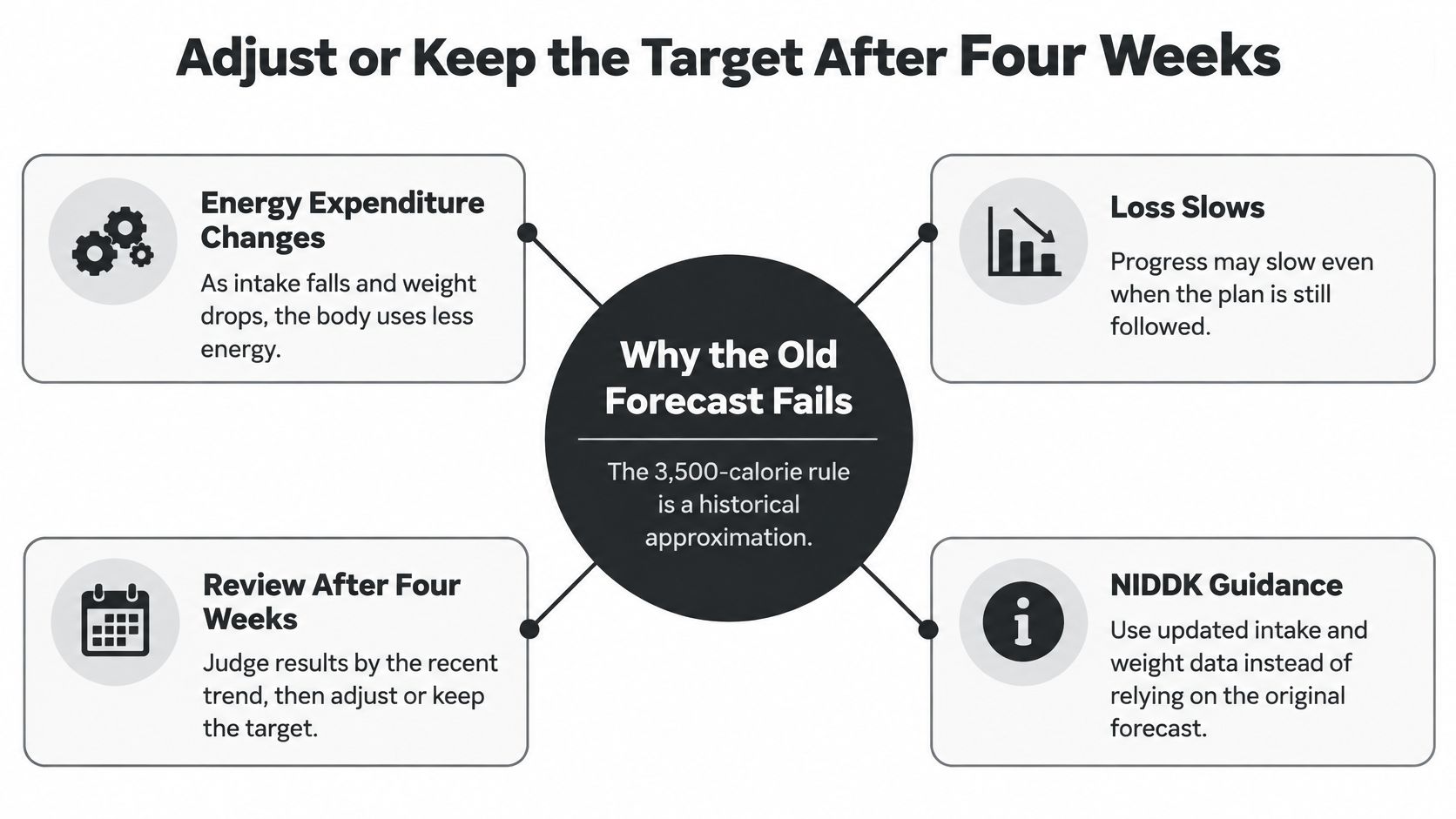
The National Institute of Diabetes and Digestive and Kidney Diseases explains that the familiar 3,500-calorie-per-pound rule is a historical approximation, not a precise forecasting law. Its planner accounts for changing body weight, food intake, and physical activity instead of treating the original calorie gap as permanent.
Starting calorie targets by rough maintenance band
The following rows are illustrative calculations, not recommendations based on sex and activity alone. The pace column is a planning expectation to check against your response, not a guaranteed outcome.
| Profile | Rough maintenance | Test intake | Planned deficit | Pace to watch for |
|---|---|---|---|---|
| Woman, lower activity | About 1,600 kcal | About 1,200 kcal only with clinician | About 400 kcal | About 0.5–1 lb per week |
| Woman, higher activity | Up to about 2,400 kcal | About 1,900 kcal | About 500 kcal | About 1 lb per week |
| Man, lower activity | About 2,000 kcal | About 1,500 kcal, review with clinician | About 500 kcal | About 1 lb per week |
| Man, higher activity | Up to about 3,000 kcal | About 2,300–2,500 kcal | About 500–700 kcal | About 1–1.5 lb per week |
| Worked example at 2,400 maintenance | 2,400 kcal | 1,900 kcal | 500 kcal | About 1 lb per week at first |
Say your estimated maintenance matches the worked-example row. The arithmetic is maintenance minus planned deficit equals test intake. The important question isn't whether you can subtract correctly. It's whether that intake supports adequate nutrition and produces a tolerable, gradual trend.
Don't automatically select the lowest row. A mathematically possible intake can still be inappropriate, particularly when you're older, already eating little, or managing a medical condition. Pregnancy, diabetes, an eating-disorder history, and medicines that affect appetite or glucose call for individualized clinical guidance.
Save these figures: your maintenance estimate, your test intake, and the date you'll review the result.
Circle the closest maintenance band only after estimating your own needs. If none fits, don't force a match. Keep the planner's estimate and discuss a suitable starting intake with a registered dietitian or qualified clinician.
Logging Food So the Deficit Is Real
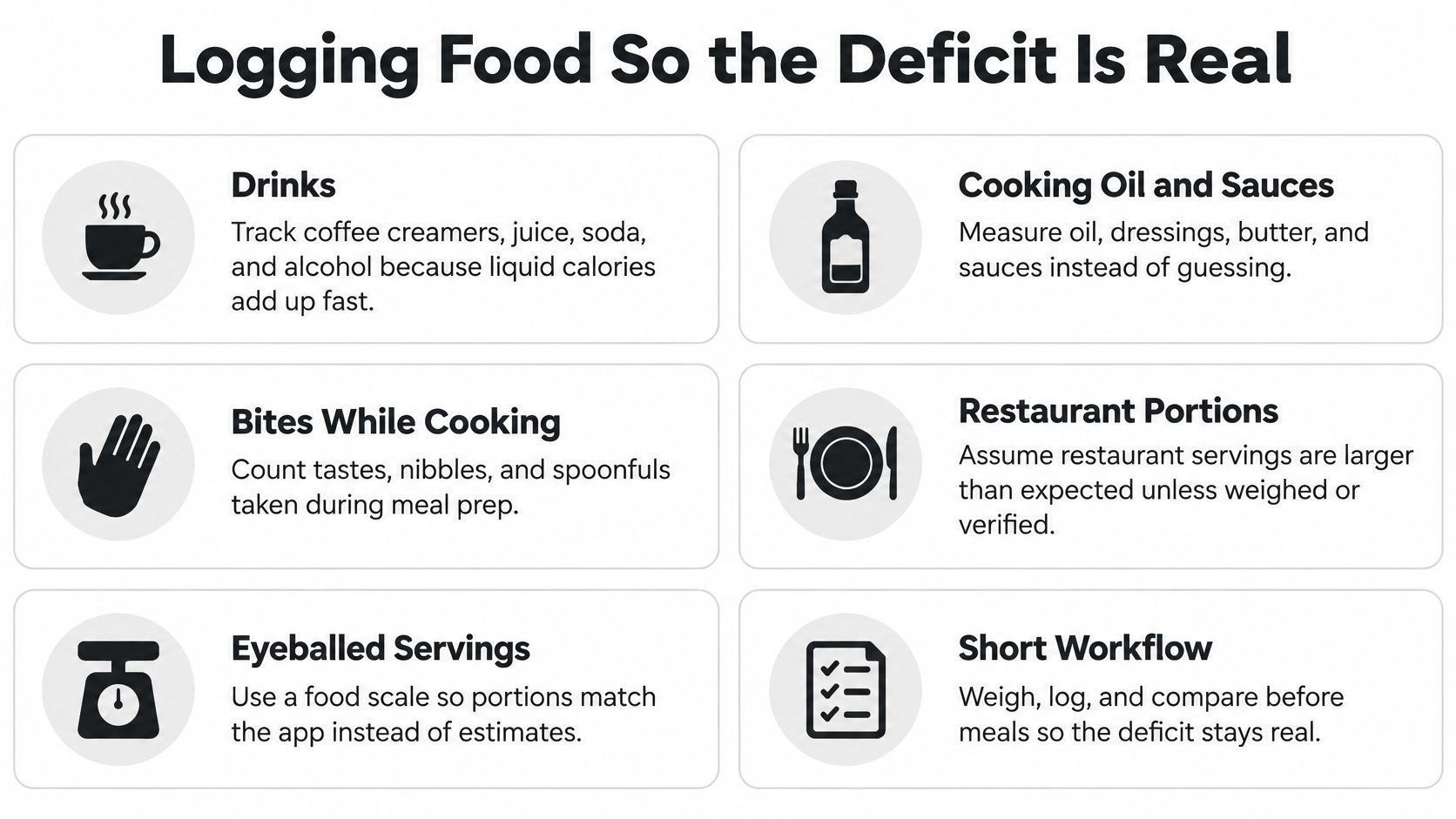
The easiest calories to miss often aren't on the plate. They're in cooking oil, coffee additions, sauces, tastes during meal preparation, and portions that look smaller than they are. If those entries are missing, an app can show a deficit that your actual intake doesn't create.
Accurate logging isn't about proving that you've eaten perfectly. It's about making the calculation useful. A complete record of an ordinary day tells you more than a carefully edited record of an ideal one.
Build a routine around meals
Use a kitchen scale in grams for foods you prepare at home. Match the database entry to the food's condition: dry rice isn't interchangeable with cooked rice, and raw meat isn't the same entry as cooked meat.
Use the package label when it's available. Check whether the listed serving matches what you're eating, especially when a package contains multiple servings. For homemade mixed dishes, enter the ingredients as a recipe and divide the finished dish into measured portions.
Log the meal before eating or immediately afterward. Waiting until bedtime makes it easier to forget a drink, a handful of snacks, or a second helping. For restaurant meals, use published nutrition information when available; otherwise, choose an entry that reasonably matches the dish and portion rather than the smallest search result.
Check the usual omissions
- Drinks: Include latte milk, creamers, juice, soda, and alcohol.
- Cooking fats: Measure oil, butter, and dressings rather than estimating the amount left in the pan.
- Sauces: Record mayonnaise, dips, spreads, and toppings.
- Unplanned bites: Include tastes while cooking and snacks eaten while standing.
- Serving sizes: Check cereal, nuts, cheese, rice, and other foods you usually pour or scoop.
Meal timing belongs in the record too, but not because breakfast is mandatory. If skipping breakfast leaves you uncomfortably hungry later, Bearded Brothers' discussion of why breakfast might matter offers a useful prompt to examine that pattern. Compare how different schedules affect your hunger and ability to follow your intended intake.
The CDC's guidance on losing weight favors gradual loss of approximately 1–2 lb per week, which is more likely to be maintained than faster loss. Don't respond to a higher-intake day by severely restricting the next one.
A food log is a measurement tool, not a report card.
At the end of the week, calculate your average recorded intake. Compare it with the target you saved, and check whether the record includes meals out, drinks, and weekend eating. If the log has gaps, improve the record before concluding that your calorie target is wrong.
Estimate How Long Your Goal Will Take
Start with simple division: the weight you want to lose divided by your planned weekly pace. This gives you an initial planning date, not a deadline your body must meet.
For a hypothetical 20 lb goal, losing 1 lb per week would take 20 weeks. At 1.5 lb per week, the calculation gives about 13 weeks. Those are arithmetic examples, not predictions about your response.
Give the estimate room to change
A timeline assumes that you can maintain the same pace throughout. Real life includes travel, illness, treatment changes, and periods when maintaining weight is the more appropriate goal. You may also find that your initial pace doesn't remain comfortable or practical.
Use the calculation to organize your effort, not to justify a deeper cut whenever you're behind schedule. A realistic understanding of average weight loss per week can help you distinguish an initial expectation from an individual outcome.
For a longer goal, divide the process into phases. Plan an initial period of consistent eating and monitoring, followed by a review of your weight, nutrition, activity, and treatment tolerance. A maintenance phase can be a deliberate choice rather than an accidental interruption.
Planning principle: revise the date before making an intake target unsafe.
Put checkpoints on the calendar
You don't need to predict your exact finish date to make the next review useful. Schedule checkpoints in advance so that an emotional reaction to the scale doesn't determine when you change course.
- At the first checkpoint: Check whether you're recording intake consistently and whether the eating pattern is manageable.
- During later reviews: Compare your recent weight trend with your intended pace and assess energy, hunger, and daily functioning.
- Before extending the plan: Reconsider whether your goal, timeline, and calorie allowance still fit your circumstances.
In the hypothetical example, you might choose reviews at weeks 4, 8, and 12. Those are organizational choices, not biological deadlines. Keep the same review dates even if an early scale change looks encouraging.
Write your projected finish date beside today's date, and label it provisional. If progress is slower than expected, investigate the pattern before changing the intake. If progress is faster but you're struggling to eat or function normally, don't treat the earlier finish date as evidence that everything is going well.
When the Calorie Target Gets Too Low
A calorie calculator usually assumes that eating less will be the difficult part. With appetite-suppressing treatment, the problem can reverse: you may feel full before you've eaten enough to meet your nutrition needs.
The danger is not just missing an app target. It's repeatedly missing the foods and fluids that make a reduced-calorie intake nutritionally adequate. A lower number doesn't automatically mean a better treatment response.

Treat low intake as a nutrition question
A 2025 joint advisory on nutritional priorities during GLP-1 therapy reports observed calorie reductions of 16–39% among people using these medicines and warns that vitamin and mineral adequacy becomes difficult particularly below approximately 1,200 kcal/day for females and 1,800 kcal/day for males.
Those are warning lines, not universal prescriptions or guarantees of adequacy. Being above them doesn't prove that your diet meets your needs. Being below them is a reason for individualized review, not a challenge to tolerate more hunger or fatigue.
This is also why an 800-calorie-a-day diet shouldn't become an improvised response to reduced appetite. Very low intake needs medical assessment, not encouragement from an app's remaining-calories display.
Build meals around what must fit
Confirm your intended pace and nutrition needs with your treating clinician. Then organize meals around foods you need to retain, rather than removing whatever is easiest to skip.
- Anchor meals with protein: Consider eggs, yogurt, fish, poultry, tofu, or legumes, according to your preferences and medical needs.
- Keep plant foods in the day: Include fruit, vegetables, whole grains, and beans in portions you tolerate.
- Make fluids deliberate: Keep drinks accessible rather than waiting until a busy day is over.
- Adapt the texture and timing: If early fullness interferes with meals, smaller eating occasions and softer protein foods may be easier to manage.
Persistent nausea, constipation, fatigue, or declining strength shouldn't be celebrated as signs that treatment is working. If you can't reliably eat or drink enough, contact your prescriber before attempting another reduction. Severe symptoms, fainting, or inability to keep fluids down warrant prompt medical attention.
At Weight Method, our providers set expectations from each patient's clinical profile, rather than copying brand-product trial figures. We provide ongoing clinical support and can review nutrition, recommend exercise modifications, and adjust medication dosing when clinically appropriate. Don't change your dose yourself.
The useful outcome is an eating pattern you can sustain while protecting health and function. When appetite suppression makes that impossible, the response is clinical reassessment, not a lower calorie goal.
Adjust or Keep the Target After Four Weeks
Your original forecast can become inaccurate even when you follow the intended eating pattern. A smaller body generally needs less energy, and changes in appetite and activity can make the original plan harder to sustain. That's a reason to reassess, not evidence that you've failed.
The NIH's discussion of obesity and metabolic health describes the adaptive context behind weight management; use a 2–4-week weight trend, rather than daily fluctuations, when deciding whether your approach needs review. The question is whether your current intake still produces an appropriate result for your current circumstances.
Review the pattern before choosing an action
Weigh under reasonably similar conditions, such as after using the bathroom and before breakfast. Use the same scale and avoid comparing a morning reading with an evening reading after meals.
Water, glycogen, sodium, digestive contents, and menstrual-cycle changes can affect the scale without representing an equivalent change in body fat. Record relevant circumstances without trying to mathematically subtract them. A salty restaurant meal doesn't tell you how much fat you gained.
Then examine the record beside your weight trend. Did your food intake match the intended average? Did your activity change because of an injury, a demanding work period, or fatigue? Has a medication change made eating more difficult?
What to do after four weeks on the target
These are practical review scenarios, not diagnostic cutoffs. The numeric adjustments are examples to discuss in the context of your current intake and health, not automatic instructions.
| Four-week pattern | Likely meaning | Next move |
|---|---|---|
| About 0.5–1.5 lb lost per week, energy stable | Deficit may be in a useful range | Keep the same target and recheck in 4 weeks |
| No change and the food log is complete | Original gap may have narrowed, or maintenance was overestimated | Recalculate, then consider trimming about 100–200 kcal or adding activity |
| Loss above about 2 lb a week, fatigue, or intake under rough warning lines | Target may be too aggressive | Raise calories when appropriate and review with a clinician |
| Weight jumps day to day but the weekly average is steady | Water, sodium, glycogen, or cycle shifts may obscure the pattern | Don't change calories from one weigh-in |
If the trend is appropriate and you feel well, keep the target. There's no need to make an effective approach more restrictive because you could tolerate a harder day. Preserve the meals and routines that make consistency possible.
Stable energy doesn't mean you must never feel hungry. It means you can carry out normal activities, eat regularly, and follow the plan without persistent symptoms or an escalating preoccupation with food. If the process is becoming distressing, the response shouldn't be tighter tracking.
If the trend is flat, investigate before cutting
A flat trend with an incomplete log doesn't establish that your maintenance estimate is wrong. Check the items that are difficult to record, including restaurant dishes, shared snacks, cooking fats, and weekend drinks. Improve the measurement without treating omissions as a character flaw.
If intake records are credible, update the maintenance estimate using your current weight and usual activity. A change in job demands, walking, or exercise may matter as much as a change in body size. Use your ordinary routine rather than your most active day.
Choose a manageable change instead of changing everything at once. You might slightly reduce an energy-dense extra, or add planned walking if your health and mobility permit it. Don't combine a drastic food reduction with a sudden exercise increase and then try to determine which change helped.
A plateau is a decision point. It isn't an instruction to keep removing food.
Protect nutrition while making the adjustment. Keep protein-containing meals, include resistance exercise suited to your ability, and consider whether poor sleep or treatment side effects are making consistency harder. Removing a balanced meal can create more problems than it solves.
For a structured review of intake, movement, and treatment factors, use our guide to how to overcome a weight loss plateau. A persistent stall deserves a broader review than choosing a smaller calorie number.
If the target is already difficult to meet, get help
Recalculate after a meaningful weight change, a substantial activity change, or a treatment adjustment that changes appetite. Repeatedly entering nearly identical information into a calculator won't make the estimate more precise. Your recorded response supplies information that the initial calculation couldn't.
If you're fatigued, dizzy, persistently cold, losing strength, or noticing concerning hair shedding, seek clinical review rather than assuming further restriction is appropriate. These symptoms can have different causes and shouldn't be diagnosed from a calorie log. Bring your intake record, weight trend, medication list, and symptom notes.
Our licensed providers specialize in obesity medicine and can review the full pattern rather than the scale alone. Weight loss isn't guaranteed; diet, exercise, and individual biology all influence the result. The appropriate next step may be to maintain intake, improve nutrition, modify activity, or reassess treatment.
Make the next review easy
Tonight, write down your current maintenance estimate, test intake, and next four-week review date. Add a brief note about energy, appetite, and whether you're consistently able to eat balanced meals. Those observations help distinguish a useful deficit from an intake that's becoming too difficult or too low.
Your task isn't to defend the first number you calculated. It's to use that number, your actual intake, and your response to make a better decision. Keep what works, adjust what no longer fits, and get clinical help when nutrition or symptoms make further restriction unsafe.
Weight Method connects you with licensed providers who specialize in obesity medicine and offers ongoing clinical support for nutrition questions, treatment adjustments, and weight loss plateaus. Visit Weight Method to complete our guided health assessment and discuss an individualized approach to your calorie target and progress.