Semaglutide and tirzepatide together aren't an established combination treatment, and U.S. prescribing information for tirzepatide advises against using it with another GLP-1 receptor agonist. The popular idea that two effective drugs should work even better stacked on top of each other doesn't hold up here, because no trial has tested that approach and the overlap between them points toward added side effects rather than proven added benefit.
Why Taking Both Together Is Not Standard Practice
The question is understandable. Semaglutide activates GLP-1 receptors, while tirzepatide activates both GIP and GLP-1 receptors, so the two can look complementary on paper. That partial difference doesn't establish that combining them improves weight loss or health outcomes.
Prescribing information draws a clear line. The FDA-approved Zepbound label states that coadministration with any GLP-1 receptor agonist is not recommended and that the safety and efficacy of combining Zepbound with other weight-management products haven't been established. The National Institute of Diabetes and Digestive and Kidney Diseases advice on prescription medicines for overweight and obesity likewise tells patients not to combine weight-loss medications or products unless a healthcare professional prescribes the combination.
Comparison Is Not Combination
Evidence comparing these medicines comes from head-to-head trials and separate treatment groups, not from people receiving both at once. That's why you can't add one drug's weight-loss percentage to the other's and predict a combined result. The numbers describe alternative regimens, not a recipe for stacking.
A switch from one drug to the other is a different clinical decision, and it's one a qualified prescriber may consider after reviewing your history, contraindications, and current medicines. If you're checking how these drugs fit alongside anything else you take, a structured review of GLP-1 drug interactions is a useful starting point for that conversation. The logic that follows is simple. Compare the drugs fairly, understand where they overlap, then treat switching, not stacking, as the supported route.
Practical rule: If a plan involves two GLP-1 medicines at once, it isn't a standard plan, no matter how logical the mechanism sounds.
Semaglutide and Tirzepatide Side by Side
Use this table as a lookup for single products. It helps you identify what you're really holding and which one drug to discuss with a prescriber.
| Attribute | Semaglutide | Tirzepatide |
|---|---|---|
| Mechanism | GLP-1 receptor agonist | GIP and GLP-1 receptor agonist |
| Manufacturer | Novo Nordisk | Eli Lilly |
| Diabetes brand and first approval | Ozempic, 2017 | Mounjaro, 2022 |
| Weight-management brand and approval | Wegovy, 2021 | Zepbound, 2023 |
| Weight-management weekly dose range | 0.25 mg to 2.4 mg | 2.5 mg to 15 mg |
| Dose escalation | Steps about four weeks apart | Steps about four weeks apart |
| Dosing frequency | Once weekly injection | Once weekly injection |
| Mean weight loss at 72 weeks (SURMOUNT-5) | 13.7% at 2.4 mg | 20.2% at 15 mg |
| Combined use with other GLP-1 products | Not recommended | Not recommended |
How to Read the Mechanism and Brand Rows
The first row explains most of the confusion. Semaglutide works through one incretin receptor, while tirzepatide works through two, and readers often assume the extra pathway means the drugs fill different gaps. The brand rows matter for a practical reason. People talk about Ozempic, Wegovy, Mounjaro, and Zepbound as if they're four separate families, when they're really two active ingredients sold for different indications.
Check the product name and strength printed on your pen, not the brand family you remember from advertising. A diabetes pen and a weight-management pen containing the same ingredient aren't interchangeable extras you can rotate.
How to Read the Dose and Result Rows
Both medicines start low and increase in steps about four weeks apart, because tolerability, not impatience, sets the pace. The dose ranges aren't comparable milligram for milligram. A larger number for tirzepatide doesn't mean a proportionally stronger dose, since they're different molecules.
The final two rows belong together. The trial result shows what each drug achieved on its own, and the last row confirms neither is recommended alongside another GLP-1 product. Reading those rows as an invitation to combine them reverses what the table says.
How the Two Pathways Overlap
After you eat, your gut releases incretin hormones that help regulate appetite and blood sugar. GLP-1 is one of those signals. It increases feelings of fullness, slows how quickly food leaves your stomach, and supports insulin release when glucose is present.
Semaglutide mimics that one signal by activating GLP-1 receptors. Tirzepatide activates GLP-1 receptors and also GIP receptors, a second incretin pathway involved in appetite and fat metabolism, with effects that are still being studied. Two pathways sounds broader, and in a single molecule it may be. It doesn't make a second GLP-1 drug a missing piece.

What Overlap Means in Practice
Both drugs act on the same GLP-1 receptor system, so adding semaglutide and tirzepatide together increases exposure to a shared pathway rather than opening an entirely new one. That has three consequences worth separating.
- Weight loss isn't guaranteed to add up. Receptors can saturate, appetite suppression has practical limits, and a person who can't tolerate treatment won't stay on it long enough to benefit.
- Gastrointestinal effects can stack. Nausea, vomiting, reflux, and early fullness all relate in part to slowed gastric emptying and central appetite signaling.
- Fluid and glucose effects can compound. Persistent vomiting or diarrhea reduces fluid intake and absorption, while lower food intake changes glucose patterns, especially alongside other diabetes medicines.
Say someone's appetite is well controlled on one drug, but they add a leftover pen from an earlier prescription hoping to break a plateau. Their portions may not shrink much further, yet nausea after small meals can rise sharply, hydration can fall, and they may stop exercising or skip protein because eating feels unpleasant. The added drug has mainly added burden.
A shared mechanism is a reason for caution, not a rationale for combining two drugs.
That's the analytical point many comparison pages miss. Mechanism diagrams show arrows, but patients experience dose exposure. Without a trial testing the pair, nobody can convert overlapping arrows into a reliable prediction of extra benefit.
What the Trials and Real-World Data Actually Show
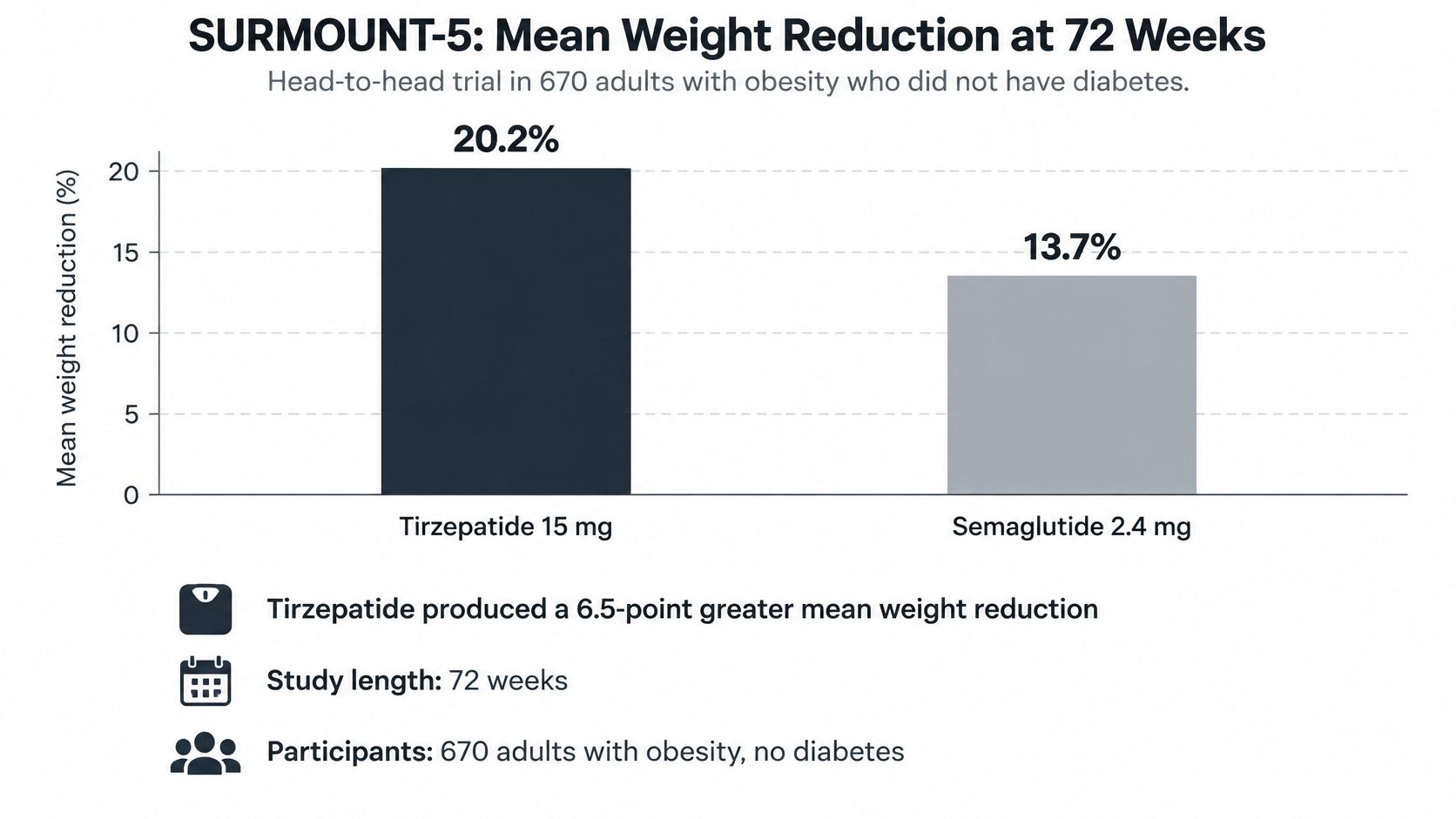
The evidence supports comparing semaglutide and tirzepatide as alternatives, not combining them. In the 72-week SURMOUNT-5 trial, 670 adults with obesity who did not have diabetes received one medicine or the other. The FDA-approved Zepbound prescribing information reports mean body-weight reductions of 20.2% with once-weekly tirzepatide 15 mg and 13.7% with once-weekly semaglutide 2.4 mg (P < 0.001). Serious adverse-event rates were 4.8% and 3.5%, respectively; approximately 85% of participants in each group completed the study.
What Real-World Records Add
A 2024 US electronic-health-record cohort summary from the American College of Cardiology included 41,222 adults: 32,029 received semaglutide and 9,193 received tirzepatide. These records show how the medicines were used in routine care, but patients were not randomized and received one drug or the other. The cohort therefore cannot establish the causal effect of either treatment or estimate outcomes from taking both.
| Evidence source | What it tested | What it cannot tell you |
|---|---|---|
| SURMOUNT-5 head-to-head trial, 72 weeks, 670 adults | Tirzepatide 15 mg versus semaglutide 2.4 mg as separate regimens | Whether the two drugs add their effects when taken together |
| US electronic-health-record cohort, 41,222 adults (32,029 semaglutide, 9,193 tirzepatide) | Real-world patients treated with one drug or the other | Causal effect of either drug, or outcomes of concurrent use |
The Gap That Matters
No randomized trial in the evidence described here tested semaglutide and tirzepatide together. Their combined efficacy, serious-event risk, and safe combined dose are therefore unknown. Results from separate-treatment groups cannot establish what happens when both medicines are used at once, so the evidence supports comparing them as options for a prescriber-led treatment change, not stacking them.
Side Effects to Expect and Warning Signs
The practical risk of taking semaglutide and tirzepatide together is not a known combined side-effect rate. No combined rate is established. In the head-to-head type 2 diabetes trial, nausea and vomiting were common with both drugs used separately. Those trial results do not show what happens when the medicines are combined.
FDA safety information about unapproved GLP-1 products describes reports of nausea, vomiting, diarrhea, abdominal pain, and constipation with compounded semaglutide or tirzepatide, including doses beyond approved labeling. With vials, check the product's concentration carefully: a syringe volume appropriate for one product may not be appropriate for another.
Expected Discomfort Versus Urgent Symptoms
Mild nausea after a dose increase may ease within days. Smaller meals and slower eating may help; tell the prescriber if it persists. Being unable to keep fluids down is different. It can lead to dehydration and kidney injury, so seek same-day medical advice.
| Symptom | Usually expected or urgent | Action |
|---|---|---|
| Mild nausea after a dose increase | Expected, often eases within days | Try smaller meals; tell the prescriber if it persists |
| Persistent vomiting or inability to keep fluids down | Urgent, with risk of dehydration and kidney injury | Contact the prescriber the same day |
| Severe abdominal pain, possibly spreading to the back | Urgent; possible pancreatitis or gallbladder disease | Seek emergency care now |
| Fainting, shakiness, sweating, or confusion | Urgent if taking insulin or a sulfonylurea; possible hypoglycemia | Check blood glucose and contact the prescriber immediately |
| Constipation or diarrhea lasting more than a week | Track the symptom and discuss it at the next review | Tell the prescriber if it worsens or persists |
Both medicines carry warnings involving severe gastrointestinal reactions, acute gallbladder disease, pancreatitis, kidney injury from dehydration, hypersensitivity, and thyroid C-cell tumors. Severe or persistent symptoms should not be dismissed as routine effects.
People Who Need Extra Caution
If you use insulin or a sulfonylurea, eating less while continuing the same doses can increase the risk of low blood glucose. Shakiness, sweating, confusion, or fainting calls for prompt attention.
For a broader discussion of benefits, drawbacks, and everyday use, see this overview of weight loss medication for health-conscious adults. This guide to GLP-1 medication side effects covers drug-specific patterns and timing.
Record the medication name, concentration, dose, injection date, prescriber, and pharmacy. That record helps a clinician assess whether a symptom followed a dose increase, product change, dosing error, or unrelated illness.
Tracking rule: A symptom is harder to interpret without the product, dose, and date.
How to Switch Between Them Under One Prescriber
A switch means one drug replaces the other. It is a single-drug transition, not a taper with both medicines in use or alternating pens week by week. Because the combination has not been studied, its safety and effectiveness are unknown, and no validated dose-conversion chart can guide a do-it-yourself switch.
A Safe Switching Sequence
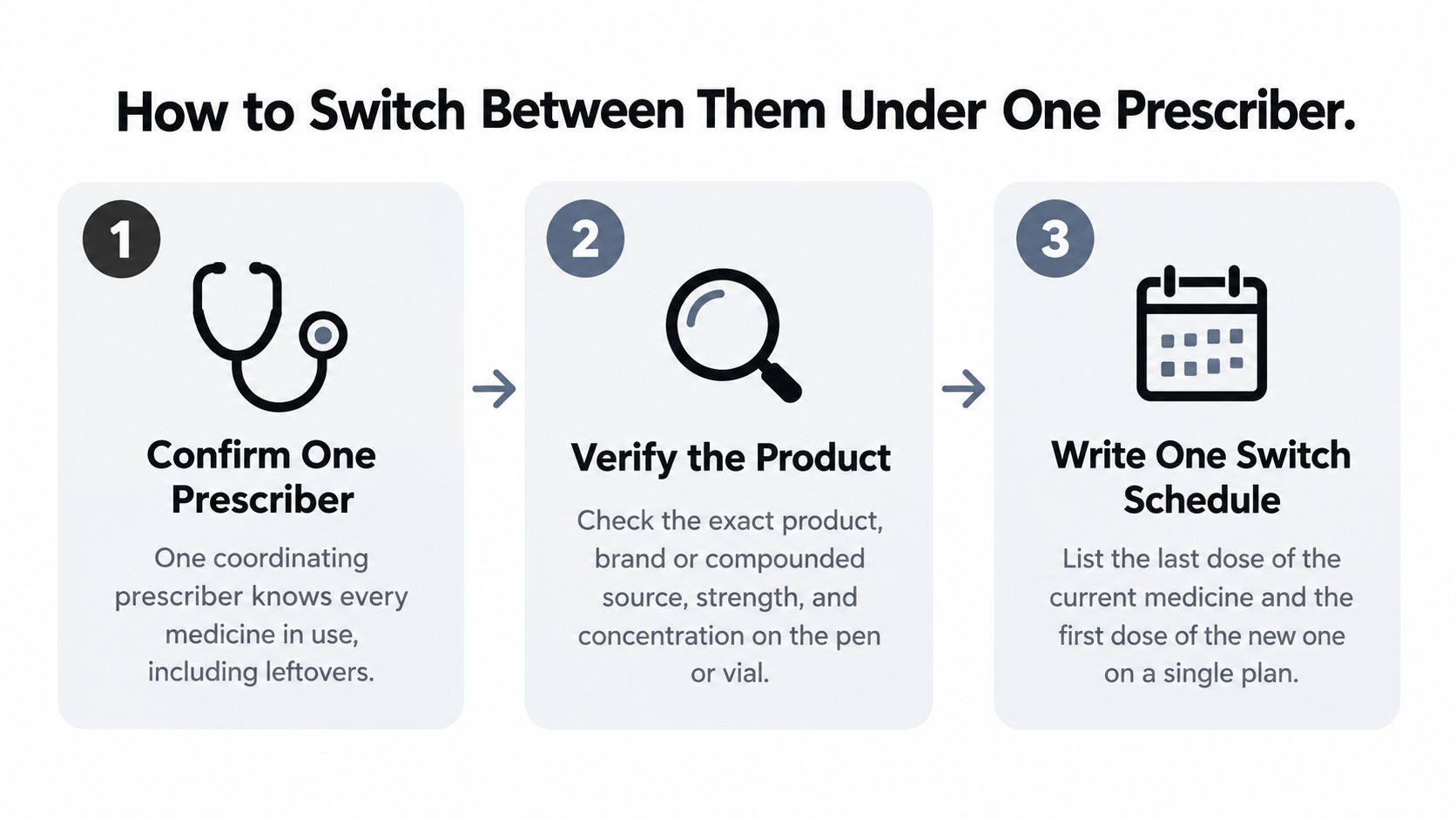
- Confirm one coordinating prescriber. Share the full list of products, including leftover pens, compounded vials, samples, and medicines from another telehealth service. A prescriber needs that information to set a clear transition.
- Verify the exact product. Read the brand or compounded source, strength, and concentration on the pen or vial with the prescriber. Packaging and memory-based dosing can lead to errors.
- Record the last injection. Write down the drug, dose, and date. The prescriber needs these details to set the timing of the next product.
- Have the prescriber set timing and starting dose. These choices are not standardized. Symptoms, prior dose, treatment goal, and other conditions inform the plan.
- Review glucose-lowering medicines first. Insulin and sulfonylureas may require a monitoring or adjustment plan before the first new dose. Agree on when to check glucose and which results should prompt a call.
- Use only the newly prescribed drug. Never inject semaglutide and tirzepatide together. The prescriber sets the transition from the old drug to the new one as a single-drug switch. Keep the discontinued supply away from active medicines so it does not re-enter the routine by habit.
- Track the first several weeks. Note nausea, vomiting, bowel changes, fluid intake, appetite, and glucose readings if relevant. The record can help the prescriber assess how you respond to the new product.
- Book follow-up before any increase. A dose rise should wait if you're dehydrated, barely eating, or still recovering from the prior step.
For questions to take to your appointment, read this guide to switching from semaglutide to tirzepatide. The prescriber should set the schedule from the last dose of the old drug to the first dose of the new one.
Choose One Medication and One Prescriber
The safest organizing principle is one medication, one prescriber, and one pharmacy at a time. It sounds administrative, but it prevents the exact situations that lead people to take semaglutide and tirzepatide together by accident or by improvised design. Split care creates duplicate supplies, conflicting escalation advice, and no single record of what's active in your body.
| Situation | Recommended approach | Mistake to avoid |
|---|---|---|
| Plateau on semaglutide after months at the highest tolerated dose | Prescriber reviews adherence, dose and side effects, then considers a single-drug switch | Adding tirzepatide on top of semaglutide |
| Nausea or vomiting on tirzepatide | Prescriber decides on dose reduction or a different single drug | Keeping leftover semaglutide to boost results |
| Type 2 diabetes treated with insulin or a sulfonylurea | Coordinated plan with glucose checks during any change | Changing drugs without a glucose plan |
| Supplies from two prescribers or pharmacies | Stop, consolidate all products with one prescriber and pharmacy | Injecting from both supplies on alternating weeks |
| Compounded product with unclear strength | Confirm product, concentration and source before any dose | Dosing from memory of an old pen or vial |
| Already taking both at once | Same-day contact with the prescriber for a single-drug plan, with glucose and symptom checks | Continuing both until the next scheduled visit |
What to Do This Week
Write a complete medication list before your next visit. Include diabetes medicines, leftover pens in the fridge, compounded vials, supplements marketed for weight loss, and anything prescribed by a second service. Bring photos of labels if concentration wording is confusing.
Then ask one direct question. Who owns my GLP-1 plan, and which single product am I taking from today onward? If nobody can answer that in one sentence, consolidation is the next step, not another injection.
Weight management also involves mood, stress, eating patterns, and the frustration that builds during a plateau. If that side of treatment needs attention, mental health support for weight management from Providers for Healthy Living is one resource to discuss alongside medical care. Support doesn't make stacking safer, but it can make a single-drug plan easier to sustain when progress slows.
If you're already taking both, don't add a third product and don't keep dosing from both supplies while waiting to see what happens. Contact your prescriber the same day, state the product names, doses, and injection dates, and ask for a single-drug plan with clear instructions on what to stop, what to monitor, and when to follow up.
If you want one coordinated prescriber to review whether semaglutide or tirzepatide fits your history, current medicines, and goals, Weight Method offers telehealth consultations, monitored dose escalation, and ongoing support without waiting rooms. Start with a complete medication list, including any leftover supplies, and ask for a single-drug plan you can follow safely.