You've compared a pharmacy coupon with a manufacturer savings page, opened a telehealth quote, and still can't answer the question that matters: what will I pay each month for a weight loss injection? One price may describe a branded list price, another may reflect a self-pay offer, and a third may include clinical care, shipping, and dose management. Insurance eligibility, coupons, titration, delivery format, and the pharmacy filling the prescription can all change the final bill.
That's why weight loss injections prices are difficult to compare from headlines alone. A retail list price can look unaffordable while an eligible patient pays a much lower copay, but a promotional cash price may rise after the introductory period or after dose escalation. The useful comparison isn't just Wegovy versus Zepbound. It's the full treatment pathway you qualify for, including medication, monitoring, dispensing, and ongoing access.
Introduction to Weight Loss Injection Costs
Consider an adult who's been prescribed a weekly GLP-1 injection for weight management. Their employer plan might cover one product but exclude another. A manufacturer program may offer a lower self-pay route, while a telehealth provider advertises a bundled monthly rate. The patient is left comparing figures that aren't measuring the same thing.
The market contains several distinct price layers. Independent analysis found annual net prices of roughly $8,000 to $9,000 per patient for GLP-1 medicines used for weight management after typical insurance rebates, equivalent to approximately $667 to $750 per month. The same analysis identified manufacturer direct-to-consumer self-pay offerings at about $4,200 to $6,000 per year, or approximately $350 to $500 per month. These are materially different from the retail list price, which has historically been around $1,349 per month for Wegovy before rebates and discounts, as documented in the independent analysis of GLP-1 pricing and access.
The practical question: Don't ask only, “What does the medication cost?” Ask, “Which price applies to my insurance status, dose, pharmacy, and care model?”
This guide separates those layers. It examines the factors that move the bill, compares branded and compounded pathways without treating them as interchangeable, explains how insurance and savings tools work, and evaluates direct-pay and telehealth models. Readers researching a different market can also use this guide to Mounjaro prices for UK adults for country-specific context.
The goal is a more useful budget estimate. You'll see why a low first-month offer may not represent maintenance pricing, why dose escalation can change cash costs, and why a flat copay can be more important than a drug's headline list price.
Overview of Pricing Factors for Weight Loss Injections
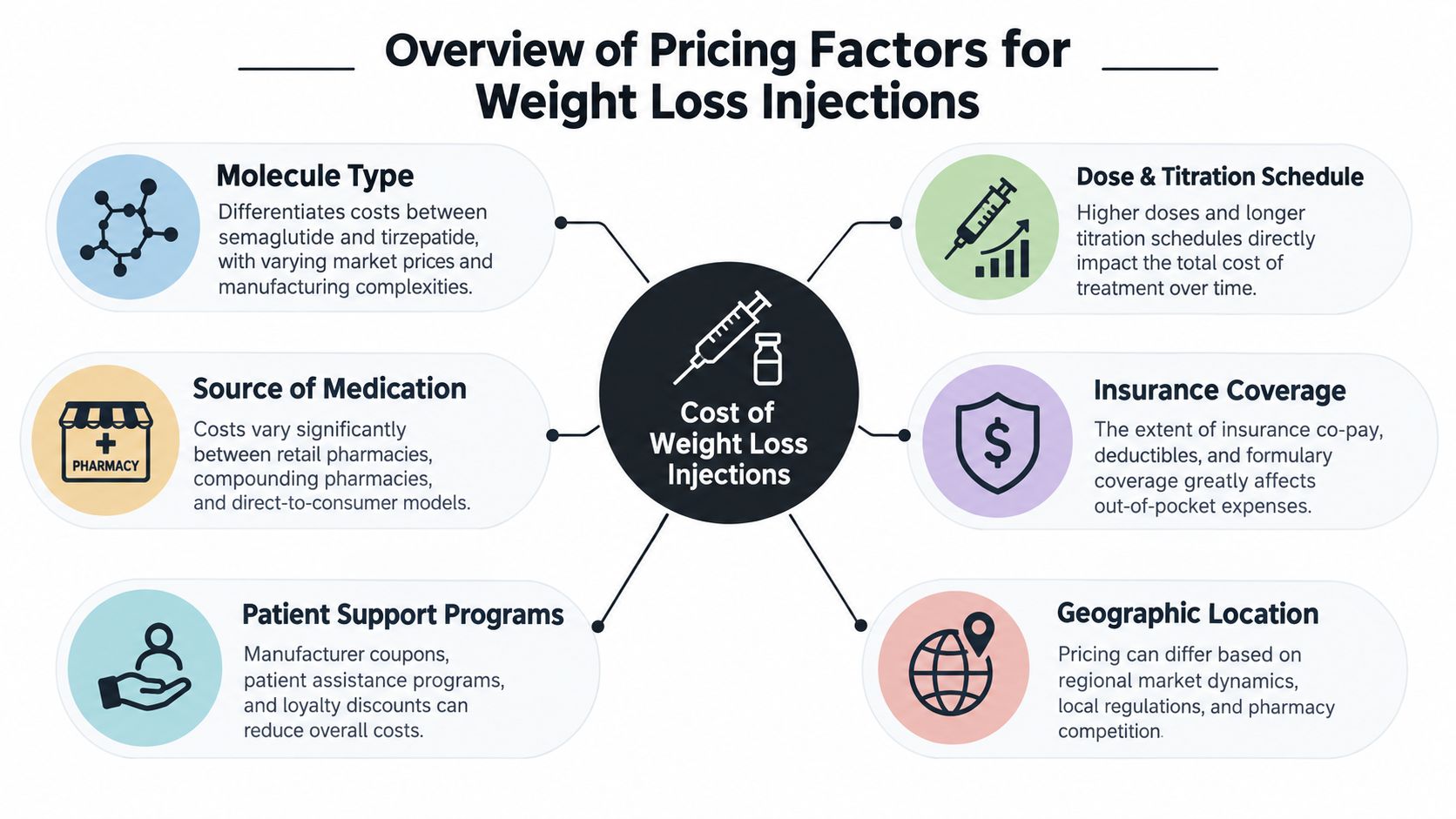
A monthly quote reflects several decisions made before the prescription reaches the pharmacy. The molecule, dose, format, coverage, care setting, and support program interact, so comparing one advertised number with another can produce a misleading result.
The medication and the dose
Semaglutide and tirzepatide are different active molecules, and branded products attach different commercial pricing to them. Wegovy is associated with weight management, while Ozempic contains semaglutide but is marketed for type 2 diabetes. Zepbound and Mounjaro contain tirzepatide, with product selection depending on the approved indication and a clinician's assessment.
Dose matters because treatment commonly involves titration. A starting dose may be priced differently from a later maintenance dose, especially when a program uses dose-specific self-pay rates. The total monthly cost can therefore rise even when the patient stays with the same medication.
Format and source
A prefilled pen, vial, and oral option can have different prices and dispensing arrangements. The source also matters. Retail pharmacy pricing, manufacturer-direct self-pay programs, and telehealth bundles may package the medication and clinical services differently.
The term list price usually refers to a manufacturer's published price before negotiated rebates or patient discounts. It shouldn't be treated as the amount every patient pays. Actual out-of-pocket costs can range from about $25 with employer insurance and savings-card combinations to roughly $149 to $499 in cash programs, according to independent GLP-1 access pricing data.
Coverage, care, and payment tools
Insurance can place a medication on a preferred or specialty tier, apply a deductible, require prior authorization, or exclude weight-management treatment altogether. A savings card may help some commercially insured patients, but eligibility rules can exclude government coverage and may change over time.
FSA and HSA funds can also affect affordability by allowing eligible healthcare spending to be paid from designated accounts. They reduce the effective financial burden for qualifying expenses, but they don't automatically lower the pharmacy's charged price.
Consultation fees, prescription management, shipping, dose reviews, and messaging may be separate or included. Before choosing a program, compare the entire package against a pharmacy-only quote. A broader explanation of how treatment costs may be assembled appears in this weight loss medication cost guide. For comparison, people evaluating other ongoing medical treatments may find this overview of testosterone therapy pricing useful for understanding bundled versus medication-only fees.
Comparing Costs of Semaglutide and Tirzepatide Options
The most important distinction in a brand comparison is that not every price represents the same dose or delivery format. A low-dose vial, a standard-dose injection, and a high-dose pen may all be listed under the same drug family while producing very different monthly totals.
For cash-pay consumers in the U.S., current pricing illustrates the spread. Wegovy injection is listed around $349 per month for standard doses and $399 per month for the 7.2 mg high-dose formulation. Zepbound ranges from approximately $299 per month at the lowest dose to $699 per month for higher-dose pen or vial configurations, according to reported 2026 cash-pay pricing.
Monthly Cost Ranges for Common Weight Loss Injections
| Medication | Dose Range | Monthly Price Range |
|---|---|---|
| Wegovy injection | Standard doses | About $349 |
| Wegovy injection | 7.2 mg high-dose formulation | About $399 |
| Zepbound | Lowest dose | About $299 |
| Zepbound | Higher-dose pen or vial configurations | Up to about $699 |
| Ozempic | Product and coverage dependent | Varies by pathway |
| Mounjaro | Product and coverage dependent | Varies by pathway |
| Compounded semaglutide | Program and dose dependent | Varies by provider |
| Compounded tirzepatide | Program and dose dependent | Varies by provider |
The table highlights a key budgeting mistake. A patient beginning at a low dose may see an attractive initial quote, but that figure may not apply after titration. Conversely, a patient who remains at a lower effective dose may not need the highest advertised price. The correct comparison requires asking whether the price is dose-specific, whether the supply is a pen or vial, and whether the quoted amount includes medical oversight.
Branded products and compounded pathways
Branded Wegovy, Ozempic, Zepbound, and Mounjaro are commercial products with established manufacturer distribution and, where applicable, manufacturer savings programs. Their prices can be high at retail, but insurance rebates, formulary placement, or eligible discounts may change the final amount.
Compounded semaglutide and compounded tirzepatide are different purchasing pathways, not cheaper versions of branded pens. Pricing may be lower in some cash programs, but the patient should verify the dispensing pharmacy, prescription process, dose instructions, clinical monitoring, and the exact substance supplied. A low advertised number is incomplete if it excludes consultation, shipping, supplies, or follow-up.
The molecule also affects the decision. Semaglutide and tirzepatide have different clinical profiles and aren't interchangeable solely because both are discussed as GLP-1 treatments. A licensed provider should determine whether a product is appropriate, which dose is suitable, and whether a branded or compounded pathway is clinically and legally available.
For readers comparing the active ingredients rather than only the price, this semaglutide versus tirzepatide comparison provides a separate framework. UK readers seeking a market-specific reference can review Mounjaro prices via a UK online pharmacy, since U.S. cash-pay figures shouldn't be transferred directly to another country.
How Insurance and Coupons Change Your Out of Pocket
A list price answers a manufacturer or pharmacy pricing question. It doesn't answer the patient's affordability question. The final amount depends on whether the plan covers weight management, whether the medication sits on a preferred tier, whether the deductible has been met, and whether a coupon can legally and contractually be used.
Commercial insurance can produce the widest range of outcomes. One patient may receive a manageable copay after authorization, while another may face the full pharmacy charge because their plan excludes obesity treatment. A savings card may lower the amount for an eligible commercially insured patient, but it isn't a universal substitute for coverage.
Three common payment pathways
Commercially insured patient: The patient first checks the formulary and asks the prescriber whether prior authorization is required. If the plan covers the medication, the copay may be determined by the drug tier and deductible status. If the plan excludes it, a manufacturer or pharmacy discount may offer a separate self-pay route, subject to eligibility.
FSA or HSA user: These accounts generally change how qualifying healthcare expenses are paid rather than changing the medication's posted price. The patient should confirm eligibility, retain receipts, and compare the effective after-tax cost with an insurance or direct-pay option.
Medicare beneficiary: CMS announced that eligible Part D beneficiaries will pay a flat $50 monthly copay for certain GLP-1 weight-loss medications from July 1, 2026 through December 31, 2027. The government's projected net price is $245 per month, creating a meaningful difference between the beneficiary's payment and the negotiated acquisition cost, as described in the CMS announcement on Medicare GLP-1 access.
Coverage check: Ask the insurer whether the benefit covers the specific indication, not merely whether the drug name appears in the formulary.
Why coupons require careful reading
Coupons can apply only to a defined insurance category, product, dose, or dispensing channel. A price shown after a discount may also exclude the clinical assessment or follow-up required to obtain the prescription. Before relying on it, confirm the expiration date, renewal terms, eligibility restrictions, and whether the price changes at a later dose.
A useful GLP-1 insurance coverage guide can help organize those questions. The safest comparison is a written estimate showing the medication price, deductible treatment, coupon conditions, dispensing fees, and any recurring care charge.
Affordable Telehealth Programs and Direct Pay Models
Telehealth and manufacturer-direct programs change the purchasing equation by combining remote clinical evaluation with home delivery or a defined self-pay price. That can be useful for adults whose insurance excludes weight management, but a lower monthly figure only has value if it remains understandable after dose changes and includes the care the patient needs.
Manufacturer direct-to-consumer pricing has moved below historical retail list pricing in some channels. Novo Nordisk announced in February 2026 that, effective January 1, 2027, the U.S. list price for Wegovy and Ozempic would be $675 per month, representing a reduction of about 50% for Wegovy and about 35% for Ozempic compared with the then-current list prices, according to the company's pricing announcement. Because that change is future-dated, patients should distinguish the announced effective date from prices available today.

Bundled care versus medication-only pricing
A pharmacy quote may cover only the medication. A telehealth plan may include an online intake, a licensed provider consultation, prescription coordination, monitoring, messaging, dose adjustments, and shipping. These models shouldn't be compared by medication price alone.
Weight Method offers semaglutide or tirzepatide plans starting at $149 per month, with free shipping and ongoing messaging, as described in the publisher information. Patients should still verify eligibility, the medication source, whether the rate changes with dose, and what happens when an introductory offer ends.
Questions that expose the real price
Ask each provider the same questions:
- Medication included: Is the advertised amount for the prescription only, or does it include clinical care and shipping?
- Dose schedule: Does the price remain constant during titration, or are higher doses billed differently?
- Continuity: What happens if a patient needs a refill, a dose adjustment, or a clinician review?
- Eligibility: Is a prescription issued only after a licensed provider determines that treatment is appropriate?
- Promotions: Is the first-month price temporary, and what is the recurring amount afterward?
- Refund terms: Does the program provide a refund if the patient is found ineligible, and what conditions apply?
The strongest direct-pay comparison is not necessarily the one with the lowest opening price. It's the one that makes the full recurring pathway visible, including dose escalation, support, shipping, and cancellation rules.
Real Life Scenarios Illustrating Cost Differences
The same medication can create very different financial decisions for different patients. The following profiles use verified market ranges to show how the payment pathway, rather than the drug name alone, shapes the monthly bill.
The employer-insured professional
A busy professional receives a prescription and discovers that the employer plan requires coverage verification. The sensible first move is to confirm whether the plan covers weight management, whether prior authorization applies, and whether a savings card can be used. If the plan produces a low copay, staying with the covered retail pathway may be more economical than switching to cash pay, even if a telehealth advertisement looks simpler.
The patient should ask for the post-authorization amount in writing. A formulary listing by itself doesn't guarantee that the deductible, specialty tier, or indication rules will produce an affordable fill.
The cash-pay budget seeker
Another adult has no usable coverage and compares a branded pen with a cash program. The 2026 audit of cash-pay GLP-1 programs recorded prices from about $69 to $249 per month, with a median near $158, while also noting that introductory prices often rise after dose escalation or a promotional period ends, according to the cash-pay GLP-1 price index.
That patient shouldn't choose based on the opening month. They should calculate the recurring price at the expected dose, then add any consultation, shipping, supplies, and follow-up fees.
The Medicare beneficiary
An eligible Medicare Part D beneficiary using the announced program structure may budget around the applicable flat copay during the stated period. Their key task is confirming eligibility, participating medications, enrollment mechanics, and the effective dates, rather than comparing the copay with a retail list price that doesn't apply to their pathway.
The high-dose patient
A patient who reaches a higher dose may face a meaningful increase in cash spending. The reported Wegovy and Zepbound ranges show why: Wegovy is listed around $349 for standard doses and $399 for the 7.2 mg formulation, while Zepbound ranges from about $299 to $699 depending on dose and format, as reported in the earlier pricing source.
The provider should discuss whether the higher dose is clinically appropriate and how the program prices it before the prescription changes.
Recommendations for Choosing the Right Option
Start with your insurance documents, not a search result. Confirm whether weight management is covered, identify the drug tier, ask about prior authorization, and request the expected copay after your deductible status is applied.
Then obtain a complete cash quote. Compare the medication, consultation, follow-up, shipping, supplies, and dose-related charges in one place. If a coupon is available, check its eligibility rules and expiration date before treating the discounted figure as your long-term budget.
Use this checklist:
- Ask about the next dose: Confirm whether titration changes the monthly price.
- Separate temporary offers: Record the recurring rate after any introductory promotion.
- Compare care models: Put a pharmacy-only quote beside a bundled telehealth quote.
- Check payment accounts: Ask whether eligible costs can be paid through an FSA or HSA.
- Verify the pharmacy: Confirm who dispenses the medication and how refills are handled.
- Review clinically: Choose the medication and dose with a licensed provider, not from price alone.
A realistic budget includes the month after the promotion, the month after a dose increase, and the cost of clinical support. That approach prevents the most common surprise, an affordable first fill followed by an unclear recurring bill.
Weight Method offers online provider evaluation, semaglutide or tirzepatide treatment pathways, home shipping, ongoing messaging, and dose management with pricing starting at $149 per month. If you want a clearer comparison between bundled telehealth care and pharmacy pricing, visit Weight Method and review the current eligibility and plan details.