Medicare pays for Wegovy based on the diagnosis on the prescription, not the name on the pen. Weight loss as the only reason is the usual denial. Write a covered cardiovascular risk-reduction use instead, and the plan may review the claim. A temporary Medicare GLP-1 Bridge changes the answer for some people who meet the criteria and receive plan approval. It leaves the answer the same for people who do not qualify.
People want a single yes or no. Medicare sorts the claim by indication.
The prescription works like a shipping label. The drug is the package. The indication is the address. Send it to weight loss and Part D usually returns the claim unpaid. Send it to a covered heart-risk use, or through Bridge rules your plan accepts, and the claim can move forward.
Medicare Coverage for Wegovy at a Glance
Medicare can pay for Wegovy, and it can refuse the same pen. The difference is the diagnosis written on the prescription, not the brand on the label. Weight loss by itself is the usual Part D denial. A covered heart-risk use, or the temporary GLP-1 Bridge during 2026 and 2027, can send that same drug to a reviewer. Each path has its own gate.
| Situation | Part D coverage for Wegovy | Main condition |
|---|---|---|
| Wegovy prescribed only for weight loss | Usually not covered | Part D excludes drugs used for weight loss |
| Cardiovascular risk reduction with established heart disease | May be covered | Plan approval, prior authorization, and records of the approved use |
| Medicare GLP-1 Bridge during the 2026 to 2027 window | Covered for eligible people | Part D through a standalone plan or Medicare Advantage with drug coverage, plus BMI and risk thresholds |
| Original Medicare without Part D | Generally not covered as an outpatient drug | Part D is the outpatient prescription benefit |
| Already receiving a GLP-1 through Part D | Excluded from the Bridge | Current Part D GLP-1 use disqualifies the patient from the Bridge |
The prescription works like a form with two boxes. One box names the medicine. The other names why. Plans read the why first. A weight-loss reason hits the rule that keeps weight-loss drugs out of Part D. A cardiovascular reason, written for someone with established heart disease who is overweight or has obesity, can move the claim into prior authorization instead of an automatic no.
Three facts place you in a row. The diagnosis on the prescription is the first. The specific plan is the second, because each Part D plan and each Medicare Advantage drug plan keeps its own formulary. The clinical criteria that plan applies are the third: body mass index, heart history, and other listed conditions.
Original Medicare without a drug plan leaves the pen unpaid. An injection does not move Wegovy into hospital or doctor benefits. Outpatient prescriptions sit in Part D, either a standalone plan or Medicare Advantage that includes drug coverage.
The Bridge changes the answer only for some people. You need Part D already in place, a qualifying BMI, and a listed risk condition. If you already fill another GLP-1 through that drug plan, the Bridge row stays closed even when your weight would otherwise fit. Someone who has never filled a GLP-1, and who meets those thresholds, can be reviewed under the Bridge while it is open. Someone using Wegovy only to lose weight, with no covered heart indication and no Bridge fit, stays in the denial row.
Practical rule: Match your chart to one row before you call the plan. A general question about Wegovy gets a general no.
Why Medicare Covers Wegovy by Diagnosis, Not Brand
FDA approval and Medicare payment are separate decisions. One says a drug may be sold for a use. The other says who pays.
A driver's license lets you operate a car. It does not make the state pay for the gas. The FDA label is Wegovy's license. Part D benefit rules decide the bill. Wegovy is FDA-approved for chronic weight management, and that approval still does not create a weight-loss benefit. The FDA's announcement of the heart indication sits next to a hard Part D limit: Medicare generally does not cover Wegovy when it is prescribed solely for chronic weight management, because federal rules exclude drugs used for weight loss. A person seeking it only to lose weight will usually face denial, regardless of obesity status.
The March 2024 exception
A real exception opened in March 2024. The FDA approved Wegovy for adults with established cardiovascular disease who have obesity or are overweight, specifically to reduce the risk of cardiovascular death, nonfatal heart attack, and nonfatal stroke. CMS then told Part D plans that anti-obesity medicines may qualify as covered Part D drugs when they are prescribed for an FDA-approved, medically accepted indication that Medicare covers.
CMS draws a bright line. The same medicine may be covered for cardiovascular disease and remain excluded when it is prescribed only for obesity or overweight. Coverage can be available when the prescription is tied to cardiovascular-risk reduction. It is not automatic. It still depends on the plan, clinical eligibility, prior authorization, and formulary rules.

Two patients, one drug
Picture two neighbors, both 68, both with a BMI in the obesity range, both holding a Wegovy prescription.
Patient A had a heart attack two years ago. The prescriber writes the cardiovascular indication and sends cardiac records. The plan must still review the request, but the claim is in a category Medicare can pay.
Patient B has obesity and wants to lose weight, with no established cardiovascular disease on the chart. The prescription says weight management. Part D's weight-loss exclusion applies, and a denial is the expected result.
Nothing about the pen changed. The words on the prescription did.
Coverage follows the indication written on the prescription, not the brand name on the box.
Bridge Eligibility Thresholds Explained
The Medicare GLP-1 Bridge is a side door, and it is temporary. Ordinary Part D still treats a weight-management prescription as a different question from heart-risk coverage. Medicare's weight-loss drug coverage page states that, beginning July 1, 2026, the Bridge can cover Wegovy for weight management when you have Part D through a standalone prescription-drug plan or a Medicare Advantage plan with drug coverage. On or after that start date, a Bridge claim is measured against the thresholds below.
The Bridge works like a guest pass. It can open for weight management. Ordinary Part D rules stay in place for claims that are not using it. People who already receive a GLP-1 through their Part D plan are outside this door. You also need to be an adult, and you need one risk profile.
| Eligibility profile | What has to be true besides weight |
|---|---|
| Severe obesity alone | Weight status in the highest category can stand on its own |
| Obesity with a serious comorbidity | A serious condition such as heart failure, hard-to-control high blood pressure, or advanced chronic kidney disease |
| Overweight with cardiovascular or metabolic history | A history such as prediabetes, a prior heart attack or stroke, or symptomatic peripheral artery disease |
Read the rows as a ladder. A lower weight category plus a blank medical history does not get the treatment of the top row. The highest weight category can qualify without an extra condition. The middle category needs a serious comorbidity on the chart. The overweight category needs cardiovascular or metabolic history.
The prescriber must certify that treatment is part of a diet-and-exercise lifestyle program. The plan may still require prior authorization. Bridge cost-sharing is its own arrangement. Confirm the monthly amount with the plan, and ask whether that payment counts toward the Part D deductible or the annual out-of-pocket limit. Check the current formulary and authorization criteria before you assume a fill will go through.
A 62-year-old whose weight sits in the obesity range, and who has uncontrolled hypertension, fits the middle row. Adult status, Part D, the weight category, and a listed condition are all present, so the prescriber can submit the Bridge request with the lifestyle certification.
A 58-year-old in a lower weight range, with none of the listed conditions, does not fit any row. Weight alone, short of the highest category and without a qualifying diagnosis, is not enough. Calling the plan before you know your row wastes the call. Have the weight category and the condition name in front of you, then ask whether that profile is on the plan's Bridge criteria.
Cardiovascular Coverage and the Records to Submit
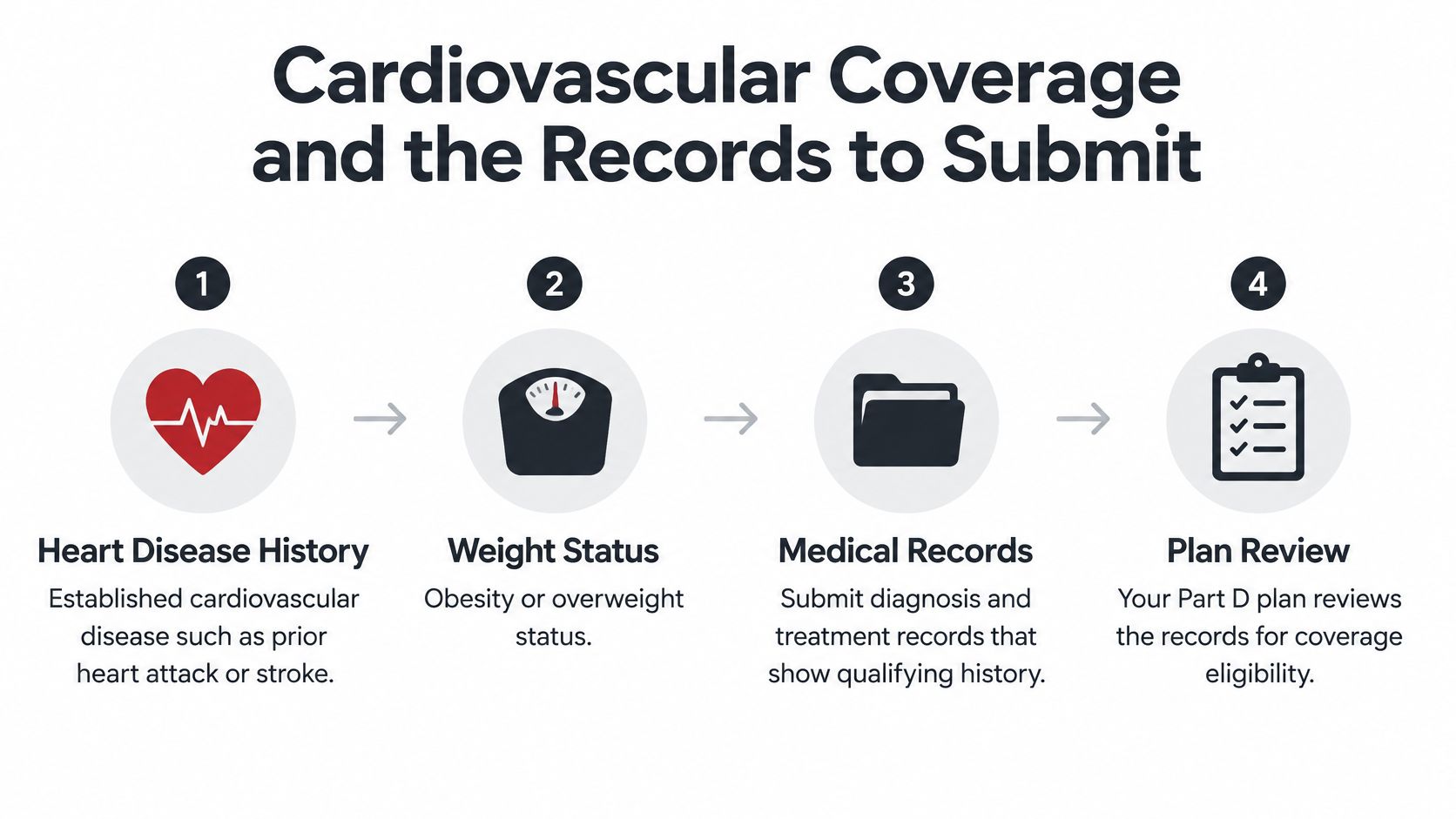
This route is for adults with overweight or obesity and established cardiovascular disease, when Wegovy is prescribed to reduce the risk of cardiovascular death, heart attack, or stroke. A prior heart attack, a prior stroke, or another established cardiovascular diagnosis is the history plans look for. Obesity alone is a different request, and Part D generally excludes that one.
The USC Schaeffer Center's review of Medicare obesity-drug coverage makes the practical point many summaries skip. Plans may cover this FDA-approved cardiovascular use. Coverage is not automatic. You may need a qualifying cardiovascular diagnosis, documentation of the approved use, and approval from the specific Part D or Medicare Advantage drug plan.
Records that belong in the packet
Build the packet before anyone submits it.
- Heart history: Diagnosis codes plus chart notes of the heart attack, stroke, or other established cardiovascular disease.
- Weight status: Current BMI and a short recorded weight history showing obesity or overweight.
- The prescription itself: The indication must say cardiovascular risk reduction, not weight loss.
- Prior care: Notes on earlier treatments and any diet or activity program you have joined.
- The plan form: The prior authorization form, signed by the prescriber.
- Labs that matter: Recent results only when they speak to cardiovascular risk.
Manufacturer savings programs generally do not resolve Part D eligibility. A coupon is not a substitute for formulary status. Ask the plan whether Wegovy is on the formulary, whether step therapy applies, and whether the prescriber must submit prior authorization.
Federal retirees sometimes assume doctor coverage and drug coverage travel together. They don't. A clear walk-through of Medicare Part B for federal retirees helps separate physician services from the drug plan that would process this claim. If you want the clinical side of this indication, our guide to GLP-1 treatment for heart disease explains how that use differs from a weight-only prescription.
Ask your prescriber one question before the request goes in: will the chart document the cardiovascular indication, in those words, before you submit?
What You Pay Under Each Coverage Route
Price follows the route, not the pharmacy shelf.
| Coverage route | What you pay | Counts toward deductible or out-of-pocket limit |
|---|---|---|
| Medicare GLP-1 Bridge | $50 per one-month supply | No |
| Standard Part D coverage for the cardiovascular indication | Plan copay or coinsurance after the deductible | Yes |
| Cash pay without coverage | Full price set by the manufacturer | No |
The number that surprises people is how the Bridge payment sits off to the side. Novo Nordisk's Wegovy cost page, citing CMS, states that eligible beneficiaries pay a $50 monthly copayment for Wegovy under the Bridge beginning July 1, 2026. Twelve months at that copay is $600. Those payments do not move you toward the Part D deductible or the annual out-of-pocket limit. You can pay them all year and still be in the same place on your other drugs.
Ordinary Part D versus paying cash
Standard Part D coverage for the cardiovascular indication uses that plan's deductible, then its copay or coinsurance. The tier, and the dollar amount, change by plan and by benefit year. Open the formulary, find Wegovy, and read the tier before you budget.
Cash pay is whatever price the manufacturer sets for an uncovered fill. A savings card generally does not fix Part D eligibility. Compare that full price with a covered route before you decide to skip the paperwork. Our breakdown of what Wegovy costs is a useful benchmark when you are weighing an uncovered fill against a plan copay.
Say one neighbor is on the Bridge and pays $50 each month. Another neighbor has the heart indication, has not met the deductible, and owes a much larger share of the first fills until that deductible is reached. After the deductible, the second neighbor's copay or coinsurance does count toward the plan's out-of-pocket limit. The first neighbor's $50 never does.
Ask the plan three questions. What is my copay per month? Does it count toward my out-of-pocket maximum? What does my cost become under standard Part D after the Bridge ends?
Stopping semaglutide, including Wegovy, is expected to bring weight regain. Before that end date, compare three options: a plan offering coverage of the drug, qualifying under the cardiovascular indication, or paying cash. Set the switch before the last covered month so treatment does not lapse.
Prior Authorization, Appeals and Denials
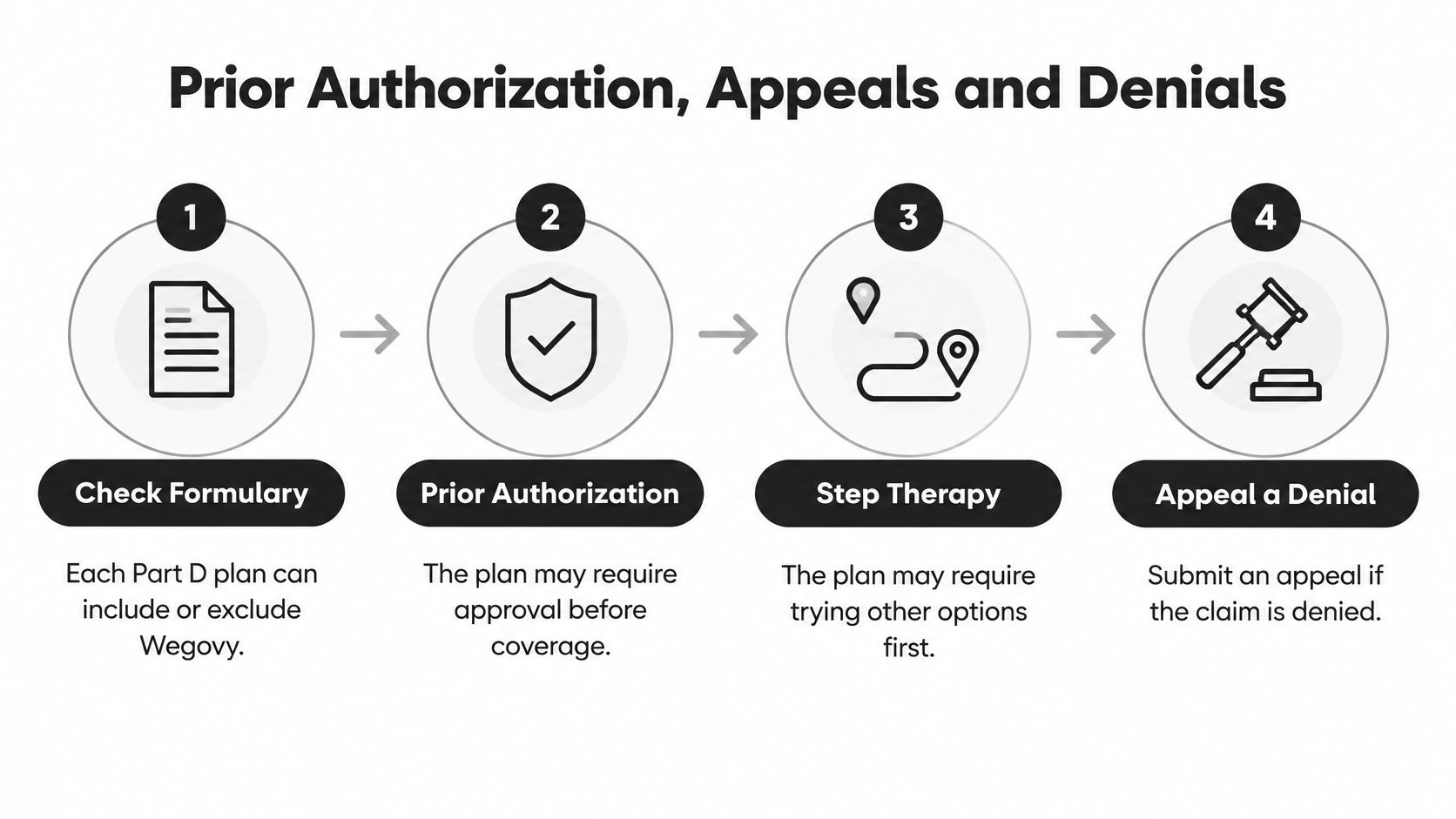
A clinical match is the ticket in your pocket. The pharmacy still needs the plan's stamp before it can hand over the pen. Medicare's Part D guidance puts the rules with each plan: the formulary, any exclusion, prior authorization, and step therapy. Qualifying on paper is not the same thing as an approved fill.
The diagnosis written on the prescription decides which rulebook the plan opens. A cardiovascular indication follows ordinary Part D rules. Obesity treatment, for people who qualify, can follow the temporary Bridge instead. Those are different doors, even when the pen in the box is the same drug.
CMS's provider page on the Medicare GLP-1 Bridge states that the program runs from July 1, 2026 through December 31, 2027 for eligible Part D beneficiaries, for Wegovy and selected GLP-1 drugs. It is not a blanket benefit for everyone with obesity. A BMI of at least 35 qualifies on its own. A BMI of at least 30, or a BMI of at least 27, also needs one of the listed conditions, such as uncontrolled hypertension or stage 3a-or-higher chronic kidney disease. The program still uses prior authorization. It also excludes people who already receive a GLP-1 through their Part D plan.
The sequence that actually gets a fill
Prior authorization works like a building permit. You can already own the lot, and construction still waits on the stamp.
- Search the plan formulary for Wegovy. Note the tier and any restrictions.
- Ask whether prior authorization or step therapy applies, and request the coverage-determination criteria.
- Have the prescriber submit BMI, qualifying conditions, the intended indication, prior treatments, and diet-and-exercise participation.
- Wait for the decision inside the timeframe the plan states. Write that date down.
- If the plan denies you, request the written reason and the criteria it applied.
- Fill at a network pharmacy only after you have approval.
A Medicare Advantage member can be turned away at the counter because the prescriber never filed prior authorization. The drug was on the formulary. The missing form was the whole denial. Our walk-through of the prior authorization process shows how that paperwork is usually sequenced. If the office faxes the packet, a one-page header with the member ID and the request type saves a lost document. These fax cover letter tips for 2026 are worth five minutes before that send.
If the answer is no
Ask for a coverage determination first. If that denial stands, request a redetermination. Ask the prescriber for a short letter that restates the indication and the records already in the chart. Keep a copy of every decision.
Original Medicare without Part D generally cannot cover outpatient Wegovy through Part B just because the drug is injectable. Part D is the outpatient prescription benefit. Check that enrollment before you appeal a denial that was never a Part B claim.
Put December 31, 2027 on your calendar. The Bridge is temporary. If you are responding to Wegovy, ask the plan, well before that date, which rule applies once the demonstration ends: continued coverage under a covered indication, a formulary change, or no coverage at all. The written indication on the next prescription is what sorts you into one of those paths.
Weight Method connects patients with licensed healthcare providers for evaluation, prescription, and delivery of the GLP-1 medications semaglutide and tirzepatide. Licensed clinicians decide eligibility from medical history and their own assessment, the same kind of chart review a Medicare request depends on.
If you are sorting out whether your diagnosis, your BMI, or your drug plan could support a GLP-1 prescription, start with a licensed clinician rather than a guess at the pharmacy counter. Visit Weight Method to begin that review.