In the 72-week SURMOUNT-1 trial, adults with obesity who took 15 mg of tirzepatide lost 20.9% of their starting body weight on average. The placebo group lost 3.1% (New England Journal of Medicine). Losing a fifth of your body weight without surgery was, until recently, a surgical result.
That comparison explains the surge of interest in semaglutide alternatives, and it also explains why so many comparisons mislead. A trial average describes a group of hundreds of people. It doesn't describe your gut, your schedule, your coverage or your family history of thyroid disease.
The percentages below are real. They're also sorted by trial design as much as by potency. What usually decides a prescription is something else entirely: whether you can inject weekly, whether a boxed warning rules out an entire drug class, what your plan pays, and how much weight you need to lose to change your health.
Semaglutide Alternatives at a Glance
Reported weight loss and approval status by alternative
| Option | Route and dosing | Reported average weight loss | Approval status |
|---|---|---|---|
| Tirzepatide (Zepbound) | Weekly injection | 15.0% to 20.9% at 72 weeks (SURMOUNT-1) | FDA-approved for weight management |
| Semaglutide 2.4 mg (Wegovy) | Weekly injection | 13.7% at 72 weeks at maximum tolerated doses (SURMOUNT-5) | FDA-approved for weight management |
| Liraglutide 3.0 mg (Saxenda) | Daily injection | 8.0% at 56 weeks | FDA-approved for weight management |
| Oral semaglutide | Daily tablet | 10.9% at one year versus lifestyle (network meta-analysis) | Approved in an oral form for weight management |
| Phentermine-topiramate (Qsymia) | Daily capsule | 8.1% at one year versus lifestyle (network meta-analysis) | FDA-approved for weight management |
| Naltrexone-bupropion (Contrave) | Daily tablet | About 4.8% (FDA-approved medication reference data) | FDA-approved for weight management |
| Orlistat (Xenical) | Capsule taken with meals | About 3.8% (FDA-approved medication reference data) | FDA-approved for weight management |
| Retatrutide | Weekly injection | Up to 24.2% at 48 weeks (phase 2) | Investigational |
| Orforglipron | Daily pill | 9.9% at one year versus lifestyle (network meta-analysis) | Investigational |
Three Groups, Not Nine Rankings
The rows fall into three practical groups. Injectable incretin medicines include tirzepatide, semaglutide, liraglutide, and investigational retatrutide. Daily pills act through different mechanisms, including appetite pathways or fat absorption. Surgery and structured lifestyle programs are not included because the table compares medication results.
These averages come from different trial designs and follow-up periods. Some studies compared treatment with placebo, while others compared it with lifestyle treatment. Retatrutide's 24.2% comes from a phase 2 study at 48 weeks; the tirzepatide range comes from a phase 3 trial at 72 weeks in a different population. Those figures cannot establish which medicine is superior.
Dose also affects the result. Tirzepatide's 15.0% to 20.9% range reflects three dose levels of the same medicine, so a percentage is most useful when read alongside its dose, study duration, and comparison group.
Use the table to identify options that fit the reason semaglutide may not work for you. Route, dosing frequency, and approval status can narrow the choices; a clinician can then consider your medical history and treatment preferences. The largest trial average is only one part of that decision.
Tirzepatide Versus Semaglutide Head to Head
The cleanest comparison available puts the two leading incretin drugs in the same trial, at the same time, in the same people.
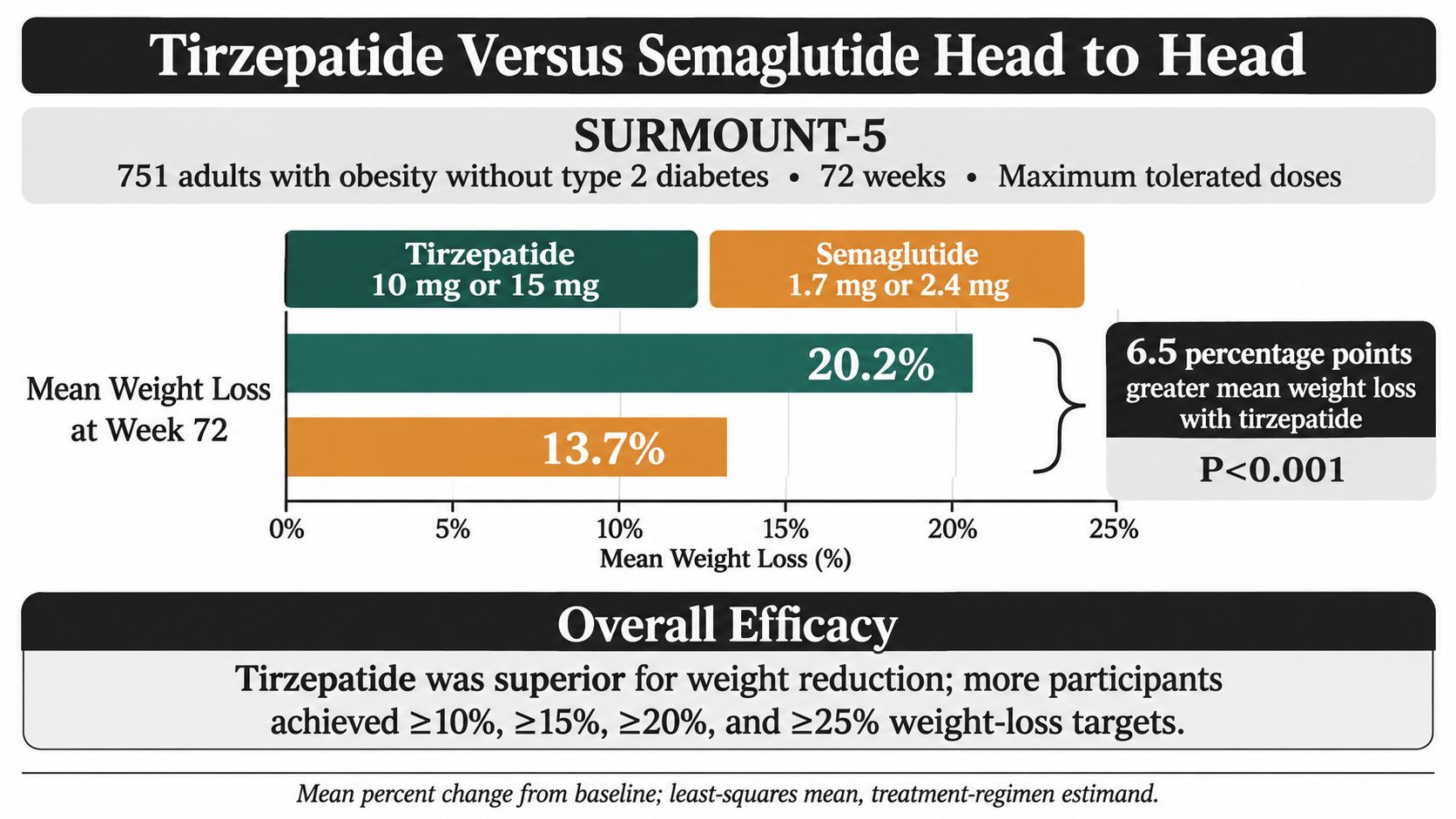
In the phase 3b SURMOUNT-5 trial, 751 adults with obesity but without type 2 diabetes were randomized to maximum tolerated once-weekly doses of tirzepatide (10 or 15 mg) or semaglutide (1.7 or 2.4 mg) for 72 weeks. Mean weight reduction was 20.2% with tirzepatide versus 13.7% with semaglutide, an absolute difference of 6.5 percentage points that was statistically significant (p<0.001). Waist circumference fell 18.4 cm versus 13.0 cm (New England Journal of Medicine).
Put a body on it. A 100 kg patient tracking the trial average would finish near 79.8 kg on tirzepatide and near 86.3 kg on semaglutide. Both outcomes are clinically meaningful. One is larger.
The core comparison, in one frame:
What the Average Does Not Prove
SURMOUNT-5 was open-label, so participants and investigators knew which drug each person received. Doses were titrated to whatever each participant tolerated, which means the comparison reflects best-case dosing rather than a fixed protocol. People with diabetes were excluded, and that group's response and treatment priorities differ. The trial also used branded, regulated medications, so its results shouldn't be extended to compounded products.
The limit that matters most: a 6.5-point gap between group averages doesn't promise 6.5 points for you. It could be ten, it could be two, and it could be nothing but nausea until you stop.
Individual response, gastrointestinal tolerability, contraindications, comorbidities, cost, coverage and availability can each outweigh the average efficacy gap. That's not a hedge. It's how the prescribing decision works.
Two Cases Where the Gap Does Not Decide It
Consider a patient who tolerated semaglutide well, is within a few kilos of goal, has stable coverage and no side effects beyond a settled stomach. Switching to chase an average is unlikely to add much and may cost weeks of re-titration. Staying put is the reasonable move.
Now consider a patient who plateaued at the top semaglutide dose, handles dose increases without much trouble, has no thyroid or pancreatic history, and wants more reduction. That patient has a legitimate case for discussing a switch, because the head-to-head evidence is exactly about people like them.
Cost can outweigh the gap too. Weight Method prices compounded tirzepatide at $119 for the first month, then $329 per month on a monthly plan that's billed monthly and can be canceled anytime. Introductory pricing applies to new GLP-1 patients, and standard pricing applies to anyone who has used a GLP-1 before.
Questions to Take to the Appointment
- Is the goal maximum average reduction or the fewest side effects? The answer changes which drug leads.
- What is the actual blocker? Tolerability, cost, a contraindication and needle aversion lead to four different shortlists.
- What dose will I titrate to, and how fast? A trial average assumes you reached the tested dose.
- What result at three months would make us switch? Decide the exit rule before you start.
Other GLP-1 Medicines and Pipeline Drugs
Tirzepatide isn't the only other incretin drug on the market, and the class splits cleanly into approved products and compounds that are still experiments.
Approved Options Beyond Semaglutide
Liraglutide (Saxenda for weight, Victoza for diabetes) is a daily injection rather than a weekly one. The dose is started low and escalated over several weeks to reduce nausea, and the daily schedule means more injection events per month. It carries the same class boxed warning as the other incretins.
Dulaglutide and exenatide are labelled for type 2 diabetes, not weight management. Their weight effects are smaller and are a secondary finding rather than the purpose of the prescription. If a clinician offers one of these for weight, ask what indication is being treated.
Oral semaglutide replaces the pen with a tablet taken once a day on an empty stomach with water, and you wait before eating. Oral Wegovy is a daily-pill option for GLP-1 therapy without weekly injections, and daily dosing requires more consistent adherence than a weekly injection. Miss doses and the appetite effect fades.
Compounded oral semaglutide exists for people who want to avoid injections, and Weight Method offers it as a convenient option for patients who aren't candidates for or prefer to skip needles. Be clear about what that is: compounded products aren't the branded medications used in the trials, so the published percentages don't transfer to them.
Pipeline Drugs That Are Not Yet Alternatives
Retatrutide is the most-watched compound in this space. It's a once-weekly triple receptor agonist hitting GLP-1, GIP and glucagon pathways, and phase 2 data reported mean weight loss of up to 24.2% at 48 weeks compared with 2.1% for placebo (PMC review of the evidence). That magnitude exceeds semaglutide's head-to-head result and approaches or surpasses tirzepatide's, but the figures aren't directly comparable: the studies differed in duration, populations, trial design, dose-ranging and comparator.
Retatrutide shouldn't be described as equivalent to an FDA-approved treatment or as interchangeable with semaglutide. Phase 3 TRIUMPH studies and a head-to-head comparison against tirzepatide are still needed to establish durability, adverse-event rates, cardiovascular outcomes and practical dose tolerability. For now it belongs in the pipeline category. If you want to follow the readouts, when will retatrutide be available tracks the trial timeline.
Orforglipron is an oral investigational drug that appears in the same one-year comparison as the approved options, still short of a label.
How to Check Any Drug's Status
Open the prescribing information and search for "chronic weight management." If the indication isn't there, the weight effect is a side finding, not a labelled purpose. That single check separates a treatment from a marketing claim faster than any comparison chart.
For type 2 diabetes, dulaglutide, exenatide and liraglutide's diabetes formulation are labelled for blood-sugar control, and tirzepatide and semaglutide carry that indication too. Non-incretin options such as metformin or SGLT2 inhibitors are often combined with these drugs, so ask a clinician to confirm your HbA1c goal before choosing a weight-focused alternative.
Non-GLP-1 Pills and What They Target
A pill isn't automatically the weaker choice. It's the choice with a different job, and the job matters more than the percentage.
The historical context is worth holding onto. Orlistat was approved in 1999, liraglutide in 2014, and the naltrexone-bupropion combination in 2014, according to a National Center for Biotechnology Information clinical reference. Conventional oral medicines generally produced single-digit mean weight loss, while newer incretin-based therapies have shown substantially larger reductions in randomized trials.
The mechanisms differ sharply. Orlistat inhibits intestinal lipases and can cut dietary-fat absorption by up to 30%; the same reference table reports roughly 3.8% average weight loss and a 50.5% versus 30.7% responder comparison. Naltrexone-bupropion works on appetite and cravings through opioid, dopamine and norepinephrine pathways, with about 4.8% average loss and a 48% versus 16% responder comparison.
Those responder splits are the part patients skip. A mean of 4.8% with a 48% responder rate describes a drug that works well for about half of users and barely at all for the rest. Averages hide that spread; response rates expose it.
Matching a Mechanism to an Eating Pattern
Phentermine-topiramate pairs appetite suppression with a second agent, and it sits above the older pills in the table but well below the incretins. Setmelanotide is approved only for specific rare genetic obesity conditions confirmed by testing, so it isn't a general alternative for anyone.
The useful question is what drives the eating. Someone whose problem is nighttime grazing and food noise may find a craving-targeted option more relevant than a lipase blocker. Someone whose meals are high in fat and who gets gastrointestinal distress may consider orlistat, which only works if the diet stays low in fat, and which reduces absorption of fat-soluble vitamins enough that a supplement may be needed.
If you're comparing over-the-counter products against prescription pills, which slimming ingredients actually work is a useful primer on where the evidence sits for common supplement ingredients. And a fuller list of FDA-approved weight loss pills shows which mechanisms carry an actual weight indication.
Two questions do most of the work here. What pattern is driving the weight, and does this drug's mechanism touch that pattern? A pill that doesn't match your eating behavior is a pill with side effects and no upside.
Surgery, Devices and Lifestyle Options
Bariatric surgery produces the largest and most durable average reductions of anything in this discussion, and it does it without a weekly injection. Sleeve gastrectomy and Roux-en-Y gastric bypass change anatomy, not just appetite signals.
Eligibility usually starts at a BMI of 35, or 30 with conditions such as type 2 diabetes. The commitment is real: lifelong vitamin supplementation, regular nutrient monitoring, and a permanent change to how you eat and absorb food. For the right patient, that trade is worth it.

What Each Route Asks of You
Endoscopic options such as an intragastric balloon are temporary and produce more modest loss. The balloon is typically removed after several months, which makes it a bridge or a trial rather than a permanent fix. If the idea of surgery appeals but the permanence doesn't, that's the conversation to have.
Structured lifestyle programs deliver the smallest average effect, and they still matter. A 100 kg adult who loses 7 kg through diet and activity reaches 93 kg, a loss big enough to shift blood pressure and glucose control for many people, with no prescription and no injection. That's not a consolation prize. It's a clinically meaningful result that some patients reach and keep.
Cooking is often the piece that fails first. If that's your pattern, Thermomix dietary cooking resources walk through guided recipes with built-in times and temperatures, which removes some of the daily decisions that derail a plan.
These routes aren't mutually exclusive, and they aren't ranked against each other either. A drug can carry you to a healthier weight before surgery, and surgery can hold a result a drug alone couldn't. If you're weighing the two, GLP-1 versus bariatric surgery sets the expectations side by side. Raise surgery or a device with a clinician when drugs are unsuitable and your BMI is high, rather than treating it as a last resort.
Choose the Right Alternative and Confirm It With Your Clinician
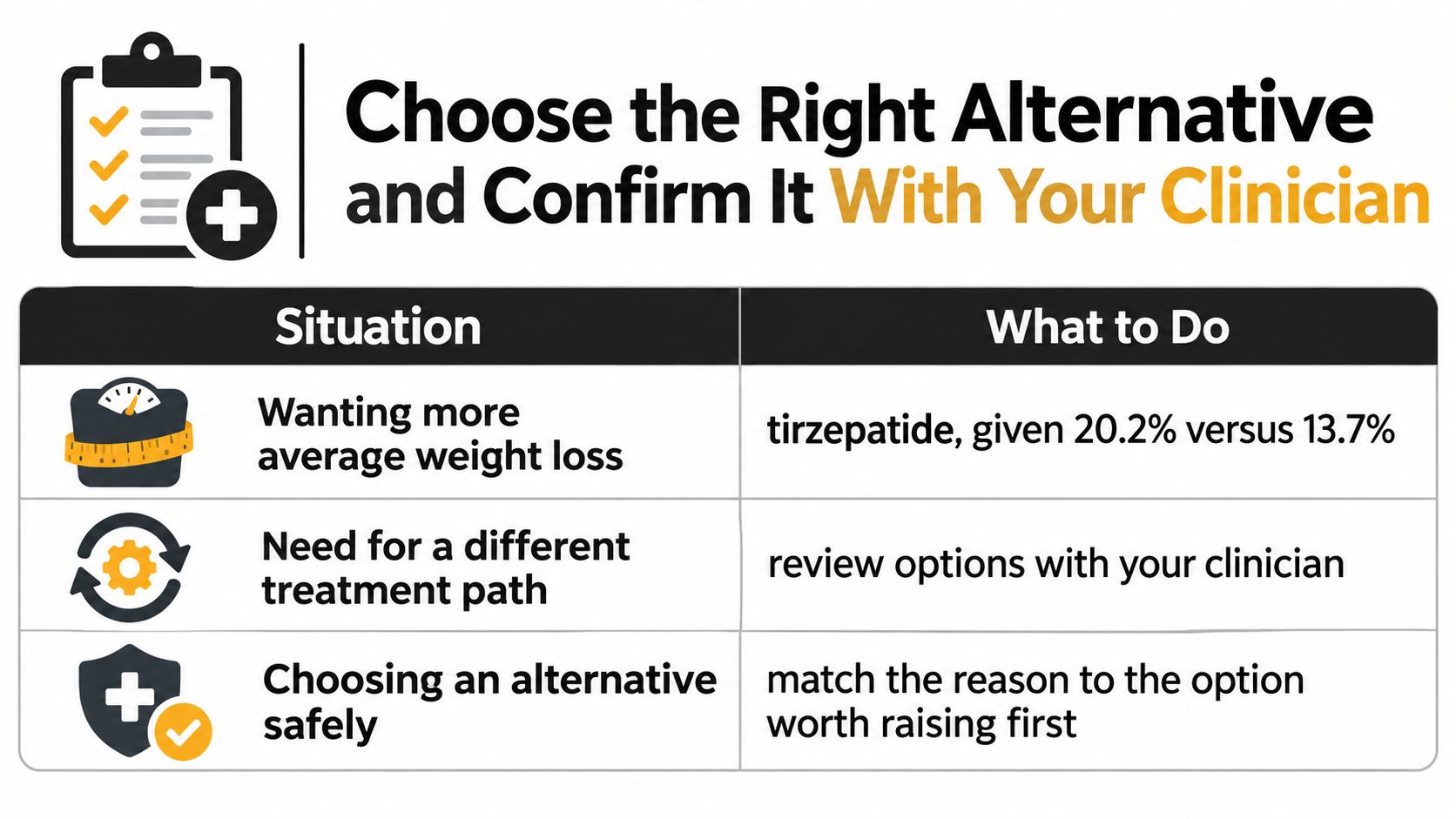
Start with the reason, not the percentage. The table below matches the situation to the option worth raising first.
Reason for seeking an alternative and the options to discuss
| Reason for seeking an alternative | Options to discuss first | Why it fits |
|---|---|---|
| Want more average weight loss | Tirzepatide | 20.2% vs 13.7% in SURMOUNT-5 at maximum tolerated doses |
| Want to avoid injections | Oral semaglutide; orforglipron if approved | Daily pill route, with different dosing rules |
| Thyroid C-cell tumor history | Phentermine-topiramate, naltrexone-bupropion, orlistat | Non-incretin mechanisms; check each label for contraindications |
| Cost or coverage limits | Orlistat; structured lifestyle program | Lower drug cost or no drug cost; expected loss is smaller |
| BMI very high or regain after medication | Bariatric surgery evaluation | Larger and longer-lasting loss in published series, with lifelong monitoring |
The one-year comparison behind several rows is a network meta-analysis, which pools trials rather than running one. It reported average weight loss versus lifestyle treatment of 14.9% for tirzepatide, 10.9% for oral semaglutide, 9.9% for the investigational oral drug orforglipron, 9.8% for injectable semaglutide, and 8.1% for phentermine-topiramate (Weill Cornell Medicine). Emerging agents such as retatrutide and mazdutide showed potentially larger reductions, but evidence certainty was low or very low.
That last detail is the whole argument in miniature. Ranking by percentage flattens the differences that decide a prescription: route, evidence quality, eligibility and practical constraints.
The Decision Rule
An alternative is a match to your reason for switching, not an automatic upgrade. A patient near goal on semaglutide with no side effects may reasonably stay exactly where they are.
A real clinical relationship outperforms a chart. In our program, semaglutide or tirzepatide is selected based on BMI, medical history and expected response, with gradual escalation dosing. A provider also monitors your trajectory and can discuss switching to injectable options if oral results are insufficient.
Your Appointment Checklist
- Is the goal maximum loss or the fewest side effects? These point to different drugs and different doses.
- Is the blocker injections, cost, or a contraindication? Name it out loud so the clinician answers the right question.
- Are you planning pregnancy in the next year? Obesity medications aren't for use during pregnancy, so this reshapes the shortlist immediately.
- What does each option cost you after coverage? Ask for the cash price too, including whether a direct-pay program applies.
- What result at 3 and 12 months counts as success? Agree on the number that means continue, and the number that means switch.
Bring your full medication list and any family history of thyroid cancer or pancreatitis to that visit. The best option is the one whose cautions don't include you, and that's a conversation, not a leaderboard.
Weight Method pairs a short online quiz with a video visit with a licensed provider who reviews your BMI, medical history and goals before prescribing semaglutide or tirzepatide when it's appropriate, then ships the medication to your door with provider care, unlimited messaging and free priority shipping included. Tirzepatide runs $119 for the first month and $329 per month after on a plan you can cancel anytime, and semaglutide runs $59 for the first month and $205 per month after. If you're deciding between staying on semaglutide and switching, start at Weight Method and get a provider's read on which row of the table fits your reason.