11.8% of U.S. adults reported having used a GLP-1 drug in 2025, according to a nationally representative RAND survey of 8,793 Americans. That's a substantial shift in how people approach treatment, but widespread use doesn't make these medications interchangeable or suitable for everyone.
GLP-1 weight loss meds can make eating less feel more manageable. Choosing treatment still requires a clear understanding of the ingredient, formulation, likely results, side effects, and ongoing cost. You also need a plan for what happens if you can't tolerate treatment, lose coverage, or want to stop.
Which GLP-1 Weight Loss Drugs Are FDA-Approved
FDA-approved GLP-1 products by brand and use
| Brand | Active ingredient | Approved main use | Dosing |
|---|---|---|---|
| Wegovy | Semaglutide | Chronic weight management | Once-weekly injection |
| Oral Wegovy | Semaglutide | Weight-management pill option | Daily pill |
| Zepbound | Tirzepatide | Chronic weight management | Once-weekly injection |
| Ozempic | Semaglutide | Type 2 diabetes | Once-weekly injection |
| Mounjaro | Tirzepatide | Type 2 diabetes | Once-weekly injection |
The main distinction is brand versus active ingredient. Wegovy and Ozempic contain semaglutide, while Zepbound and Mounjaro contain tirzepatide. A shared ingredient does not make products interchangeable: their approved uses, formulations, doses, and supporting evidence can differ.
Read the label, not just the brand name
Before comparing prescriptions, check three details:
- Active ingredient: Does the product contain semaglutide or tirzepatide?
- Approved indication: Is this specific product labeled for weight management, diabetes, or another use?
- Dosing frequency and formulation: Is it a weekly injection or a daily tablet, and what strength is prescribed?
The form matters. An oral product and an injectable product may contain the same ingredient, but that does not mean their doses can be converted or substituted directly. Use the formulation and dose prescribed for you.
This table covers the semaglutide and tirzepatide brands readers commonly encounter, not every medication used for obesity. Approval applies to a specific product and formulation, rather than to an ingredient in every form.
Label check: Recognizing an ingredient name does not establish that a particular vial, pen, or tablet is FDA-approved.
The weight-management versions in the table carry a chronic weight-management indication. A clinician may prescribe another product off-label, but that does not change its FDA-approved labeling or guarantee insurance coverage. Because treatment is chronic, the brand and formulation are only part of the decision: ongoing use, dose adjustments, and any switch or stop should be discussed with the prescribing clinician.
How GLP-1 Drugs Quiet Hunger and Slow Digestion
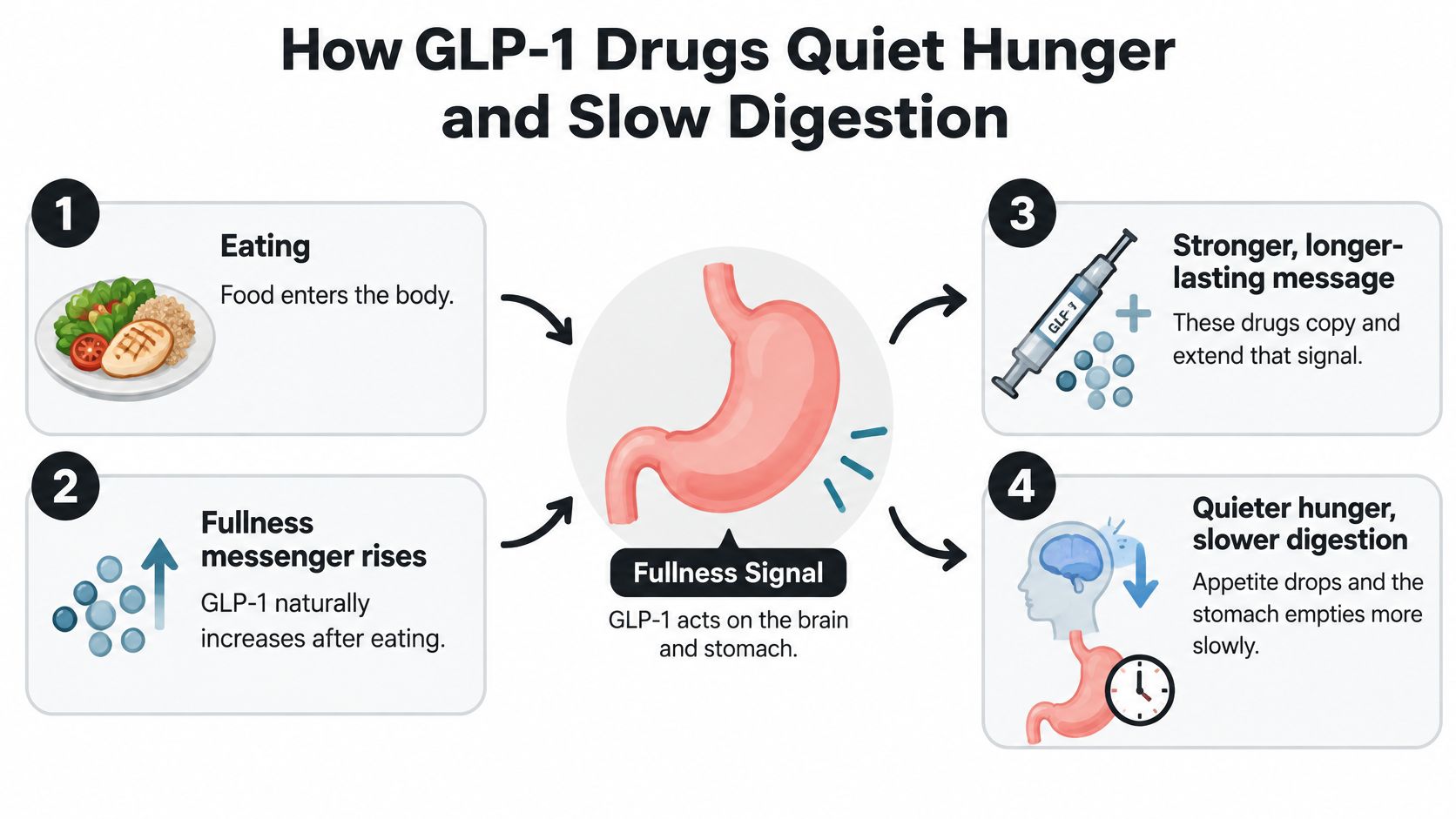
Think of GLP-1 as a fullness messenger. Your body releases it after eating, helping coordinate the response to a meal. These medications copy and extend parts of that message rather than relying on a short-lived signal alone.
Say you normally finish lunch and start thinking about snacks soon afterward. With treatment, the change might be less dramatic than feeling constantly full: you may reach a comfortable stopping point earlier and spend less time thinking about the next thing to eat.
- Food arrives in the gut. After a meal, the gut releases GLP-1, which helps signal that nutrients have arrived.
- The medication activates GLP-1 receptors. Its effects on appetite-regulating pathways can reduce hunger and make food cravings less persistent.
- Stomach emptying slows. Food can remain in the stomach longer, contributing to fullness. This effect isn't identical in every person or constant throughout treatment.
- Eating patterns change over time. Smaller portions and fewer unplanned snacks can support a sustained calorie deficit.
Why tirzepatide belongs to a related class
Semaglutide is a GLP-1 receptor agonist. Tirzepatide activates both GLP-1 and GIP receptors, making it a dual-receptor medication rather than a stronger version of semaglutide.
GIP is another hormone involved in the body's response to food. Its role includes glucose regulation and interactions with appetite pathways, so describing it only as an extra fullness switch oversimplifies the biology.
These drugs don't burn fat directly; they change how much you eat.
Early changes may include finishing meals sooner, leaving food on the plate, or losing interest in habitual snacks. The aim isn't to make eating unpleasant or eliminate hunger completely. You should still be able to drink adequately and eat nourishing meals.
Weight Loss Results and What Drives Them
Average weight loss in key GLP-1 trials
| Trial or comparison | Drug and dose | Average weight loss | Duration |
|---|---|---|---|
| STEP 1 approval summary | Semaglutide 2.4 mg weekly | 14.9%, versus 2.4% with placebo | 68 weeks |
| SURMOUNT-1 trial summary | Tirzepatide 5 mg weekly | 15.0% | 72 weeks |
| SURMOUNT-1, same trial | Tirzepatide 10 mg weekly | 19.5% | 72 weeks |
| SURMOUNT-1, same trial | Tirzepatide 15 mg weekly | 20.9% | 72 weeks |
| Head-to-head phase 3b trial | Tirzepatide 10 or 15 mg, maximum tolerated | 20.2% | 72 weeks |
| Same head-to-head trial | Semaglutide 1.7 or 2.4 mg, maximum tolerated | 13.7% | 72 weeks |
These trials enrolled adults with obesity or overweight without diabetes. The figures describe group averages after extended treatment, not what a person should expect immediately after starting.
In STEP 1, 83.5% of semaglutide-treated participants reached at least 5% weight loss, compared with 31.1% receiving placebo, according to the approval summary linked in the table. That broader response matters because an average alone doesn't tell you how consistently participants benefited.
Why individual results spread out
The dose reached and maintained influences results, but a higher dose isn't automatically the right dose for every patient. A person who experiences substantial side effects may need a slower progression or a different maintenance plan.
Treatment duration matters too. Someone still working through the starting doses shouldn't compare their progress with a participant who completed the full trial regimen.
The trials also evaluated medication within a treatment program, not in isolation. Dietary changes, physical activity, follow-up, and continued use formed part of the approach.
- Dose exposure: Record the dose you take, not just the intended maintenance dose.
- Consistency: Tell your clinician about missed doses, supply gaps, or difficulty following the schedule.
- Nutrition: Build meals around adequate nourishment rather than trying to eat as little as possible.
- Activity: Include movement you can sustain and resistance exercise appropriate for your abilities.
- Tolerability: Report symptoms that interfere with eating, drinking, or daily functioning.
Interpret your own trend carefully
A smaller early loss doesn't establish treatment failure. Your clinician needs to consider the dose, time on treatment, adherence, symptoms, and overall health before deciding whether to continue or change direction.
Equally, the trial range isn't a personal guarantee or a minimum acceptable result. Use it to understand the scale of benefit these treatments can produce, then agree on individualized goals that include health, function, and tolerability.
Choosing Between Semaglutide and Tirzepatide
Semaglutide targets GLP-1 receptors; tirzepatide targets both GIP and GLP-1 receptors. That biological difference helps distinguish the medications, but the practical choice depends on more than receptor activity.
Tirzepatide produced greater average weight reduction in the randomized comparison summarized above. A separate 2024 U.S. real-world study found a 6.9-percentage-point greater weight reduction after 12 months among tirzepatide users, according to the American College of Cardiology's summary of the JAMA Internal Medicine study.
Real-world evidence helps show how treatment performs outside tightly managed trials. It doesn't prove that every person switching to tirzepatide will achieve an additional benefit of that size, because observational comparisons can be affected by differences between patients and their care.
Compare the prescription you can sustain
Expected weight loss is a reasonable starting point. If a larger reduction would help meet your health goals, tirzepatide's average results may make it worth discussing.
Tolerability can change the decision. A medication that produces excellent trial results isn't the better choice for you if its symptoms repeatedly interrupt treatment or prevent adequate nutrition.
Dosing form matters. Semaglutide has injectable and oral options, while the tirzepatide regimens discussed here use injections. A daily pill avoids an injection but requires a dependable daily routine and attention to its administration instructions.
Coverage and access also matter. A covered, consistently available prescription may be more workable than an otherwise appealing medication that repeatedly becomes unaffordable. Ask for the actual patient cost rather than assuming drugs in the same broad class receive the same coverage.
Choose by situation, not a universal ranking
- When greater average loss is the priority: Discuss tirzepatide if your medical history, side-effect tolerance, and coverage support it.
- When formulation preference matters: Consider whether an oral semaglutide option fits your routine better than an injection.
- When your current treatment is working: Don't assume a switch is necessary because another drug has a higher trial average.
- When medical history complicates the choice: Let the prescriber assess the full medication list, previous response, and relevant risks.
A switch also needs instructions. Don't overlap medications, reuse a previous dose, or assume milligram strengths translate directly between semaglutide and tirzepatide.
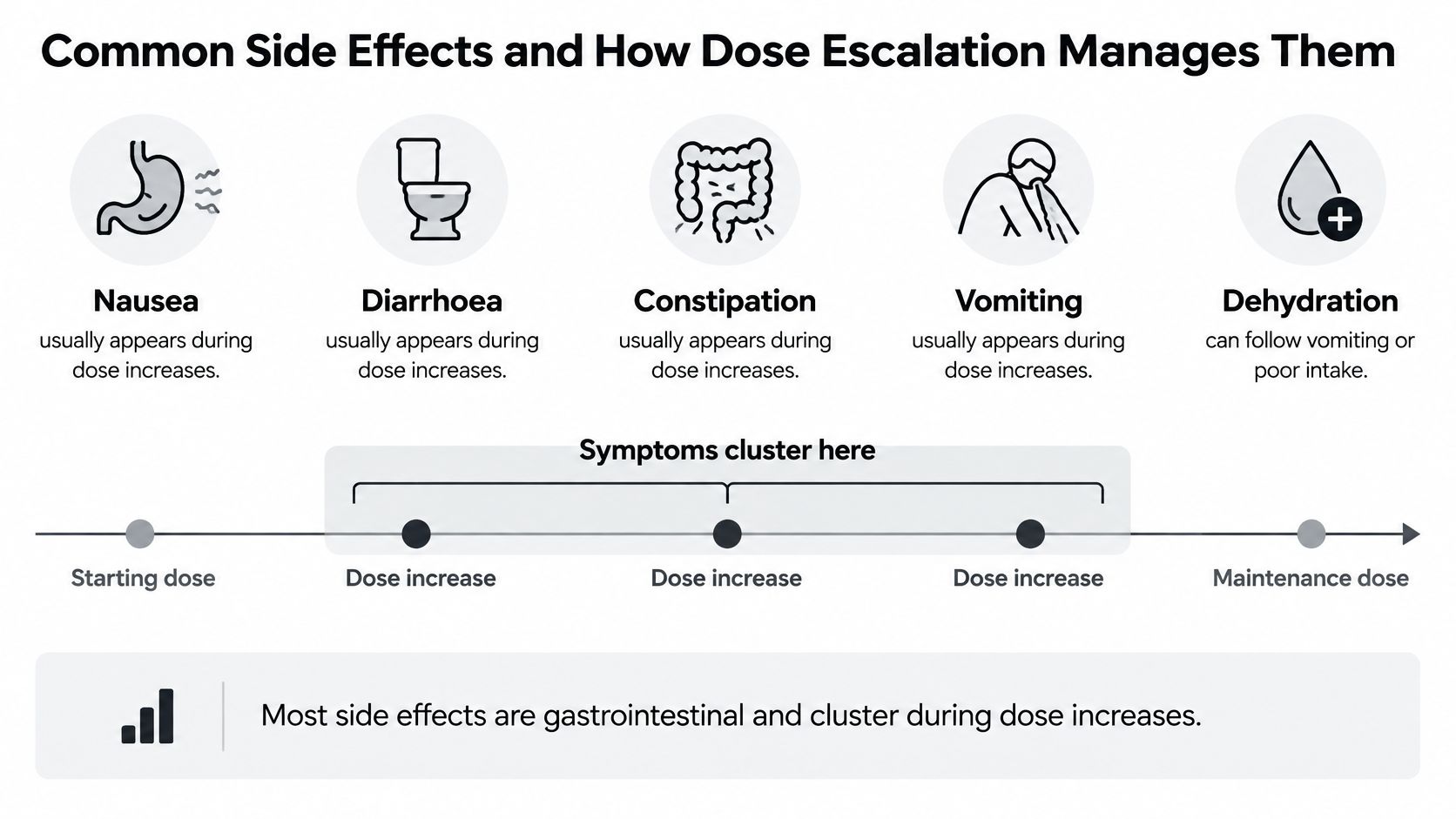
Common Side Effects and How Dose Escalation Manages Them
| Side effect | When it usually appears | What helps |
|---|---|---|
| Nausea | Often during dose increases | Smaller meals, eating slowly, avoiding greasy food, clinician-directed slower escalation |
| Diarrhoea | Can occur during escalation | Fluids, appropriate electrolyte replacement, review persistent symptoms with the prescriber |
| Constipation | Can develop as intake and digestion change | Gradually adjusted fibre, fluids, daily movement |
| Vomiting | May occur during dose increases | Small sips of fluid, avoid forcing large meals, contact the clinician if persistent |
| Dehydration | Can follow vomiting, diarrhoea, or poor intake | Regular fluids and prompt assessment if you can't keep them down |
Gastrointestinal symptoms are the main tolerability issue, especially while doses increase. The FDA's Zepbound approval announcement describes a principal obesity study with a 20-week dose-escalation period, showing that gradual escalation was part of the studied treatment design.
Increase deliberately, not automatically
- Start at the prescribed initiation dose. Starting low gives your clinician a way to assess your response before increasing exposure.
- Review tolerance before moving up. Follow the product-specific schedule and your clinician's instructions rather than increasing because appetite suppression feels less noticeable.
- Report symptoms before the next increase. Your prescriber may delay escalation or adjust treatment. Don't independently change or skip doses.
- Choose an appropriate maintenance plan. The goal is a useful clinical response with manageable symptoms, not reaching the highest dose at any cost.
Our GLP-1 titration schedule guide explains the purpose of supervised dose progression. Keep a brief record of injections, symptoms, bowel movements, and whether you can eat and drink normally.
Watch function as well as discomfort. Feeling mildly queasy after a meal is different from being unable to work, repeatedly vomiting, or drinking too little to stay hydrated.
Complete the safety screen first
Semaglutide and tirzepatide carry boxed warnings concerning thyroid C-cell tumours. They must not be used by people with a personal or family history of medullary thyroid carcinoma or multiple endocrine neoplasia syndrome type 2. Tell the prescriber exactly which thyroid condition you or a relative had, because not every thyroid diagnosis means the same thing.
Discuss previous pancreatitis, gallbladder disease, significant digestive problems, and pregnancy plans before starting. These medications aren't recommended during pregnancy, and planning a pregnancy requires advance medication guidance.
Seek prompt medical attention for persistent vomiting, inability to keep fluids down, or severe abdominal pain. Persistent upper abdominal pain, particularly with jaundice or fever, needs urgent assessment rather than being dismissed as routine nausea.
Who Qualifies and How to Get Prescribed
Our eligibility criteria require a BMI of 30 or higher, or a BMI of 27 or higher with qualifying comorbidities. Examples of weight-related conditions include high blood pressure, diabetes, and sleep apnoea, but a licensed clinician determines whether your particular history supports treatment.
BMI is a screening measure, not a complete medical assessment. Meeting the threshold doesn't mean a prescription is automatically appropriate, and it doesn't remove the need to review contraindications or other medications.
What the medical review covers
Our review begins with a detailed medical questionnaire covering:
- BMI: Your current height and weight help establish the initial eligibility assessment.
- Pre-existing conditions: Include diagnosed conditions and symptoms that haven't yet been fully evaluated.
- Current medications: List prescriptions, nonprescription medicines, and supplements.
- Prior GLP-1 use: Record the product, formulation, doses, dates, response, and reason for stopping.
- Contraindications: Provide relevant personal and family medical history rather than assuming the clinician already has it.
Prepare photographs of prescription labels if you're unsure about medication names or strengths. For past GLP-1 treatment, the date of your last dose is particularly useful.
Our GLP-1 eligibility guide can help you organize the information needed for review. Accurate answers make it easier for the clinician to distinguish a new start from a restart or a proposed switch.
Restarting and using telehealth
A treatment gap changes the assessment. Don't assume that a dose you tolerated previously is still appropriate after time off medication.
Under our restart process, patients who have been off GLP-1 medication for more than three months begin two steps below their reported dose. That's a program-specific process, not a universal instruction for every product or patient; the clinician must confirm the actual regimen.
Telehealth allows the medical review and consultation to happen remotely. A licensed clinician still needs to assess suitability, explain the prescription, and establish follow-up rather than treating an online questionnaire as automatic authorization.
At Weight Method, our clinicians determine eligibility from medical history and provider assessment. Come prepared to discuss your goals, your concerns about side effects, and what you can realistically sustain financially and practically.
What GLP-1 Medications Cost and How Coverage Works
There are two main payment routes: insurance and self-pay. For either route, price the ongoing treatment, not just the introductory dose or an initial offer.
Insurance coverage is specific to the plan, product, and indication. Coverage for a diabetes medication doesn't establish coverage for a weight-management brand containing the same molecule.
- Check the formulary. Ask whether chronic weight-management medications are covered, which brands are preferred, and whether any exclusions apply.
- Prepare authorization records. If prior authorization is required, gather weight history, BMI documentation, relevant diagnoses, and previous treatment information.
- Request an itemized cash quote. Ask about each prescribed dose, pharmacy charges, consultation or membership fees, supplies, and eligibility for manufacturer savings programs.
- Budget for maintenance and interruptions. Establish what happens if coverage changes, an authorization expires, or a prescription becomes temporarily unaffordable.
Understand the financial context
U.S. prescription-drug expenditures reached $805.9 billion in 2024, up 10.2% from 2023, with GLP-1 weight-loss medications identified as a leading spending driver by the American Society of Health-System Pharmacists. Those national figures don't predict your bill, but they help explain why affordability is central to treatment planning.
Budget rule: Compare the full prescription and follow-up costs, not the lowest advertised starting price.
If coverage lapses, arrange a clinical decision rather than stretching your remaining supply. A lower-priced compounded product also requires a separate quality and legal assessment; price alone doesn't establish equivalence to an approved medication.
Compounded Versus FDA-Approved GLP-1 Products
Compounded and FDA-approved products aren't automatically interchangeable. Compounded doesn't mean counterfeit, but it does mean the product hasn't undergone the same FDA review for safety, effectiveness, and manufacturing quality as an approved drug.
The FDA's warning about illegal imported GLP-1 ingredients highlights the importance of ingredient quality and legitimate supply channels. The agency has also identified concerns involving compounded formulations, including dosing errors, unapproved salt forms, and adverse events.
Shortage-related permissions aren't permanent authorization to compound copies of approved drugs. Whether a particular prescription may legally be compounded requires a current, patient-specific assessment; an old shortage explanation isn't enough.
Verify what you're receiving
Before using a compounded prescription, check:
- Pharmacy identity and licence: Confirm the dispensing pharmacy's name, address, state licence, and any claimed accreditation.
- Ingredient and form: Read the exact active ingredient and ask whether the product uses a salt form.
- Concentration: Identify the strength in milligrams per millilitre. A different concentration can change the volume needed for the prescribed dose.
- Syringe instructions: Obtain written directions that match both the prescription and the syringe supplied.
- Storage and sterility information: Check handling instructions, beyond-use information, and what to do if packaging arrives damaged or storage conditions are uncertain.
- Clinical responsibility: Know who prescribed the medication and whom to contact before injecting if anything is unclear.
A syringe's unit markings measure volume, not the medication's mass. Instructions copied from another patient, another vial, or a previous shipment may therefore be wrong for the product in your hand.
Our compounded versus brand-name GLP-1 guide explains the distinction in more detail. A pharmacy's licence is important, but it doesn't make each compounded preparation FDA-approved.
Handle discrepancies before dosing
Avoid social-media sellers and unverified foreign sources. A persuasive label, familiar ingredient name, or claim of laboratory testing doesn't replace a legitimate prescription and accountable dispensing pharmacy.
If the concentration, appearance, or syringe directions differ from what you expected, don't inject until the pharmacist and prescriber resolve the discrepancy. Don't calculate a replacement dose from an online conversion chart.
Report suspected adverse events to your clinician and through the FDA's MedWatch reporting process. Keep the packaging, prescription label, and dosing instructions so the product and circumstances can be identified.
Decide Whether GLP-1 Treatment Fits Your Plan
Nearly 30% of participants discontinued semaglutide in SELECT, while real-world studies estimate 50–75% discontinuation within 12 months, according to a JAMA review of GLP-1 treatment discontinuation. The review also describes rapid weight regain and worsening cardiometabolic measures after stopping semaglutide or tirzepatide.
That makes chronic treatment planning more useful than thinking in terms of a short course. The question isn't just whether you can lose weight, but how you'll manage treatment when your health, tolerance, finances, or preferences change.

Choose a deliberate next step
- Continue: Staying on the current regimen may make sense when it supports your goals, symptoms are manageable, and access is sustainable. A weight plateau alone doesn't establish that treatment has stopped helping.
- Adjust: Your clinician may consider a different maintenance approach if tolerability becomes a problem. A lower dose isn't automatically appropriate or equally effective, so the decision needs follow-up.
- Pause: A planned interruption should include nutrition, resistance training, sleep, and monitoring. Agree on when to reassess hunger, weight changes, and relevant health measures.
- Switch: Another medication may be reasonable if response, coverage, or tolerability changes. Get explicit instructions for timing and the new starting regimen.
Planned discontinuation differs from accidentally missing an injection. Both need product-specific guidance, but a planned stop also requires a strategy for the return of hunger and for monitoring your health.
Build an off-ramp before you need it
Evidence on the best tapering method remains limited. Don't stretch intervals or stop independently in the hope that a particular schedule will permanently preserve the medication's effects.
An individualized decision to stop can still be reasonable. The important distinction is between a supervised transition and losing access without a plan.
Take our 2-minute quiz to see whether you may qualify, then discuss whether starting, continuing, adjusting, pausing, or switching fits your situation with a licensed provider.
Weight Method connects patients with licensed clinicians for GLP-1 evaluation and offers compounded medications prescribed by licensed providers and dispensed by U.S. 503A pharmacies, with direct-to-door shipping. These compounded products aren't FDA-approved. Start with the eligibility quiz and use your consultation to discuss the exact formulation, expected benefits, tolerability, and a long-term treatment plan.