You're expecting a GLP-1 injectable at home. The tracking page says it was delivered, but the parcel may have spent hours in a carrier vehicle, on a loading dock, or in a mailroom before you saw it. The box can look perfectly normal while the medication inside has experienced a temperature excursion that no visual inspection can confirm.
That's the part of medication shipping many patients never hear about. Convenience matters, but safe delivery of semaglutide and tirzepatide depends on validated packaging, route control, temperature evidence, fast handoffs, and a clear plan for damaged or delayed shipments.
The Shift to Mail-Order Pharmacy Convenience
A patient may schedule a weekly GLP-1 injection around work, family responsibilities, or limited mobility, then choose home delivery to avoid another pharmacy visit. The convenience is real, but the delivery promise has conditions. The dispensing pharmacy and carrier must protect the medication through handoffs, customs checks, vehicle storage, and the final wait at a doorstep, mailroom, or reception desk.
Consumer behavior shows why delivery has become a serious pharmacy channel. A patient survey summarized in this analysis of digital pharmacies and prescription delivery found that 56% of respondents most often filled prescriptions at a local retail pharmacy, while 24% most often received prescriptions through delivery services. At the same time, 52% preferred delivery over in-store pickup. The same source reported that 46% had used a delivery service at least once, and 41% were likely or very likely to use an online pharmacy for medication fulfillment and delivery.
Those figures show a change in patient expectations, not the disappearance of local pharmacies. Retail pickup remains common, while delivery offers continuity when a patient cannot easily reach a store or repeatedly check local inventory. For weekly injectable therapy, that convenience depends on more than a tracking number. A delayed customs release or missed last-mile handoff can expose the parcel to uncontrolled conditions before the patient receives it.
From remote access to routine fulfillment
Mail-order pharmacy also has a long history. An RXSS account of mail-order development, this history of mail-order pharmacy development, notes that prescriptions have been mailed in the United States for more than a century. The first pharmacy dedicated to mailing prescription drugs opened in 1946 to serve veterans, while for-profit mail-order services were marketed to corporate, government, and union employers by 1963. The 1980s brought the fastest growth phase.
The use case has broadened since then. Early services helped reach patients who lived far from conventional pharmacies. Employer benefits, veteran care, chronic disease management, and digital prescribing later made mail order part of routine medication distribution.
Convenience creates a stricter logistics obligation
A local pharmacist can often identify a dispensing or product issue at the counter. A mail-order patient may not know whether the parcel waited in a hot vehicle, sat in an import facility, or arrived with the wrong dose. Responsibility therefore shifts toward the fulfillment operation and its documented handoff process.
Before choosing an online pharmacy, confirm that it requires a prescription, identifies the dispensing pharmacy, provides access to a pharmacist, and supplies shipment tracking. For GLP-1 injectables, ask how the pharmacy handles customs delays, missed delivery attempts, damaged packaging, or a temperature deviation. Patients comparing options can also review our guide to semaglutide injection online to understand what remote evaluation and fulfillment involve. A polished checkout experience does not prove that the shipment remained controlled.
Understanding Cold-Chain Thermal Excursion Limits
A refrigerator and a shipping system solve different problems. A refrigerator maintains a relatively stable environment in one location. A shipper must protect the medication through packing, pickup, sorting, vehicle transport, delivery, and the time before the patient brings it indoors.
A thermal excursion occurs when the product experiences temperatures outside its validated range or beyond its permitted exposure profile. For temperature-sensitive medication, both excessive heat and excessive cold can matter. A package can arrive cold to the touch and still lack the evidence needed to show that the medication remained within its approved conditions throughout transit.
The labeled range isn't a shipping permission
FDA stability guidance requires evidence in the intended container and packaging system. That means the formulation alone doesn't establish distribution safety. The vial, pen, closure, insulation, refrigerant arrangement, and external shipper can all affect protection from temperature, light, and humidity.
For refrigerated products kept between 2°C and 8°C, the labeled storage range doesn't automatically define how long the product may remain outside that range during shipping. USP guidance distinguishes storage conditions from transport tolerances, so a pharmacy must evaluate the actual distribution route rather than assume that a refrigerator specification is also a delivery specification.
Practical rule: A shipper should be qualified for the real container-closure system, route, season, handoff pattern, and expected delay. A formulation that is stable in a refrigerator isn't automatically stable inside an unqualified parcel.
This is why logistics and cold chain management involves more than adding gel packs to a box. A sound program uses temperature-cycling studies, excursion-risk analysis, and route qualification. Testing should examine the conditions the parcel is likely to encounter, including delays at transfer points and exposure during final delivery.
Why dwell time matters
USP shipping guidance says that when a vehicle lacks adequate heating or air conditioning, exposure to ambient conditions should be limited, ideally to no more than 2 hours. Controlled-room-temperature products are typically labeled for 20°C to 25°C, with permitted excursions between 15°C and 30°C. Brief exposure up to 40°C may be tolerated only when the mean kinetic temperature remains within 25°C. These figures illustrate why a shipping team must qualify the lane instead of relying on an average delivery estimate. (USP shipping guidance)
A delayed parcel accumulates risk at every uncontrolled stage. The right response isn't to guess whether the medication is still usable. The pharmacy or prescriber should review the temperature evidence and apply the product-specific disposition procedure.
Patients looking for broader handling guidance should also understand the difference between an expiration date and a distribution excursion. A date on the label doesn't confirm that a product exposed to unacceptable conditions remains suitable. The medication expiration date guidance helps separate those two questions.
Anatomy of Validated Refrigerated Packaging
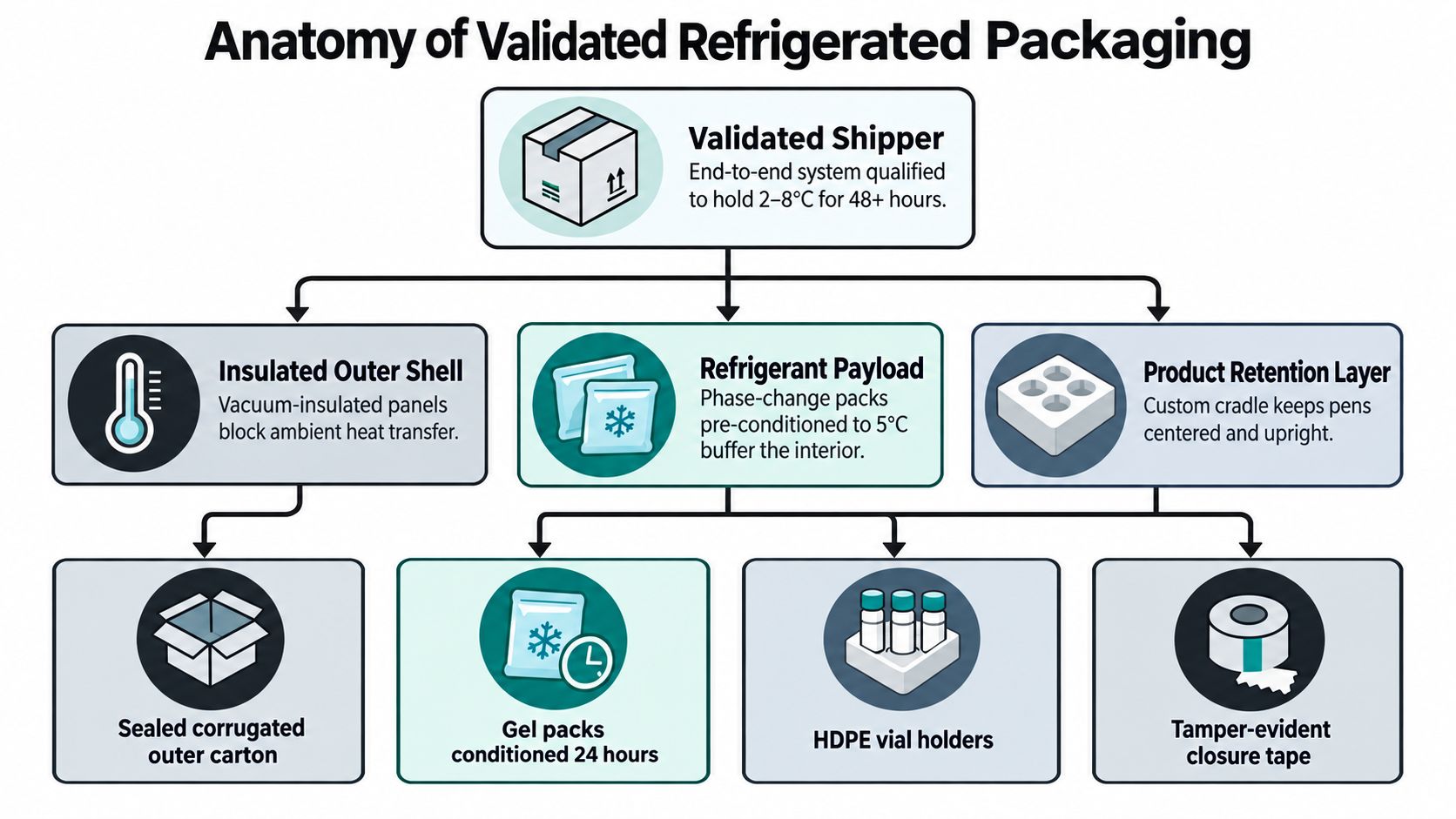
A validated refrigerated shipper is a system, not a box with frozen contents. Each part has a defined job, and the arrangement must be tested as a complete unit. Changing the liner, coolant, product holder, closure, or carrier service can change the thermal result.
What belongs inside the system
The outer carton protects the contents from compression, punctures, and ordinary handling. Inside, an insulation layer slows heat transfer. This may include a molded foam structure, vacuum-insulated panel, or another qualified barrier. The insulation doesn't create cold by itself. It buys time while the refrigerant payload manages the interior temperature.
Phase-change materials or gel packs must be conditioned consistently before packing. Their placement matters because direct contact can create a freezing risk, while poor spacing can leave warm zones around the medication. A product retention layer keeps pens or vials stable and away from the carton walls, where shocks and temperature changes may be more pronounced.
The closure completes the physical control. Sealed tape, tamper-evident materials, and a clear packing configuration help the pharmacy identify interference or damage during handoffs. They don't replace temperature monitoring, but they support chain-of-custody review.
Why packaging must match the route
FDA stability guidance requires stability evidence in the intended container and packaging. A pharmacy therefore shouldn't validate one shipper in one route and assume the result applies to every destination. A short urban delivery, a rural route, and a shipment crossing multiple carrier hubs present different dwell and handling conditions.
A practical qualification program measures maximum and minimum temperatures through the full route. It tests the likely worst case, not only a successful delivery on a mild day. The team then selects packaging size, refrigerant quantity, conditioning procedure, and service level together.
The package should be designed around the longest credible transit window, not the shortest advertised one.
Patients can use the packaging as an information source. Look for a temperature strip or data logger, instructions for storage, and a contact route for reporting damage. If the shipper contains a product cradle, don't discard the medication inside it until you've checked the label, the indicator, and the product itself.
Comparing Standard Priority and Freight Methods
Shipping speed is only one part of the decision. A fast service can still fail if the parcel waits at a handoff, arrives after the patient leaves home, or travels in packaging that wasn't validated for the route. A slower service may work for a properly qualified lane, but it leaves less margin for delay.
| Shipping Method | Transit Time | Temperature Risk | Best Use Case |
|---|---|---|---|
| Standard ground | Scheduled for routine parcel movement | Greater exposure to weekends, hub dwell, and variable vehicle conditions | Predictable domestic routes with validated packaging and reliable receiving |
| Priority air | Shorter planned journey with tighter delivery scheduling | Handoffs and missed delivery attempts still create risk | Time-sensitive prescriptions where the recipient can receive the parcel promptly |
| Specialized freight | Coordinated handling and documented chain of custody | Lower operational uncertainty when the provider controls the lane, but delays remain possible | Larger, regulated, or high-value shipments requiring managed logistics |
For a weekly injectable, the practical question is whether the service protects the medication during the entire delivery window. Continuous tracking helps the pharmacy identify a stalled parcel, but tracking alone doesn't measure temperature. A qualified shipper and a temperature record provide different forms of control.
Cost versus recovery options
Standard delivery may appear attractive because it reduces shipping expense, but a delay can create a missed dose, an investigation, and a replacement process. Priority service can reduce the time available for thermal deterioration, especially when the package is sent early enough in the week to avoid a weekend pause. Freight becomes sensible when the shipment needs controlled coordination rather than ordinary parcel handling.
The operational team should also document who can approve a reroute, where a package may be held, and what happens after a failed delivery attempt. For organizations managing carrier agreements, a recordable workflow such as secure eSignature for freight contracts can help preserve the agreed handling and escalation terms.
A patient can't control every carrier decision, but they can provide an accurate address, monitor tracking, bring the package inside quickly, and notify the pharmacy as soon as the delivery appears late or compromised.
Navigating Localized Shortages and Transit Delays
A medication can be outside a formal national shortage and still be unavailable to a particular patient. The gap may affect one pharmacy, one region, or one strength. For someone waiting for a specific GLP-1 dose, that local detail matters more than a broad supply statement.
Independent coverage reported that formal U.S. shortages of semaglutide ended in February 2025 and tirzepatide ended in December 2024, while pharmacy-level gaps continued for particular strengths and regions. It identified ongoing pressure around Wegovy 1.7 mg and 2.4 mg and Zepbound 12.5 mg and 15 mg. The same coverage projected that, in 2026, prescription mail orders could lengthen from about five days to nearly two weeks (GLP-1 shortage coverage).
In stock doesn't always mean ready to ship
A pharmacy's inventory status may refer to a product somewhere in its network, not medication assigned to your order. The prescription may still require dose verification, dispensing, pharmacist review, packing, carrier pickup, and delivery. Each handoff creates another opportunity for delay.
The precise question is: Is my exact strength allocated, packed, and scheduled for delivery? Ask the provider or pharmacy to confirm the dose, expected dispatch date, carrier service, and procedure if the order cannot leave on time.
Longer transit raises the stakes
A longer route gives the refrigerated shipper more time to protect the medication. It also creates more exposure to heat, cold, carrier storage, missed handoffs, and weekend or holiday pauses. For cross-border orders, customs clearance can add a hold before the parcel reaches the local delivery network, even when the pharmacy released it on schedule.
The last mile deserves particular attention. A parcel may move normally through the main carrier network, then sit at a depot, await a delivery attempt, or remain outside during a final handoff. Tracking shows movement, not product temperature. If updates stop or the delivery appears late, contact the dispensing pharmacy rather than waiting until the scheduled injection has passed.
Ask about the exact dose and the actual dispatch status. “Available” is not the same as “in a validated shipper on its way to you.”
Do not change a dose, substitute a product, or restart treatment based only on a shipping delay. Contact the prescribing provider for clinical instructions and the pharmacy for fulfillment and temperature questions.
Patient Protocols for Safe Receipt and Storage
The safest patient response begins before delivery. Watch the tracking page, choose an address where someone can receive the parcel, and avoid sending a temperature-sensitive prescription to a location where it may remain unattended. If you already know you'll be away, contact the pharmacy before dispatch to discuss the address or delivery plan.
Use a deliberate receiving sequence
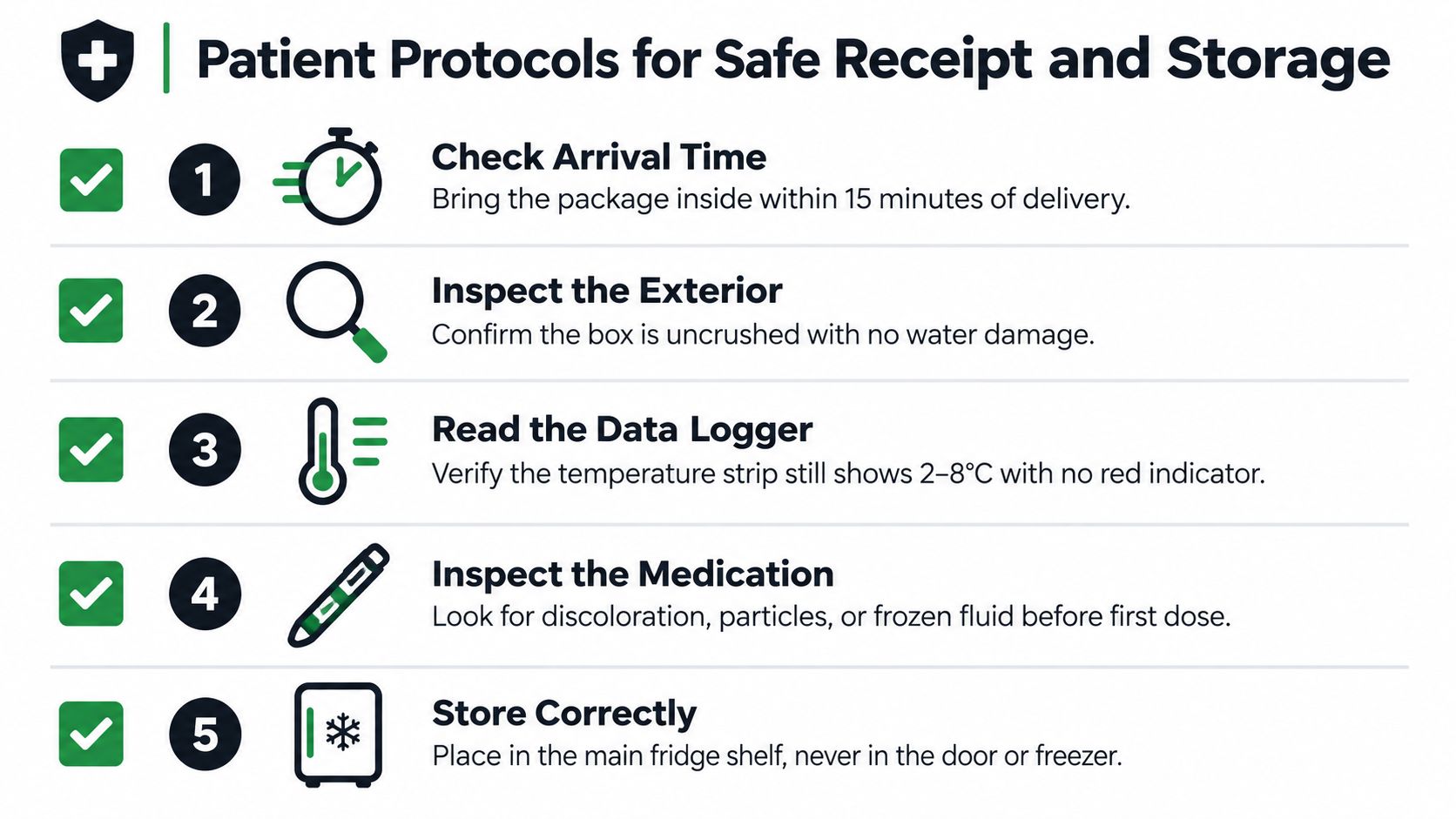
Bring the package indoors promptly. Then work through the external and internal checks before placing the medication into storage.
- Check the arrival condition. Note whether the carton is crushed, wet, punctured, or open. Photograph visible damage before you move or discard anything.
- Review the temperature evidence. Find the indicator or data logger and follow the pharmacy's instructions. A missing, triggered, unreadable, or contradictory indicator requires a call to the dispensing pharmacy.
- Inspect the medication. Check the label, patient name, dose, lot information, and expiration information. Look for unexpected discoloration, particles, leaks, or a damaged pen.
- Move it to the refrigerator. Use the main shelf rather than the door, where temperatures fluctuate more. Keep the medication away from the freezer compartment and from surfaces that may cause freezing.
- Keep the packaging until cleared. The carton, coolant, logger, and labels may help the pharmacy investigate a delay or approve a replacement.
A cold pack that still feels chilled doesn't prove that the medication stayed within its required range. Likewise, a warm-feeling pack doesn't by itself determine whether the product must be discarded. Temperature devices and pharmacy review are more reliable than touch.
Know when to stop and call
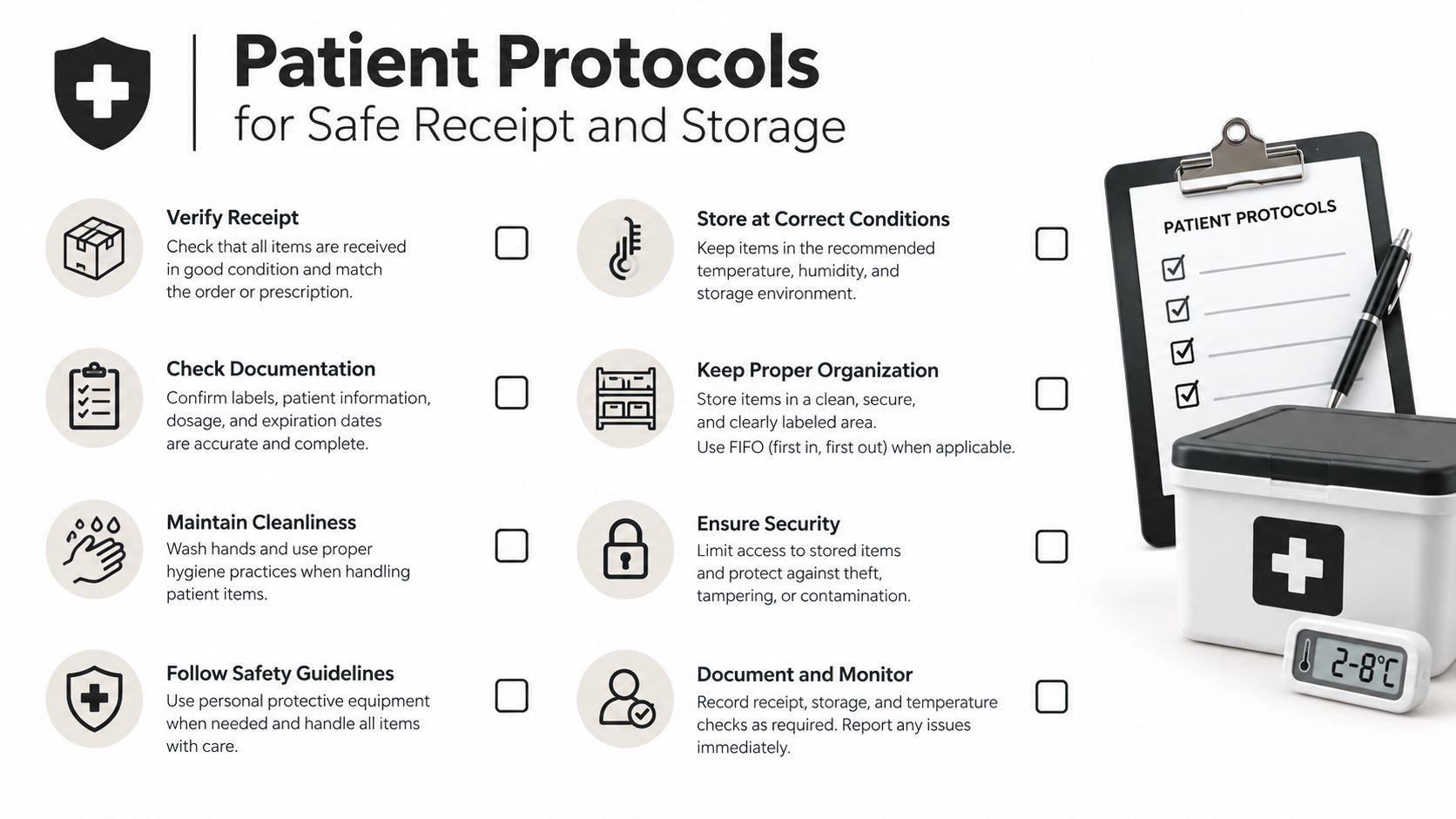
Don't inject medication if the package is materially damaged, the temperature indicator shows an excursion, the product may have frozen, or the label doesn't match the prescription. A frozen or overheated product may not show obvious physical changes, so visual inspection can't clear a questionable shipment.
For administration questions, use the provider's instructions rather than relying on an online dosing schedule. The semaglutide injection instructions can help patients review preparation and injection basics, but it doesn't replace the prescriber or pharmacist's decision about a compromised delivery.
Regulatory Compliance and Replacement Policies
Domestic medication shipping is only one part of the compliance picture. A shipment can be medically appropriate and legally dispensed yet still fail at the border, during customs review, or because the paperwork doesn't match the product and recipient.
Cross-border delivery is especially unsuitable for casual self-service ordering. Recent guidance states that, starting October 22, 2026, FDA-regulated mail shipments can no longer use the simplified postal entry process and must move through an ACE/PGA data workflow. Personal-use imports still require prior notice, and controlled drugs have no personal-use exception for mail or courier shipment. (Cross-border GLP-1 supply-chain guidance)
Customs can be the critical failure point
A product may be legally shippable in principle but delayed because customs needs documentation, the declared information is incomplete, or the destination rules differ from the sender's assumptions. Border screening can interrupt a temperature-controlled route at exactly the point where the shipper has the least control over dwell time.
Patients considering an international or lower-cost mail-order option should ask:
- Product status: Is the medication prescription-only, restricted, or controlled in the destination country?
- Importer responsibility: Who handles prior notice, customs data, and any required authorization?
- Temperature ownership: Who investigates an excursion during customs storage?
- Replacement authority: Will the pharmacy replace a parcel held or rejected at the border?
- Clinical continuity: What happens if the medication doesn't arrive before the next scheduled dose?
A parcel that clears customs isn't automatically safe. The provider must still confirm that the product's storage and transport conditions remained acceptable.
Replacement policies should be written clearly
A responsible telehealth or pharmacy program should explain what happens when a package is lost, damaged, delayed, or exposed to unacceptable temperatures. Look for a defined contact channel, a response process, and instructions not to use questionable medication while the pharmacy investigates.
Tracking should protect privacy as well as visibility. Patients should receive shipment updates without unnecessary disclosure of sensitive medical information. Packaging can support this process through tamper evidence and clear chain-of-custody signals. For an example of the physical packaging approach, see this overview of tamper evident pharmacy bags UK.
A safe program doesn't ask the patient to make a stability determination from appearance alone. It records the shipment, reviews available temperature evidence, coordinates with the prescriber when treatment timing is affected, and provides a documented outcome.
Weight Method connects eligible adults with licensed provider evaluation, ongoing care support, and semaglutide or tirzepatide delivery through its telehealth program. If you want a medically supervised option that includes home delivery and support around receiving your prescription, visit Weight Method to begin the evaluation.