Branded semaglutide injections have settled near $499 per month for many uninsured buyers, while manufacturer direct-cash offers can start at $199 for the first two fills of starter doses. Your real semaglutide injections cost depends on the product, dose, month of treatment, insurance status, and purchasing channel.
That's the part most price guides miss. A single monthly sticker price can make treatment look affordable at the beginning and unsustainable after dose escalation. If you're budgeting for semaglutide, the useful question isn't only “What does it cost?” It's “What will I pay in month one, month three, and after I reach the dose I'm expected to maintain?”
What Semaglutide Injections Actually Cost in 2026
The sharpest way to understand semaglutide pricing is to compare what patients pay with what the medication could theoretically cost to produce. An independent cost-plus analysis estimated that generic injectable semaglutide could be produced and sold for about $28 to $140 per person-year by the end of 2026, while current U.S. net prices for obesity GLP-1 medications sit around $8,000 to $9,000 annually, and some direct-to-consumer cash prices are near $499 per month. The analysis makes clear that formulation, packaging, taxation, distribution, and profit margins all sit between the active ingredient and your final bill. Read the independent cost-plus analysis of semaglutide pricing
For many uninsured buyers, branded injectable cash prices have settled near $499 per month. At the same time, manufacturer direct-cash programs can reduce the initial price to $199 for the first two monthly fills of certain starter doses. That creates a pricing ladder rather than a dependable monthly rate.
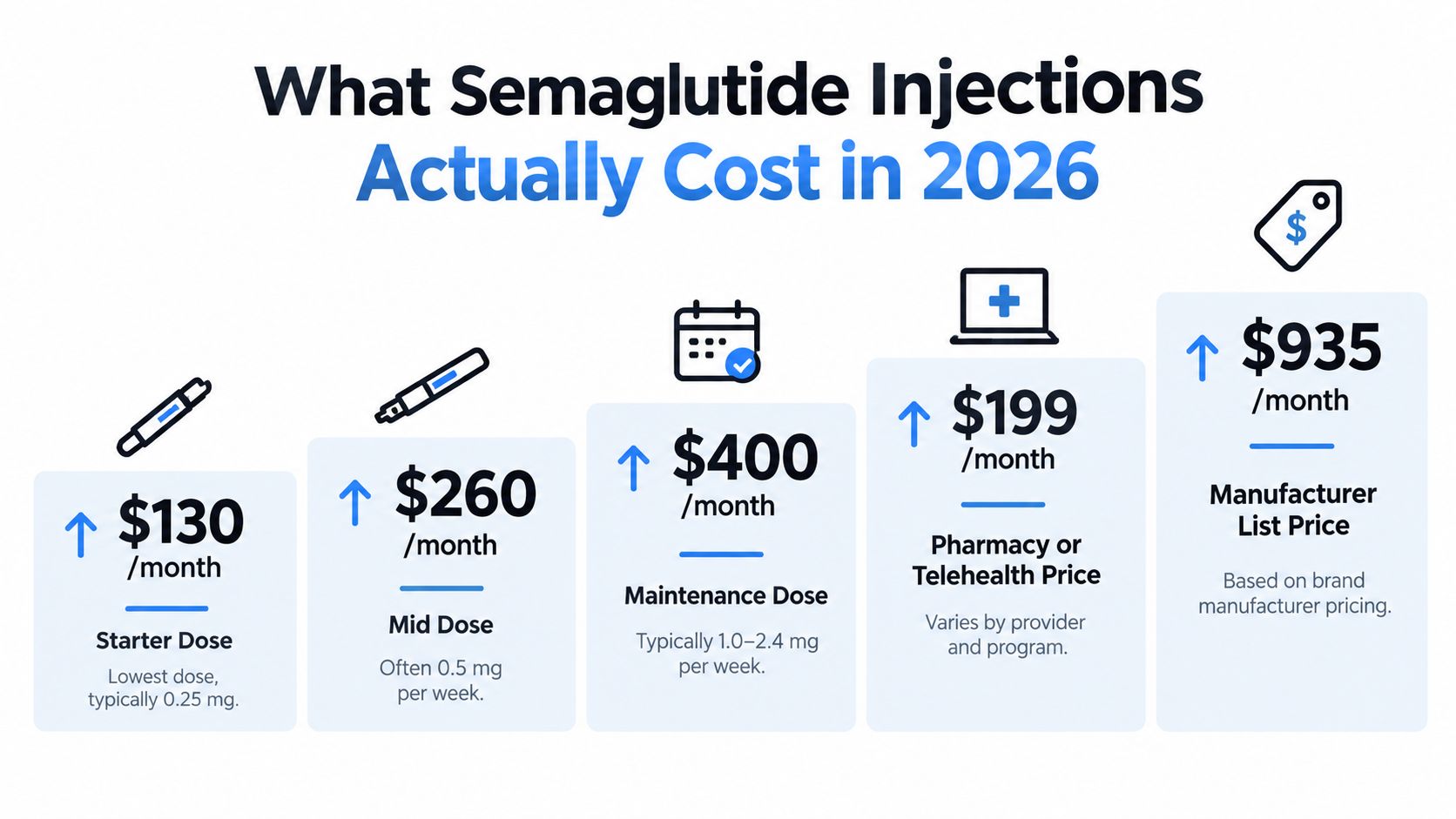
The old list-price answer is incomplete
Older articles often anchor their answer around list prices of roughly $1,027.51 for Ozempic and $1,349.02 for Wegovy. Those figures still matter as reference points, but they don't describe every current cash-buying route. Manufacturer programs and direct-to-consumer channels have changed the amount some patients see at checkout.
The shortage transition also changed the conversation. The FDA shortage resolution and semaglutide pricing transition were reported alongside the phaseout of compounded copycat versions in spring 2025 and branded cash prices settling around $499 per month for many uninsured buyers.
Practical rule: Don't build your budget around the cheapest introductory fill. Build it around the highest dose your prescriber expects you may need, then confirm whether the offer survives dose escalation.
The practical answer is simple. Month one may be an introductory cash price, month three may be a standard mid-dose price, and maintenance may carry the largest recurring bill. A useful breakdown of GLP-1 weight-loss costs should help you compare the full path rather than one attractive starting number.
Why Semaglutide Costs So Much
The active ingredient is only one part of the bill. Think of semaglutide pricing like a cake: the flour matters, but it doesn't explain the cost of the finished product. Formulation, sterile manufacturing, injection-device components, packaging, quality controls, distribution, pharmacy handling, taxes, and commercial margins can all add to what a patient ultimately pays.
That doesn't mean every fee is unreasonable. Injectable medicines require reliable production and controlled handling. It does mean the ingredient's manufacturing cost alone can't explain the price difference between countries or purchasing channels.

The cost stack behind the syringe
A patient's bill can include several layers:
- Active ingredient: The semaglutide molecule is the therapeutic component, but it isn't the entire finished product.
- Formulation and sterile production: Manufacturers must turn the ingredient into a consistent injectable medicine.
- Device and packaging: Pens, cartridges, labels, cartons, and shipping materials contribute to the product cost.
- Distribution and dispensing: Wholesalers, pharmacies, storage, and dispensing operations add separate commercial layers.
- Commercial margin: Manufacturers and other participants in the supply chain price for research recovery, operations, and profit.
A peer-reviewed estimate found that a 30-day subcutaneous semaglutide course ranged from $804 in the United States to $95 in Turkey, with an estimated minimum efficient price of about $40 per month. Review the reported international semaglutide price comparison
That spread is the important lesson. The same therapy can carry a radically different price depending on procurement, market exclusivity, local policy, and distribution. Insurance can change the patient's share again, but it doesn't erase the underlying pricing structure.
What this means for your decision
You can't negotiate the chemistry in the pen. You can compare channels, contracts, cash programs, and included services.
A pharmacy purchase may separate the prescription, clinical visit, dispensing, and delivery costs. A telehealth model may combine some of those services into a recurring program charge. Neither route is automatically cheaper for every patient. The right comparison is the complete monthly bill, not the medication line alone.
Ask for the total amount before treatment begins, including provider visits, laboratory requirements, shipping, dose changes, cancellation rules, and refill policies. A low medication quote becomes less useful if several additional charges appear later.
Brand Pricing From Starter Dose to Maintenance
Brand pricing changes as the dose changes, and that is where many household budgets get caught. Novo Nordisk's current direct-cash structure lists Ozempic at $199 for the first two monthly fills of 0.25 mg or 0.5 mg for new patients. After that introductory period, the listed cash price is $349 for 0.25 mg, 0.5 mg, or 1 mg, and $499 for 2 mg. Check the current Ozempic and Wegovy cash-pricing details from Novo Nordisk
Wegovy follows a different structure. Its self-pay price is $349 per month for injection doses, while the first two monthly fills of 0.25 mg or 0.5 mg are listed at $199 through December 31, 2026.
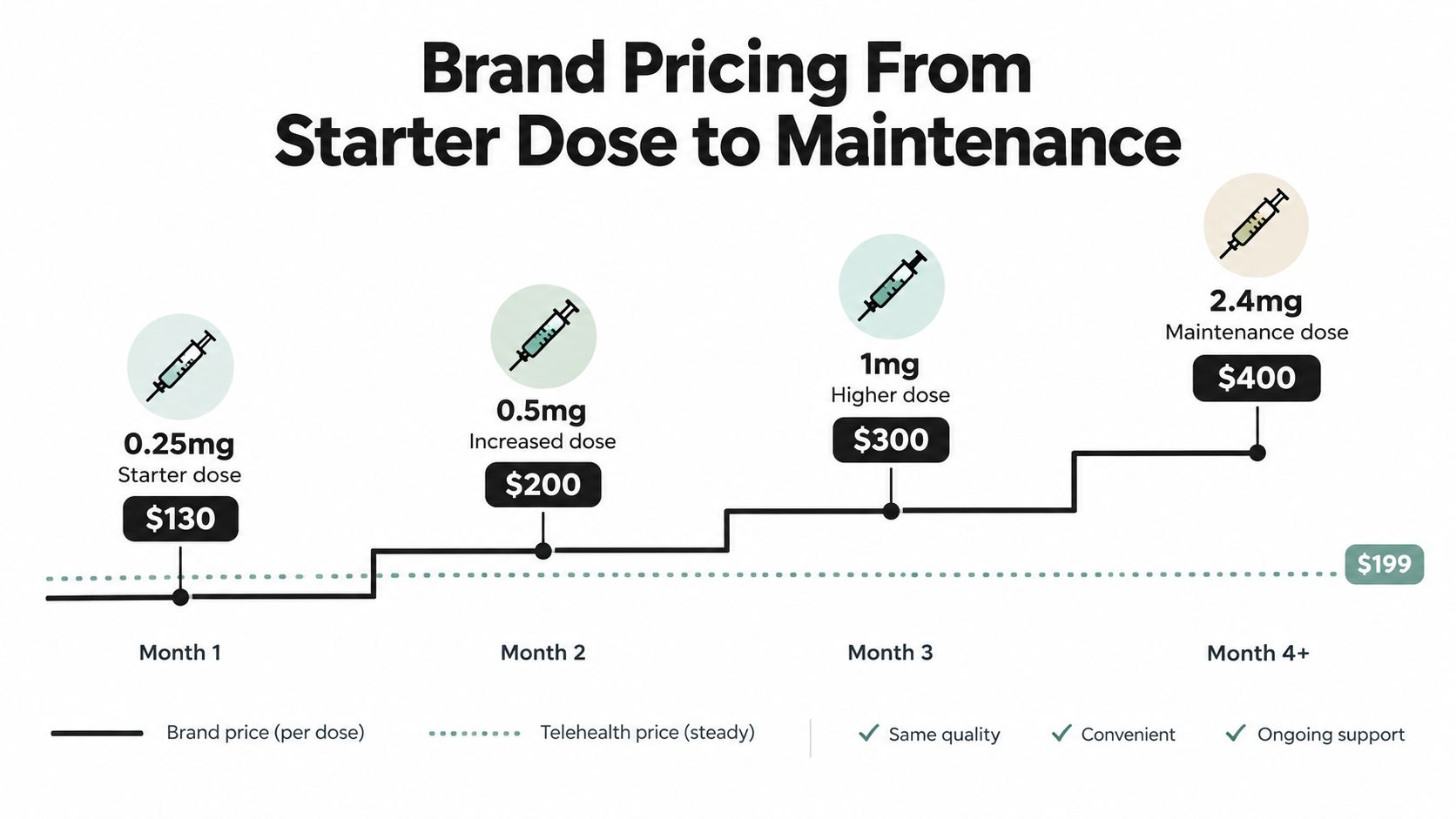
The dose ladder matters more than the teaser
Use the cash structure as a planning ladder:
| Treatment stage | Ozempic direct-cash price | Wegovy self-pay price |
|---|---|---|
| First two fills at eligible starter doses | $199 | $199 |
| Ozempic 0.25 mg, 0.5 mg, or 1 mg after the offer | $349 | Not listed in the same Ozempic offer |
| Wegovy injection doses | Not applicable | $349 |
| Ozempic 2 mg | $499 | Not applicable |
The key budgeting problem is the reset after the first two fills. A patient who begins at $199 can move to $349 at a common Ozempic dose, or to $499 at the Ozempic 2 mg dose. That means the recurring bill can approach two and a half times the introductory price, depending on product and dose.
The exact treatment schedule belongs to the prescriber. Don't increase a dose just to chase a price comparison, and don't assume that Ozempic and Wegovy are interchangeable products for your diagnosis. The financial question is separate from the clinical question, but both need an answer before you fill the prescription.
Budget by the expensive month
For a cash-pay plan, write down three figures before starting:
- Starter cost: What will the first two eligible fills cost?
- Escalation cost: What will the product cost after the introductory period at the dose your clinician expects?
- Maintenance cost: What happens if you reach the higher dose listed by the manufacturer?
That exercise prevents a common mistake: treating a promotional starter rate as the long-term cost. The right budget is based on the recurring maintenance amount, not the cheapest month on the schedule.
How Insurance Changes What You Pay
Insurance sits between the list price and your bank account, but it doesn't produce one universal answer. Your plan may evaluate the drug differently depending on whether the prescription is for diabetes management, chronic weight management, or another approved indication. The same medication can be covered for one purpose and excluded for another.
Start with the insurer, not the pharmacy counter. Ask whether the exact product is on the formulary, whether prior authorization is required, whether your plan excludes weight-management medication, and which deductible or drug tier applies. Ask the representative to explain the cost after approval, not just whether the medicine is technically covered.
The questions that expose the real bill
Use this checklist when you call:
- Coverage: Is the prescribed product covered for my diagnosis?
- Authorization: Does my clinician need to submit prior authorization or documentation?
- Deductible: Will I pay the negotiated amount until the deductible is met?
- Tier: Is the medicine placed on a specialty or high-cost tier?
- Quantity: Does the plan limit fills, refills, or dose changes?
- Pharmacy: Must I use a particular specialty or mail-order pharmacy?
- Exclusions: Does the plan exclude weight-management treatment or self-administered injections?
- Appeals: What is the process if the initial request is denied?
A representative may quote a copay without explaining deductible status, or say the drug is covered without confirming the indication. Get the answer in writing through the insurer's secure portal when possible.
Manufacturer assistance has boundaries
Manufacturer savings programs can lower a commercial patient's share, but eligibility rules matter. These programs commonly distinguish between people with private employer or individual insurance and people with government-sponsored coverage. They may also have enrollment limits, product restrictions, or expiration terms.
Don't assume a coupon will apply because you saw it online. Confirm eligibility, the duration of the offer, the qualifying product and dose, and what happens when the program ends. If coverage is denied for weight management, compare the cash price with the cost of appealing the decision and the cost of a different clinically appropriate treatment.
For a broader overview of GLP-1 insurance coverage questions, prepare your plan information and prescription details before you compare providers. Insurance is worth investigating, but it shouldn't be the only path in your budget.
Telehealth Programs Versus Traditional Clinics
Traditional care usually creates separate steps and separate bills. You may pay for an office visit, obtain the prescription, take it to a pharmacy, pay the pharmacy's cash price, and handle follow-up appointments independently. That arrangement can work well when your existing clinician manages the treatment and your insurance covers the medication.
Telehealth programs use a different operating model. A licensed provider evaluates eligibility remotely, follow-up care happens online, and medication delivery may be coordinated through the program. Some programs charge a recurring fee that includes clinical support, dose management, and shipping, while others separate the consultation from the medication.
The right comparison is not “clinic versus telehealth.” It is fragmented cost versus bundled cost.
Sample monthly cost comparison
| Cost pathway | Month 1 | Typical monthly cost | What's included |
|---|---|---|---|
| Traditional clinic and retail pharmacy | Varies by visit, coverage, product, and dose | Varies by prescription and insurance | Clinic visit, prescription, pharmacy dispensing, and possible delivery charges |
| Manufacturer direct-cash program | Depends on product, starter eligibility, and dose | Changes after introductory fills | Branded medication under the manufacturer's stated cash terms |
| Bundled telehealth program | Varies by provider and promotion | Varies by contract and medication plan | Provider evaluation, follow-up care, dose management, medication, and shipping when included |
Read the contract before paying. Check whether the quoted price includes the medication itself, clinical consultations, lab work, shipping, refill requests, and dose changes. Also confirm whether a membership continues automatically and how cancellation works.
Privacy matters too. If you prefer remote care, review questions about telehealth confidentiality before sharing health information. Ask how the provider stores records, communicates with you, and handles video visits.
A telehealth program may reduce administrative friction, but a flat monthly charge isn't automatically a bargain. Compare it with the full traditional route, including travel, visits, prescription handling, delivery, and the dose you expect to use. You can also review telehealth options for weight-loss injections before choosing a provider.
Proven Ways to Lower Your Out-of-Pocket Cost
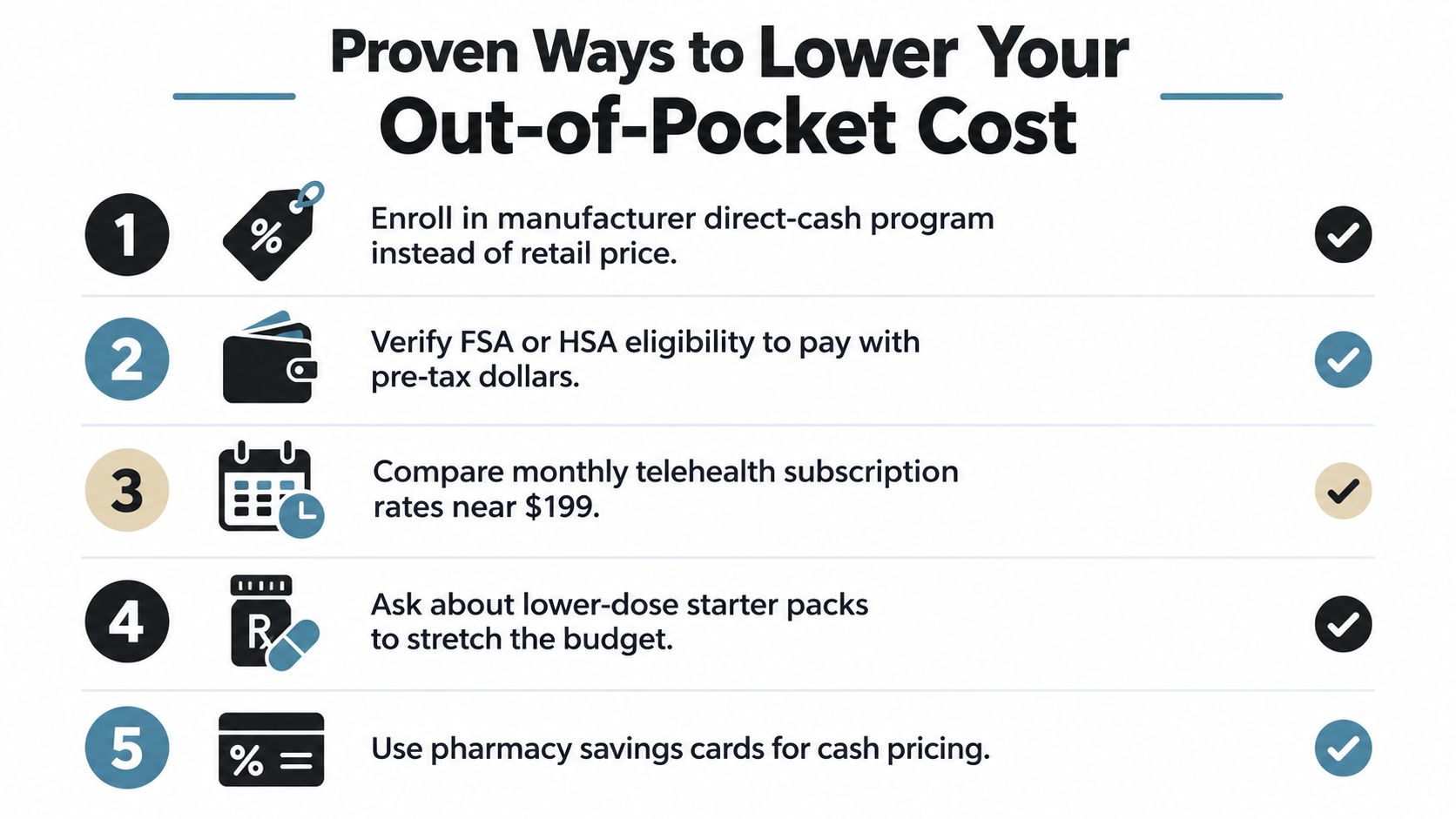
Lowering semaglutide injections cost requires stacking practical moves. No single coupon solves every situation, especially when a starter offer expires or insurance excludes the prescribed indication.
1. Use the manufacturer's cash route first
If you're eligible for a direct-cash offer, compare it with the pharmacy's undiscounted price before paying. The current branded structure can make the initial fills materially different from later fills, so record the expiration or reset point in your calendar.
2. Check pre-tax payment options
Ask your employer benefits administrator or tax adviser whether your prescription and related care qualify for FSA or HSA payment. Eligible pre-tax funds can reduce the effective burden according to your own tax situation, but eligibility depends on the expense and your account rules. Don't assume every membership fee or supplement qualifies.
3. Compare the whole program
A bundled offer can be easier to price than separate bills, but only if the bundle includes what you need. Request a written breakdown covering medication, provider access, dose changes, shipping, follow-up, and cancellation.
4. Treat promotions as temporary
A first-month promotion can help with startup costs, but it shouldn't determine whether you can continue treatment. Before accepting an introductory price, ask for the regular charge, the dose range covered, and the renewal date.
5. Verify guarantees and pharmacy discounts
If a provider advertises a money-back guarantee, read the conditions before your first purchase. Check whether the guarantee covers medication, membership, or only a defined part of the initial charge. For a retail prescription, compare pharmacy cash prices and legitimate savings cards, then confirm that the pharmacy accepts the specific card for your product and dose.
Budget test: If you can afford the starter fill but can't afford the post-promotion price, you can't yet afford the treatment plan. Ask for a sustainable alternative before you begin.
Never split doses, stretch a prescription, or change injection frequency to save money without your prescriber's approval. The safest saving strategy is a transparent price comparison, not an improvised dosing schedule.
Planning Your Semaglutide Budget With Confidence
Choose your path based on your coverage and tolerance for billing complexity.
- Commercially insured: Confirm the indication, formulary status, prior authorization rules, deductible, and final pharmacy cost. Ask what happens after approval and whether manufacturer assistance applies to your plan.
- Uninsured cash-pay: Compare the direct-cash price at your starter, mid-range, and maintenance doses. Ignore any quote that doesn't explain what you pay after the introductory period.
- Budget-focused telehealth user: Compare the full recurring charge with the traditional route. Confirm that provider oversight, dose adjustments, delivery, and cancellation terms are included.
Your budget should survive the most expensive expected month, not just the first fill. Put the recurring amount into your monthly plan alongside other automatic charges, and use a tool that helps you catch forgotten subscriptions fast so a membership or renewal doesn't remain unnoticed.
Recheck pricing before renewal. Semaglutide access has shifted since the shortage transition, and cash programs, product terms, and channel availability can change. Before ordering, complete three tasks: call your insurer, request one all-in telehealth quote, and write a realistic six-month budget using the expected maintenance price.
Weight Method offers online provider evaluation, ongoing support, dose management, and home delivery for eligible adults seeking medically supervised GLP-1 treatment. If you want one recurring-care option to compare against separate clinic and pharmacy bills, visit Weight Method and review the current pricing, medication terms, and cancellation policy before enrolling.