You've tried the meal plan, joined the gym, and promised yourself that this time would be different. Your primary-care appointment lasted barely long enough to review your medication list, yet GLP-1 ads keep appearing everywhere. You're interested, but you have no clear idea what a genuine medical program includes after you click “start.”
That uncertainty matters. A GLP-1 weight loss program isn't a weekly injection delivered to your door. You're buying a service that should include medical screening, prescribing, dose management, side-effect support, follow-up, and a realistic plan for maintenance. The medication matters, but so does the system around it.
Here's the candid version: these treatments can be powerful, but they aren't magic, they don't suit everyone, and a cheap-looking program can become expensive or unsafe when support disappears. The sections below show what the medications do, how semaglutide compares with tirzepatide, what a credible program should deliver, how eligibility works, and which questions to ask before paying.
Why GLP-1 Programs Are on Every Shortlist Now
You may be comparing a monthly price, a medication name, and a promise of fast results. That comparison misses the real purchase. A GLP-1 weight loss program is a medical service, and its value depends on the care surrounding the prescription.
The appeal is clear. Traditional weight-loss advice often asks you to tolerate hunger indefinitely, then treats regain as a personal failure when biology pushes back. GLP-1 medicines can change appetite and fullness signals, giving many patients a more manageable way to reduce food intake while they build sustainable habits.
The evidence that changed the conversation came from the STEP 1 randomized trial, published in 2021. It enrolled 1,961 adults with obesity, or overweight plus a weight-related health condition, without diabetes. Participants used once-weekly semaglutide or placebo alongside lifestyle counseling for 68 weeks. Average body weight fell 14.9% with semaglutide, compared with 2.4% with placebo, a treatment difference of 12.4 percentage points (New England Journal of Medicine).
Those results made medication-assisted weight management a serious option for people who had already struggled with conventional approaches. They also raised a practical question: what are you receiving when you enroll?
The medication is only one part of the purchase
A responsible program should answer these questions before you inject anything:
- Who evaluates you? Check the clinician's credentials and how the medical decision is made.
- How is the dose changed? Escalation should be gradual and based on your response and tolerability, not a sales target.
- Who helps with side effects? Nausea, constipation, vomiting, and excessive appetite suppression require access to clinical guidance. An unchecked message inbox is not support.
- What happens after a plateau or interruption? Ask about dose changes, follow-up, and maintenance before treatment becomes difficult.
- What exactly are you paying for? Medication, consultations, shipping, supplies, lab work, and follow-up should be clearly separated or clearly bundled.
A useful rule: if a company explains the monthly price before explaining the medical process, treat that as a warning.
Ask what clinical service you will receive and how the team will manage the entire course, not only how much weight you might lose. The next question is what these drugs change in the body, and what they do not.
What GLP-1 Actually Does Inside Your Body
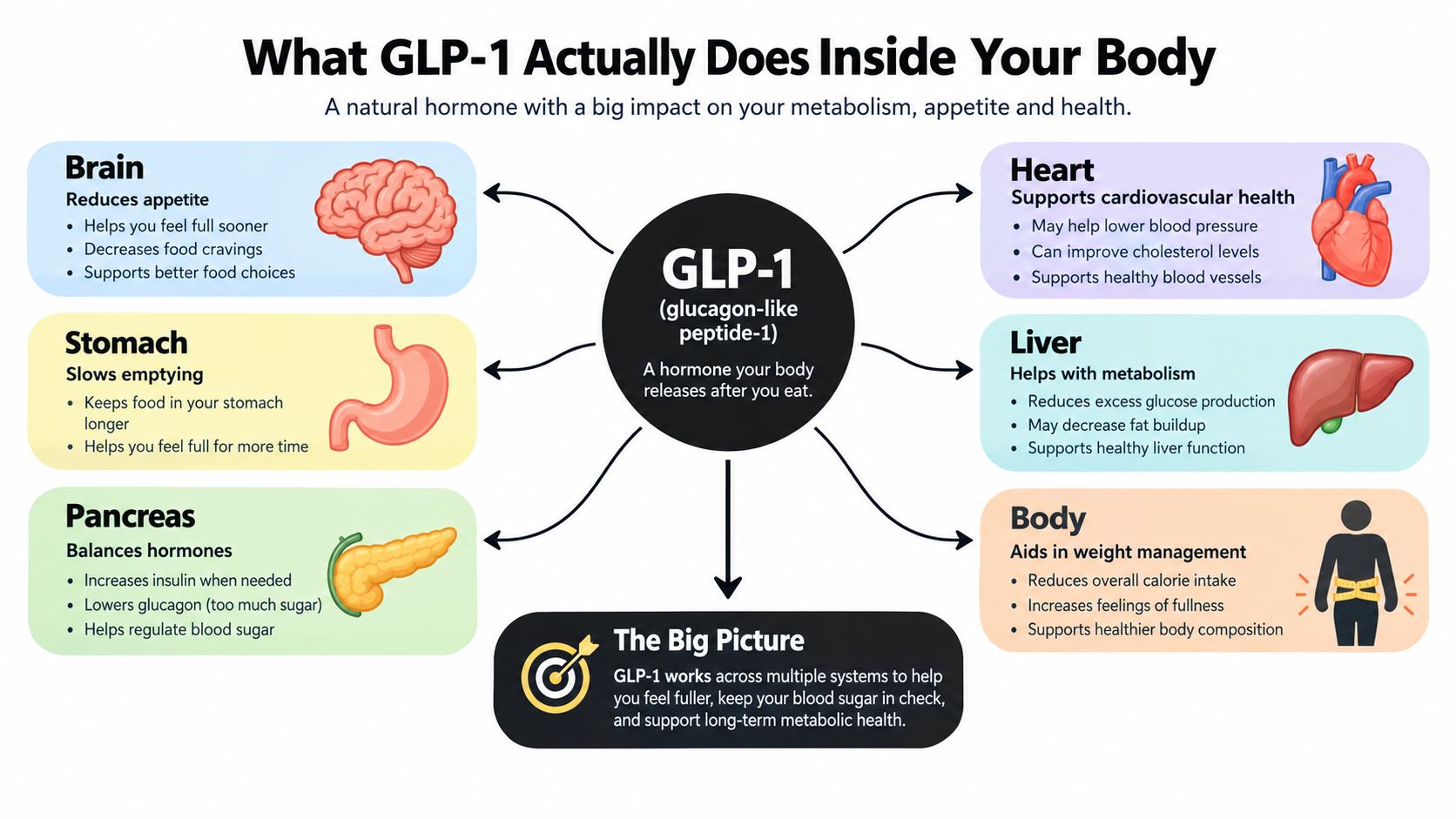
GLP-1 is a naturally occurring hormone involved in appetite, digestion, and blood-sugar regulation. A GLP-1 receptor agonist imitates part of that signal and makes it last longer. Think of your appetite like a thermostat that has been set too high. The medication doesn't burn fat by itself. It helps reset the signal that tells you how urgently and how often you need to eat.
Day to day, that can mean fewer intrusive food thoughts, less interest in large portions, and a longer stretch of fullness after a meal. The medication also slows gastric emptying, so food moves through the stomach more gradually. That effect can be useful for satiety, but it also explains why eating quickly or choosing very rich meals can trigger unpleasant gastrointestinal symptoms.
The pancreas responds to GLP-1 signaling by releasing insulin in a glucose-dependent way, while glucagon suppression helps regulate glucose output. For weight management, the practical result is usually more important than the biochemical vocabulary: you may feel less hungry, reach fullness sooner, and find it easier to maintain a calorie deficit without constant internal negotiation.
Why tirzepatide feels like a different option
Semaglutide primarily activates the GLP-1 receptor. Tirzepatide activates both the GLP-1 receptor and the glucose-dependent insulinotropic polypeptide, or GIP, receptor. That dual action influences appetite regulation, insulin secretion, glucagon suppression, gastric motility, and energy intake.
You don't need to memorize those pathways to understand the distinction. Semaglutide provides a strong appetite and satiety signal through one main receptor pathway. Tirzepatide combines two related signals, and clinical trials have shown greater average weight reduction at its higher studied doses. The trade-off is that more potent appetite suppression can also make tolerability, nutrition, and dose selection more important.
For a plain-English explanation of the biology, this guide to how GLP-1 works for weight loss offers a useful companion.
Neither medication is a stimulant, and neither works by forcing you to “try harder.” They alter the signals that influence hunger and fullness. That's why a sound program still needs nutrition guidance and monitoring. The goal isn't to make you eat as little as possible. It's to reduce appetite enough that you can eat adequately, preserve strength, and create habits you can maintain.
Semaglutide vs Tirzepatide at a Glance
The choice between semaglutide and tirzepatide affects more than the prescription. It affects dose escalation, side-effect management, follow-up, and the kind of support your program must provide. They are related medications, but they are not interchangeable products.
Semaglutide activates the GLP-1 receptor and is associated with Wegovy for obesity treatment. Ozempic is a semaglutide product used for type 2 diabetes, with different prescribing and regulatory indications. Tirzepatide activates both GIP and GLP-1 receptors. It is associated with Zepbound for obesity treatment, while Mounjaro is a tirzepatide product used for type 2 diabetes.
| Attribute | Semaglutide | Tirzepatide |
|---|---|---|
| Primary mechanism | GLP-1 receptor agonism | Dual GIP and GLP-1 receptor agonism |
| Major obesity trial | STEP 1 | SURMOUNT-1 |
| Trial duration | 68 weeks | 72 weeks |
| Average trial weight reduction | 14.9% with semaglutide, compared with 2.4% with placebo | 16.0% at 5 mg, 21.4% at 10 mg, and 22.5% at 15 mg, compared with 2.4% with placebo in the efficacy analysis |
| Dosing pattern in these programs | Gradual escalation toward once-weekly treatment | Gradual escalation toward once-weekly treatment |
| Main practical advantage | Strong evidence for meaningful weight reduction through GLP-1 signaling | Greater average weight reduction in the major higher-dose trial groups |
| Main practical concern | Gastrointestinal tolerability and continued treatment planning | Gastrointestinal tolerability, higher-dose decisions, and continued treatment planning |
The STEP 1 results, cited earlier, show that semaglutide produced meaningful weight loss across multiple response thresholds, not only in the average result. That distinction matters when you compare your likely experience with a trial average.
The SURMOUNT-1 trial evaluated tirzepatide in 2,539 adults over 72 weeks. Mean weight reduction increased with dose, reaching 22.5% at 15 mg, compared with 2.4% for placebo in the efficacy analysis (SURMOUNT-1 report).
How a provider should choose
A good program should explain why one medication fits your medical history, previous treatment response, current medicines, gastrointestinal tolerance, goals, access, and ability to continue. The higher average result in a trial does not automatically make tirzepatide the right starting option. Semaglutide is not an inferior choice because another medication produced a higher trial average.
Before paying for a program, ask whether the provider will review these factors, adjust the dose gradually, monitor side effects, and support you between refills. Read this detailed comparison of tirzepatide versus semaglutide for weight loss, then ask for a specific reason behind the recommendation.
Inside a Real GLP-1 Weight Loss Program
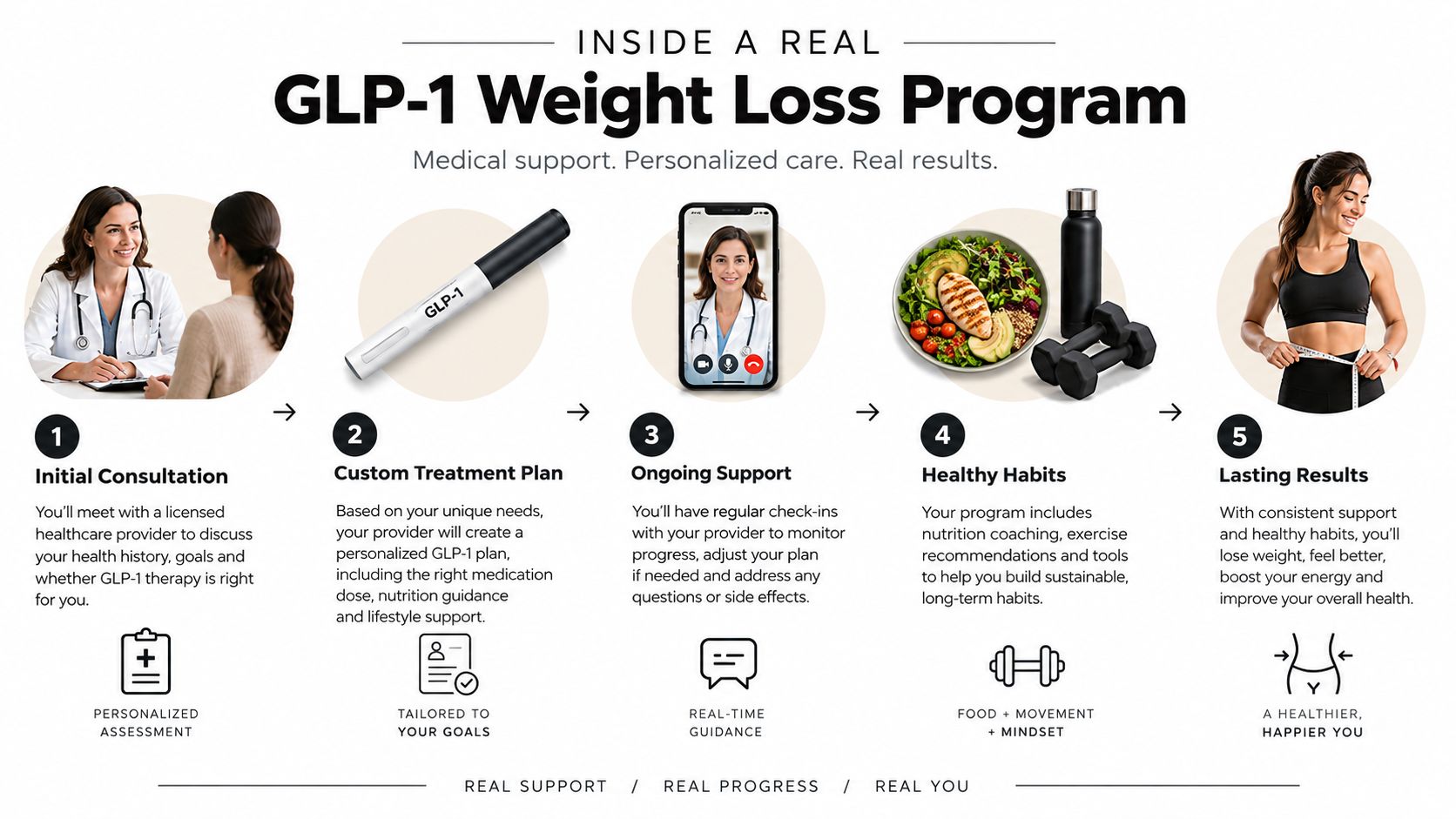
A credible program has a recognizable sequence. It doesn't begin with a payment page and end with a tracking number.
The first stage is clinical intake
You'll usually complete a health questionnaire covering weight history, current medications, allergies, medical conditions, previous weight-loss attempts, pregnancy status, and relevant family history. A useful intake asks enough to identify risk. A superficial quiz that only requests height, weight, and a credit card number isn't a medical evaluation.
Next comes a consultation with a licensed provider. The provider should review your answers, discuss expected benefits and risks, confirm whether treatment is appropriate, and explain alternatives. You should have a real opportunity to ask questions before a prescription is issued.
The prescription and shipment need a process
After approval, the prescription goes to a pharmacy that the program identifies clearly. You should know whether you're receiving an FDA-approved branded product or a compounded preparation, who dispenses it, how refills work, and what happens if the shipment is delayed.
For injectable medication, ask about cold-chain handling. The provider should explain packaging, storage, what to do if the parcel arrives warm, and how much notice you'll receive before a refill. “It ships from our pharmacy” is not enough detail.
Dosing should move slowly
Most programs start with a low dose and increase gradually, often according to a monthly schedule. The exact plan should depend on your response and side effects. A patient who is losing weight and tolerating treatment poorly shouldn't be pushed upward because the next dose is available.
A good care team reviews nausea, vomiting, constipation, diarrhea, reflux, hydration, food intake, and energy. It also checks whether you're eating enough protein and maintaining physical activity. Unlimited messaging has value only when qualified staff respond and escalate urgent issues appropriately.
What should happen after you start
Before enrolling, ask to see the follow-up workflow. Will you complete a symptom check before each refill? Can the clinician hold, reduce, or delay the dose? How are missed doses handled? What happens during travel, illness, or a pharmacy shortage?
Non-negotiable: A program must be able to change the plan. Automatic refills and automatic dose increases are convenience features, not medical care.
By the end of the early treatment period, you should understand your dose, your next review date, how to report side effects, and what your team is measuring beyond the scale.
Who Qualifies and When Telehealth Makes Sense
Eligibility usually starts with weight and health risk, not with a desire to lose a few cosmetic pounds. Clinicians commonly consider treatment for adults with a BMI of 30 or higher, or a BMI of 27 or higher alongside a weight-related condition such as hypertension, prediabetes, or sleep apnea. BMI is only a screening tool, so the provider should also assess medical history, medications, eating patterns, and previous treatment attempts.
Some situations require extra caution or a different care setting. A personal or family history of medullary thyroid carcinoma, pregnancy, and a history of pancreatitis should be discussed directly with a qualified clinician. Don't rely on an online eligibility result to clear you. The provider may also request laboratory information or coordinate with your primary-care clinician when your health history is complex.
Telehealth is useful, but it isn't universal
Telehealth can work well when you're medically stable and need convenient access to a clinician, prescription management, refills, and ongoing accountability. Video visits can reduce travel, make scheduling easier, and give you a consistent care team. They can also be more comfortable for people who avoid weight discussions in a crowded clinic.
That convenience has limits. In-person care may be more appropriate when you have several uncontrolled conditions, complicated medication interactions, active eating-disorder concerns, pregnancy planning needs, or a surgical procedure approaching. A telehealth program should tell you when it can't safely manage your case and help you transition to in-person care.
What to ask before the consultation
Bring a current medication list, your medical and surgical history, prior weight-loss treatments, allergy information, and any relevant family history. Ask who will prescribe, which pharmacy will fill the medication, how laboratory testing is handled, and how urgently you can reach the team if symptoms become severe.
A good provider won't promise that you qualify before reviewing your health information. The program should make the clinical decision first and the enrollment decision second.
What a GLP-1 Program Costs
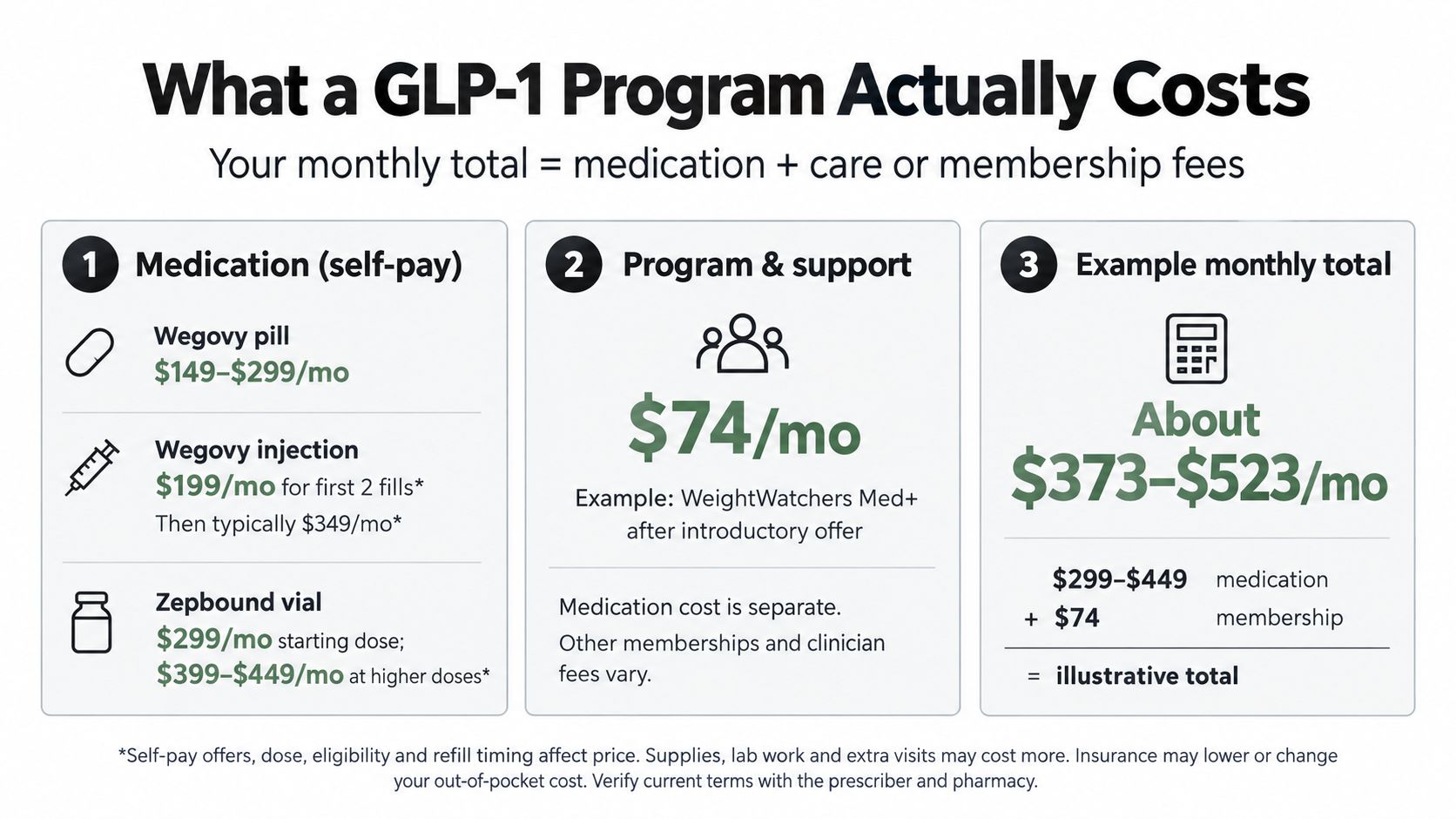
A low monthly price can hide an incomplete service. Before you enroll, separate the bill into four categories: clinical care, medication, delivery and supplies, and laboratory or monitoring charges. You are buying a care system, not only a prescription.
Clinical care may cover the initial consultation, follow-up reviews, prescription renewals, messaging, and dose adjustments. Medication may be branded or compounded, with the price changing by product and dose. Shipping may be included, charged separately, or discounted only during an introductory period. Laboratory work may come from an outside service, run through insurance, or require out-of-pocket payment.
Flat pricing versus itemized billing
Flat pricing is easier to budget when it covers the complete service. Itemized billing gives you more visibility, but a low membership fee can conceal separate consultation, shipping, refill, or dose-change charges.
Get answers in writing:
- What is included each month? Confirm consultations, messaging, dose adjustments, medication, shipping, supplies, and refills.
- What changes as the dose rises? Ask whether medication costs vary by dose or product.
- What happens after the introductory offer? Record the standard recurring price rather than budgeting around a temporary promotion.
- Can I use FSA or HSA funds? Eligibility depends on account rules and the service purchased, so verify before assuming reimbursement.
- What happens if I stop? Ask about cancellation timing, refunds, unused medication, and follow-up after discontinuation.
For a wider budgeting view, this guide to GLP-1 weight loss cost offers a useful reference. If behavioral-health support belongs in your health budget, comparing affordable therapy session fees can help you account for care beyond medication.
The long-term bill deserves attention
The lowest starter price may conceal the cost of treatment. Ask what continued care could require before you begin, including medication, follow-up, monitoring, and support after dose changes.
Stopping also has a financial consequence when lost weight returns. Trials of semaglutide and tirzepatide reported roughly 53% to 67% of prior weight loss returning within 52 weeks after treatment stopped. A 2025 systematic review projected average regain of about 0.4 kilograms per month after weight-loss medication cessation (Nature Medicine systematic review).
You may not need the same dose indefinitely. You do need a maintenance strategy, a clear stopping process, and a program that explains what happens after the initial treatment period.
How to Pick a Reputable Program Without Getting Burned
Treat the provider like a healthcare service, not an online retailer. Before paying, spend a few minutes testing whether the company can answer basic clinical and operational questions.

The minimum standard
A credible program should provide:
- Named clinical responsibility: The company should identify the licensed clinicians who evaluate and prescribe, along with the states where they practice.
- Pharmacy transparency: Ask whether medication comes from an FDA-registered 503A or 503B pharmacy, and request the pharmacy's identity.
- Secure handling: Look for clear privacy, HIPAA, and encryption information. Security language shouldn't replace clinical transparency, but its absence is concerning.
- Real access to care: You should be able to reach a provider or care team when side effects, missed doses, or refill problems arise.
- Clear pricing: The full recurring price should be visible before enrollment, including shipping and required fees.
- A written titration policy: The program should explain how dose increases, pauses, reductions, and refills work.
- Fair cancellation terms: Read the refund or money-back guarantee carefully. Know its time limits and exclusions.
- Independent reviews: Look beyond testimonials hosted on the company's own website. Check whether reviews discuss actual care, not just delivery speed.
Weight Method is one example of an online service that connects patients with licensed providers for evaluation, prescription review, home delivery of semaglutide or tirzepatide, and ongoing support. Compare its published terms with other providers rather than assuming any single program fits every patient.
Walk away from these red flags
No clinician interaction is an immediate disqualifier. So is a website promising custom “novel” peptides, refusing to identify the dispensing pharmacy, offering a price that seems implausibly low without explaining what's excluded, or pressuring you to enroll before a consultation.
Be especially skeptical of fixed weight-loss promises. Trial averages describe groups under defined conditions. They don't guarantee your result, and they don't answer whether a program will help you maintain it.
A reputable service makes it easier to ask difficult questions. A risky service makes asking questions feel like an obstacle.
Staying on Track After the First Three Months
At month four, the question changes from “Is it working?” to “What happens when progress slows?” A good GLP-1 program should already have an answer. Your provider may hold the dose, adjust it, review food intake, activity, and sleep, or reconsider whether the medication still fits your situation. That decision requires a clinical review, not an automatic increase.
Ask for the plateau policy in writing before you pay. It should state how long a plateau is monitored, which symptoms trigger a review, and who makes the dosing decision. The same standard applies if side effects change or your health circumstances shift.
Stopping also needs a documented process. The 2025 systematic review cited in the cost section found that cardiometabolic risk markers could return to pretreatment levels within approximately 1.4 years, while follow-up for newer medications remains limited. Do not stop or improvise a taper without speaking with your prescriber. A discontinuation plan should cover monitoring, nutrition support, resistance training, and the response if weight or health markers worsen.
Resistance training helps protect strength, but it does not replace medical follow-up. Nutrition matters too, and the medication should not become permission to under-eat. For busy schedules, camera-based meal tracking for busy people can make food awareness easier without requiring manual entry for every ingredient.
Keep written instructions for missed doses, travel, refrigeration, refill delays, illness, and restarting after an interruption. The provider should tell you when to pause, whom to contact, and whether restarting requires a lower dose.
Before ordering, ask to see the first-shipment and exit plans. Weight Method connects adults with licensed providers for online evaluation, personalized semaglutide or tirzepatide treatment, home delivery, dose adjustments, and ongoing messaging support. Review its consultation and pricing information before deciding.