The most popular advice about telehealth weight loss with Mounjaro is to find the lowest monthly price, complete a quick questionnaire, and wait for medication to arrive. That approach treats access as a shopping problem. Clinically, it's a continuity, screening, dosing, and pharmacy-verification problem.
Tirzepatide can support substantial weight reduction, but safe treatment depends on the right indication, a licensed prescriber, gradual dose escalation, reliable medication sourcing, and responsive follow-up. The end of the US tirzepatide shortage has made those operational details more important, not less. A product that looks inexpensive or convenient may not be interchangeable with an FDA-approved brand, and a video visit alone doesn't guarantee adequate supervision.
Understanding Mounjaro for Telehealth Weight Loss
Remote access to tirzepatide is governed by more than a video visit. The medication's brand, indication, prescribing rules, pharmacy source, and follow-up process all affect whether treatment is appropriate and lawful.
Mounjaro is the brand name for tirzepatide, first approved for adults with type 2 diabetes to improve blood-glucose control alongside diet and exercise. On May 13, 2022, the FDA approved Mounjaro for that indication. The decision drew on nine clinical trials involving 7,769 participants, including 5,415 who received Mounjaro, according to the FDA approval announcement from Lilly.
Tirzepatide is a dual incretin agonist. It activates receptors for glucose-dependent insulinotropic polypeptide, or GIP, and glucagon-like peptide-1, or GLP-1. These pathways influence glucose regulation, appetite, and digestion. Patients may feel less hungry, become full sooner, and experience slower gastric emptying. The intensity of those effects and the medicine's tolerability differ between patients.
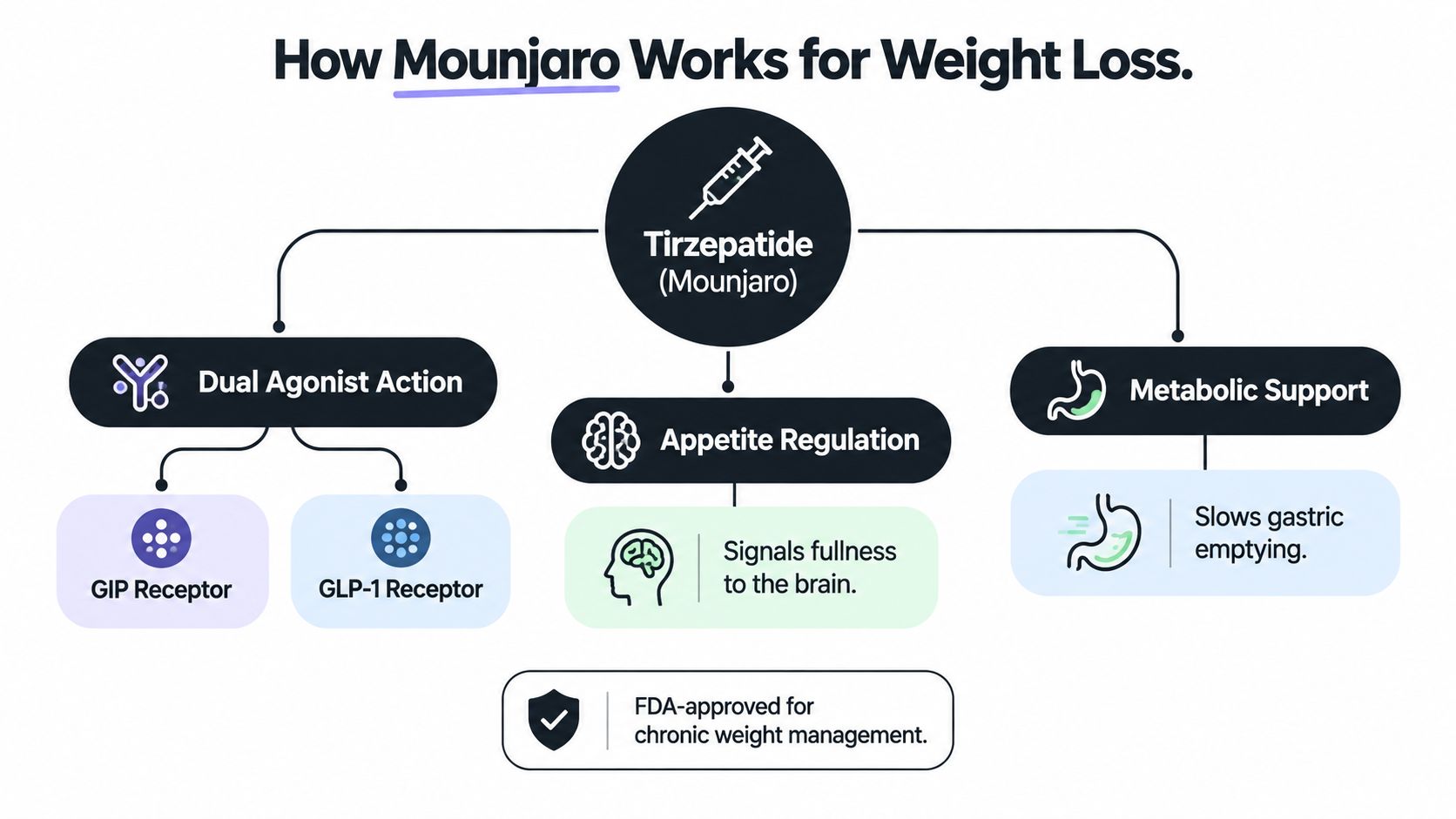
Mounjaro and Zepbound are not the same indication
The regulatory distinction affects remote prescribing. Mounjaro remains the diabetes brand, while the later obesity-specific authorization uses Zepbound. A telehealth clinician must document why tirzepatide is appropriate for the individual patient and prescribe within the applicable indication and regulatory requirements.
Weight reduction seen during the diabetes development program helped establish tirzepatide's broader clinical relevance. Average reductions differed by dose. Participants receiving 5 mg lost approximately 12 pounds, while those receiving 15 mg lost approximately 25 pounds on average, including 5,415 Mounjaro recipients, as described in the FDA approval announcement linked above. These averages are not a personal treatment forecast.
For obesity treatment, the more relevant benchmark is SURMOUNT-1, a 72-week randomized trial in adults without diabetes. Mean weight reduction was 16.0% with 5 mg, 21.4% with 10 mg, and 22.5% with 15 mg, compared with 2.4% with placebo, according to the SURMOUNT-1 trial publication. The study included lifestyle intervention and gradual titration, so its results describe a structured treatment period rather than a rapid first month.
Clinical rule: A telehealth prescription should document medical need and the patient's indication, not simply fulfill a request for a popular weight-loss product.
For a plain-language explanation of naming, uses, and practical considerations, patients can review this Mounjaro guide. The prescribing decision still depends on a licensed clinician's assessment, lawful access to the medication, and continued monitoring.
Checking Your Eligibility for Tirzepatide Treatment
Remote access should begin with a clinical decision, not a checkout page. For obesity-focused treatment, the SURMOUNT-1 trial included adults with BMI of at least 30 kg/m², or BMI of at least 27 kg/m² with a weight-related complication, according to the published trial protocol and results. BMI is a screening measure, not a complete eligibility decision. The clinician should also review medical history, current medicines, previous weight-management attempts, eating patterns, and conditions that may alter the risk-benefit assessment.
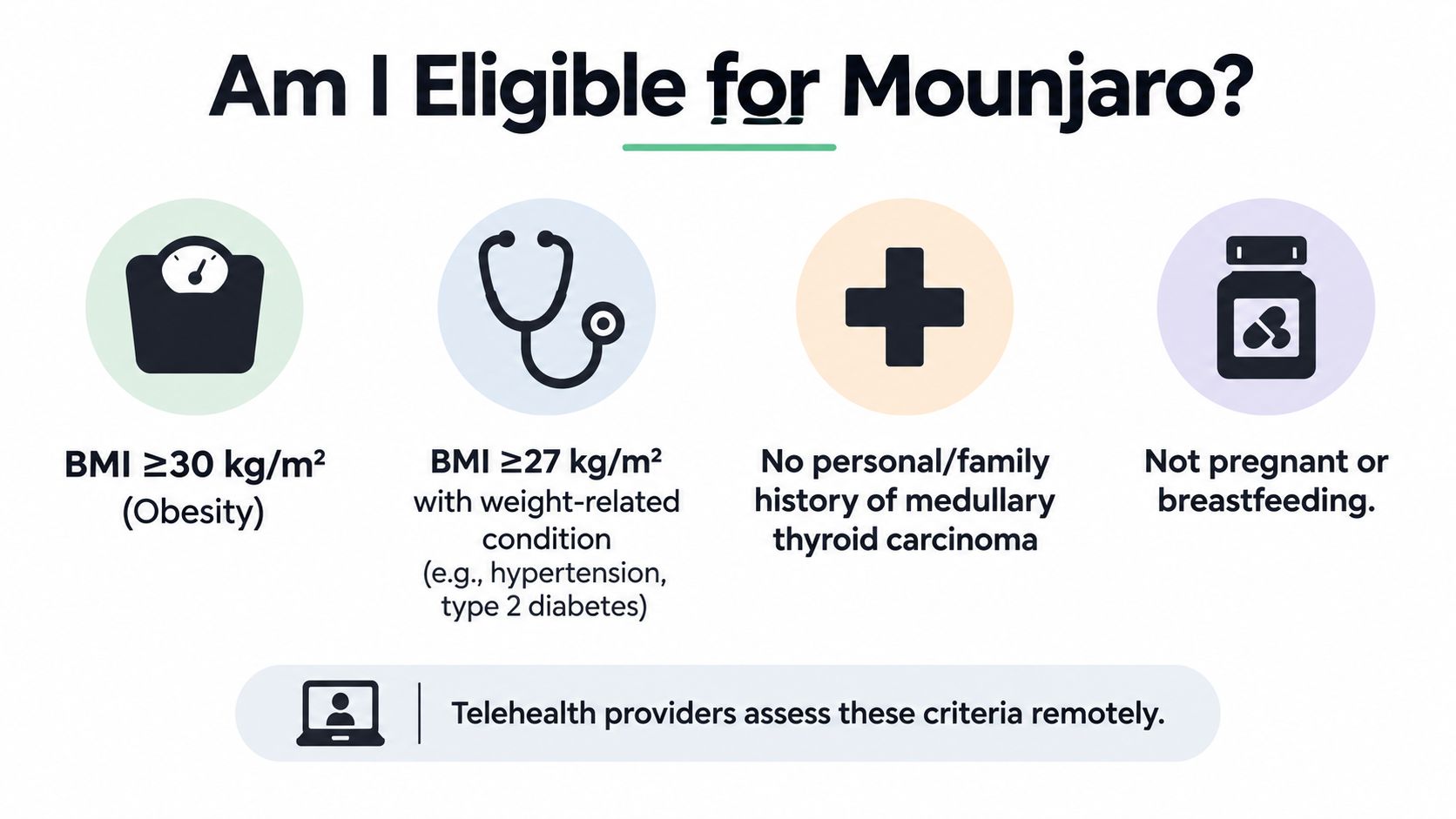
What a provider needs to establish
A responsible intake should verify:
- Body-size criteria: The clinician confirms BMI and identifies a relevant weight-related condition when BMI falls in the lower qualifying range.
- Medical context: The evaluation covers diabetes status, gastrointestinal history, prior pancreatitis or gallbladder concerns, allergies, and other conditions that could affect treatment.
- Medication reconciliation: The provider reviews every prescription, over-the-counter medicine, supplement, and diabetes treatment. Patients should provide a current medication list or pharmacy record rather than rely on memory.
- Pregnancy status and plans: Reproductive status belongs in the clinical discussion. Patients who are pregnant, breastfeeding, or planning pregnancy should ask whether tirzepatide is appropriate.
- Baseline measures: Weight, relevant comorbidity information, and waist-related risk should be documented before treatment so later decisions do not rest on a single scale reading.
The clinician should also ask about eating behavior and earlier weight-management efforts. Those answers may show that a patient needs structured metabolic care, or that another diagnosis or treatment priority deserves attention first.
Reasons a remote prescription may be declined
Tirzepatide is contraindicated in patients with a personal or family history of medullary thyroid carcinoma or Multiple Endocrine Neoplasia syndrome type 2. FDA labeling also says it is not recommended for patients with severe gastroparesis. These findings can determine whether prescribing is appropriate.
A clinic that approves every applicant without discussing these risks is not providing meaningful clinical access. A sound telehealth workflow includes live review of the questionnaire, clarification of ambiguous answers, and a documented follow-up plan. Dose escalation should also be deliberate. In SURMOUNT-1, participants underwent a 20-week dose-escalation period, supporting a cautious model rather than rushed treatment.
For practical dosing, FDA labeling begins with 2.5 mg once weekly for four weeks, followed by 5 mg once weekly. Further increases are by 2.5 mg only after at least four weeks at the current dose, and the maximum is 15 mg weekly. The 2.5 mg dose is for initiation, not maintenance. A prescriber should delay escalation when symptoms, hydration, or oral intake make a higher dose unsafe.
A telehealth prescription should document the patient's indication and medical need, not respond to a request for the product most associated with weight loss. For a plain-language explanation of naming, uses, and practical considerations, patients can review this Mounjaro guide. The decision still depends on a licensed clinician's assessment, lawful medication access, and continued monitoring.
Navigating the Remote Consultation and Prescription Process
A legitimate telehealth intake has a recognizable sequence. It doesn't end when a patient submits a form. The provider needs enough information to make an individualized decision, and the patient needs clear instructions about what will happen after approval.
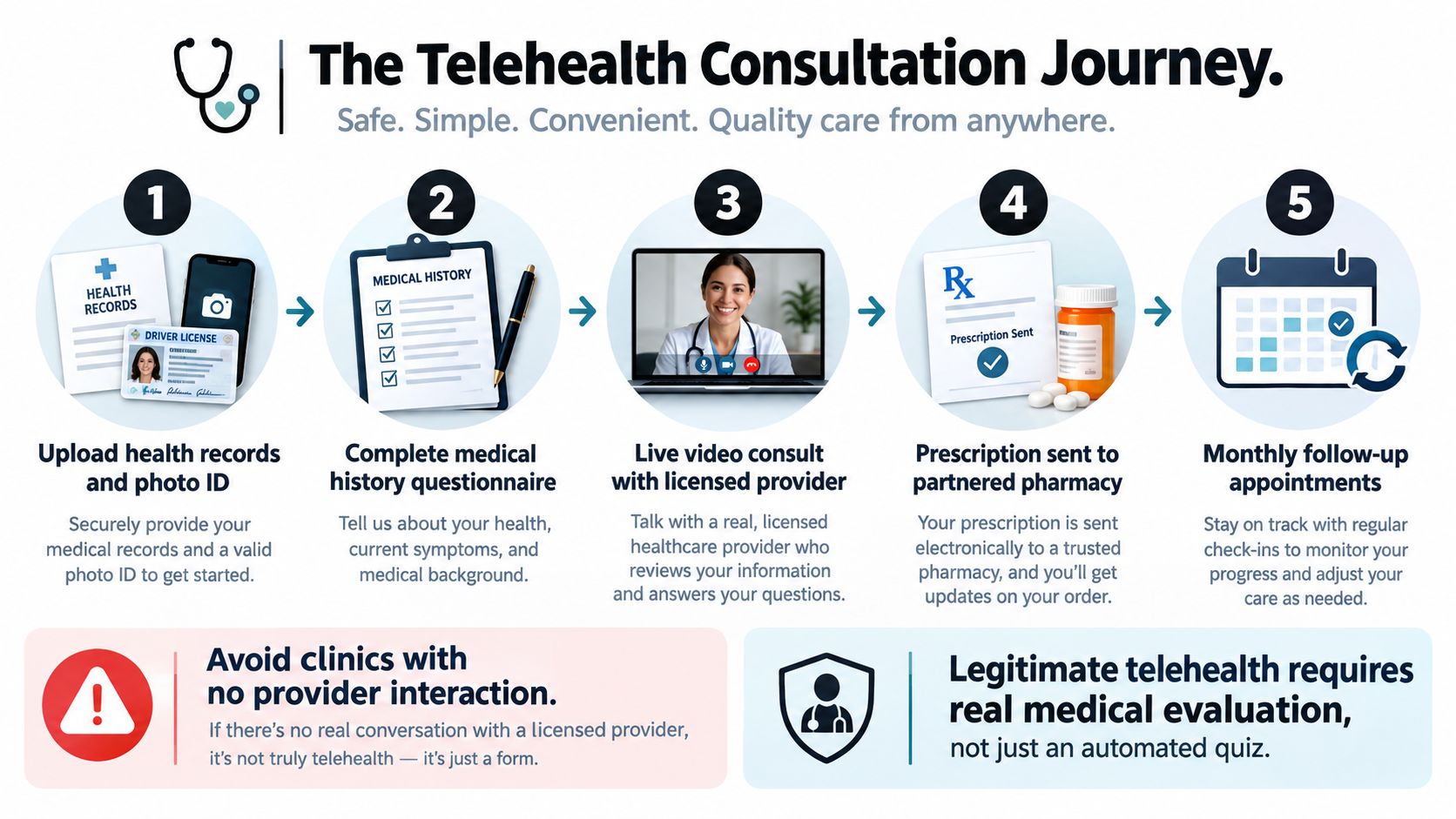
What a proper intake looks like
Before the appointment, prepare your current medication list, relevant diagnoses, allergies, recent weight information, and questions about side effects. If your care team tracks cardiovascular information, preparing heart-rate data for your doctor can make the conversation more useful, especially when symptoms or other medicines need review.
During the consultation, expect questions about:
- Your health history: This includes diabetes, blood pressure, gastrointestinal symptoms, endocrine conditions, allergies, and prior medication reactions.
- Your weight-management history: The clinician may ask what you've tried, what helped, what failed, and whether weight-related complications are present.
- Your current medicines: The provider needs to identify potential interactions, duplicate therapies, and medicines that may require coordination with another prescriber.
- Your treatment preferences: Injection comfort, food intake, work schedule, travel, and access to follow-up all affect whether the plan is realistic.
- Your ability to monitor symptoms: Remote prescribing only works when patients know how to contact the care team and when the team responds to clinically relevant messages.
A superficial automated quiz can collect useful intake information, but it can't replace clinical judgment. Clinics that never provide real provider interaction may miss contraindications, misunderstand a medication list, or escalate treatment despite persistent adverse effects. For a broader explanation of the workflow, see how telehealth weight loss works.
After the prescription is written
If the clinician approves treatment, the prescription goes to a pharmacy selected by the program or by the patient, depending on the service. The patient should receive the exact medication name, concentration or device instructions, dose schedule, storage guidance, refill process, and a contact route for problems.
Shipping is only one part of fulfillment. Patients should know how the medication will be packaged, what to do if a delivery arrives warm or damaged, and whom to contact before taking the first dose. A credible service will explain the process rather than treating delivery as the end of care.
A remote prescription is safe only when the patient can identify the product, understand the dose, and reach a clinician after the package arrives.
Managing Dosing and Monitoring Your Progress Safely
A telehealth prescription is only as safe as the titration and follow-up behind it. Faster escalation does not improve treatment. Tirzepatide uses a staged schedule because gastrointestinal symptoms can emerge or worsen when the dose increases. In the SURMOUNT-1 trial cited earlier, treatment discontinuation because of adverse events was more common at higher doses than with placebo. Gastrointestinal events were the most frequent and generally appeared during escalation.
What to monitor each week
A practical remote monitoring routine combines consistent measurements with symptom and behavior records:
- Record weight consistently: Weekly home weights taken under similar conditions are more useful than reacting to daily fluctuations.
- Calculate change from baseline: Percentage change shows the direction and scale of progress better than one isolated reading.
- Track dose interruptions: Record missed or delayed doses and any clinician-directed pauses.
- Report tolerability: Note nausea, vomiting, constipation, diarrhea, abdominal pain, hydration, and your ability to eat and drink.
- Review health outcomes: Weight matters, but nutrition, physical activity, glucose-related outcomes, and other conditions matter too.
SURMOUNT-1 offers a benchmark, not a promise. The study involved adults without diabetes and included prolonged titration, so its results cannot predict an individual patient's response. A responsible program should not promise that every patient will reach a particular percentage or lose a specific amount during the first month. A patient beginning at the introductory dose may spend time assessing tolerance before any increase, then progress only when symptoms, intake, and clinical review support it.
When to pause escalation
Persistent vomiting, dehydration, poor oral intake, severe abdominal symptoms, possible pancreatitis, gallbladder symptoms, or a suspected allergic reaction require prompt contact with the prescribing team. Anaphylaxis and angioedema are reported risks in FDA labeling. Potentially serious reactions should not be managed through an automated chat alone. Severe or persistent symptoms may require urgent or emergency evaluation.
The FDA label warns about severe gastrointestinal reactions and does not recommend tirzepatide for people with severe gastroparesis. It also lists the thyroid-cancer-related contraindications described earlier. Review Mounjaro dosing guidance with the prescribing team before changing a dose. Do not follow a calendar automatically if symptoms or clinical circumstances have changed.
Nutrition support should remain practical. Smaller meals, adequate fluids, slower eating, and a clinician-approved constipation plan may help some patients tolerate treatment. They do not replace medical evaluation when symptoms persist or become severe.
Patients who want another way to organize food, activity, and adherence can consider the GrabGains weight loss app. Medication changes and safety decisions still belong with the prescribing clinician.
Evaluating Costs and Choosing a Reputable Provider
The lowest advertised price isn't necessarily the lowest-risk option. FDA records state that the tirzepatide injection shortage was resolved, with transition periods for compounding pharmacies ending in February and March 2025, as described in the FDA shortage documentation. That change affected whether compounders could continue producing tirzepatide and left some patients facing the loss of lower-cost alternatives.
Brand access versus compounded access
FDA-approved brand tirzepatide and compounded tirzepatide shouldn't be described as interchangeable by default. Compounded drugs are not FDA-approved, and their availability, formulation, pharmacy eligibility, and prescribing rules can change. A program should tell you exactly what it intends to dispense and what will happen if that pharmacy can no longer provide it.
Brand access may offer a clearer product identity and established labeling, but patients still need to confirm coverage, prescribing requirements, refill procedures, and clinical follow-up. Compounded access may appear less expensive, yet it can carry greater uncertainty around continuity and dosing instructions. The right comparison is not just monthly price. It's product identity, pharmacy legitimacy, clinical oversight, and the plan for interruptions.
| Verification category | What to look for | Red flags to avoid |
|---|---|---|
| Exact medication | The full drug name, formulation, concentration, and device or vial instructions | A page that says only “GLP-1” or “Mounjaro alternative” |
| Approval status | Clear explanation of whether the product is FDA-approved or compounded | Claims that a compounded product is identical or interchangeable without qualification |
| Pharmacy identity | The dispensing pharmacy, licensing information, and contact process | No pharmacy name until after payment |
| Prescription requirements | A licensed provider evaluates you and writes an individualized prescription | Medication offered without meaningful medical review |
| Refill policy | Written instructions for renewals, dose changes, and interruptions | Automatic refills with no symptom or dose review |
| Supply backup | A plan for pharmacy changes, substitutions, or delays | Instructions to stop, switch, or stretch doses without clinician guidance |
Patients should also ask whether program fees cover consultations, messaging, dose adjustments, shipping, and follow-up. FSA or HSA eligibility can depend on the account rules and the nature of the expense, so confirm documentation requirements with the plan administrator rather than assuming every program charge qualifies.
A structured record of weekly body composition insights can help patients discuss changes with their clinician, but measurements should support clinical care, not replace it. A reputable provider will explain what it can prescribe, where it's fulfilled, how it handles supply changes, and how patients reach a licensed clinician.
Preparing for Your First Month of Treatment
The first month is an adaptation period, not a race to the highest dose. Your priorities are identifying the exact product, learning the injection process, tolerating the initiation dose, and creating a dependable communication routine.
Medication errors deserve direct attention. KFF Health News reported that self-reported medication-error reports involving leading GLP-1 drugs rose from just over 2,000 in 2020 to more than 25,000 in 2025, nearly a thirteenfold increase, with reports involving extra or incorrect doses, communication problems, and prescribing errors, according to its coverage of GLP-1 medication safety.
Use these safeguards:
- Read the label before injecting: Confirm the drug name, strength, prescribed dose, and injection device or syringe instructions.
- Never convert units independently: Compounded products may use concentration and syringe-unit instructions that differ from branded devices. Ask the pharmacy or clinician if anything is unclear.
- Choose one weekly routine: Put the prescribed injection day on your calendar and document each dose after administration.
- Ask about missed doses in advance: Follow the written instructions from your care team. Don't double a dose or improvise a replacement schedule.
- Use the care channel early: Message the clinical team about persistent nausea, vomiting, poor intake, constipation, suspected allergic symptoms, or uncertainty about the dose.
- Dispose of sharps safely: Use the container and disposal instructions supplied by the pharmacy or local health authority.
Remote care reduces travel, but it doesn't remove the need for supervision. A program should document dose changes, respond to symptoms, and explain why it may pause or reduce escalation. That measured approach supports safer treatment and gives patients a better chance of maintaining progress beyond the initial weight-loss phase.
Weight Method offers a virtual evaluation with licensed providers, prescription coordination for eligible patients, ongoing messaging, progress tracking, and dose adjustments for medically supervised weight management. If you want to compare your options for telehealth tirzepatide access and follow-up, visit Weight Method to begin the evaluation.