A commonly recommended pace is 1–2 pounds per week, a realistic first milestone is 5–10% of starting body weight within about six months, and prescription GLP-1 trials show average losses of roughly 15–21% over 68–72 weeks.
Those three numbers answer how long will it take to lose weight better than any single deadline. The fast weekly pace describes a middle stretch, not every week from day one through a large goal. A year of treatment can land near the trial range, while the first month rarely does.
In a 2024 real-world study published in Obesity, patients receiving anti-obesity medication through a medical weight-loss program lost an average of 18.3% after 12 months. That is a full year of supervised care, not a first-month result.
Read the timeline as phases with ranges. Early scale movement, a steadier middle, a slower approach to a larger loss, and then maintenance. A number you miss by a few pounds is still a useful checkpoint.
Realistic Weight Loss Milestones at a Glance
Plan around 5–10% of starting body weight within 6 months, not around a perfect weekly rate held for half a year. The National Institute of Diabetes and Digestive and Kidney Diseases presents 1–2 pounds per week as a good short-term goal and stresses an achievable target rather than rapid, uninterrupted loss.
Those two ideas look like they clash. At 2 pounds a week, 26 weeks would be about 52 pounds. A 200-pound adult's six-month target is only 10–20 pounds, which averages nearer 0.4–0.8 pounds per week. Loss is not linear. The early scale often moves faster, then the pace eases, so the six-month total sits below a straight 1–2 pound line. A slower stretch can still be successful progress.
Noticeable change can show up within several weeks. Clinically meaningful 5–10% reduction is judged over months. Starting weight, calories, activity, sleep, medical conditions, medications, and adherence all shift the calendar. Larger goals belong on a longer horizon, which the medication trials below put at about 12–18 months.
| Milestone | Expected loss | Pace | Example for a 200-lb adult |
|---|---|---|---|
| First 4 weeks | Early drop often includes water | Not a steady weekly rate | Often a few pounds, partly fluid |
| About 6 months | 5–10% of starting weight | About 0.4–0.8 lb per week on average | 10–20 lb |
| 12–18 months | Up to about 15–21% with prescription treatment in trials | Slows over time | About 30–42 lb; varies with dose and adherence |
Judge the scale with multi-week trends, waist measurements, health markers, and how you function, not one morning reading. If you want a closer look at weekly averages, our guide to average weight loss per week walks through how to read a trend. Every figure here is an average or a range, not a date you must hit.
How Long to Lose 10, 20, 30 or 40 Pounds
Use the table as arithmetic, not a forecast. It converts a steady 1 pound or 2 pounds a week into weeks. Real loss usually slows as your body adapts, so results often land toward the longer end, or past it.
| Pounds to lose | At 1 lb per week | At 2 lb per week |
|---|---|---|
| 10 lb | 10 weeks (about 2.3 months) | 5 weeks (about 1.2 months) |
| 20 lb | 20 weeks (about 4.6 months) | 10 weeks (about 2.3 months) |
| 30 lb | 30 weeks (about 6.9 months) | 15 weeks (about 3.5 months) |
| 40 lb | 40 weeks (about 9.2 months) | 20 weeks (about 4.6 months) |
A 20-pound goal at two different speeds
Say you weigh 200 pounds and want to lose 20 pounds. At a steady 1–2 pounds a week, that is about 10–20 weeks. If your average settles nearer 0.4–0.8 pounds a week, the same 20 pounds takes roughly 6–12 months. A 200-pound adult who is down 10–20 pounds by six months is on a realistic track, even though a straight 1–2 pound pace over 26 weeks would imply 26–52 pounds.
Practical rule: Check the weekly average at 3 months and again at 6 months. A 20-pound goal reached in 9–10 months is on track when those averages keep drifting down.
Don't throw out the plan because one week is flat. Compare the three-month weight with your start, then do the same at six months.
Why Early Weight Loss Is Faster Than Later Loss
The same calorie deficit does not produce the same weekly drop forever. The first weeks usually shed water, glycogen stored with fluid, and the weight of a smaller amount of food in your gut. The scale can fall faster than body fat is leaving.
Think of a bathtub. Water leaves quickly while the tub is full. The same open drain looks slower as the level falls. Your deficit can stay similar while the weekly number shrinks.
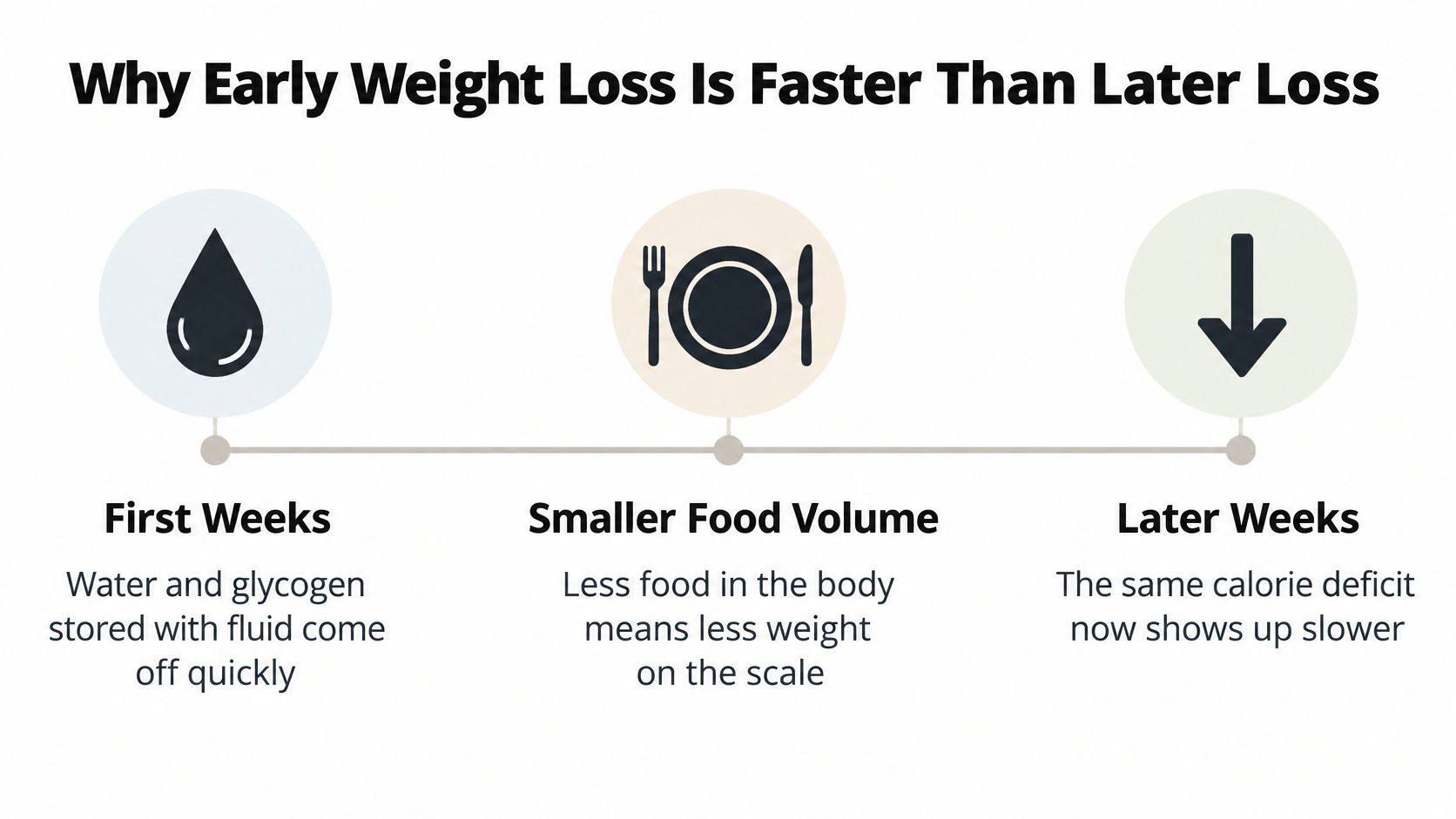
Three phases on one timeline
First weeks. Fluid and stored glycogen come off quickly, and less food in the digestive tract means less weight on the scale. Treat that drop as a start, not a forecast of every month ahead.
Middle stretch. Losses track fat more closely. At this point, 1–2 pounds a week is a fair short-term description. Energy needs also fall as body weight falls, so the same meals and walks produce smaller weekly changes than they did at the start.
Later phase. The curve flattens as you approach the 12–18 month mark. A slower week is normal. It does not mean the plan stopped working. The next section is about telling a true stall from ordinary noise.
Factors That Change Your Weight Loss Timeline
Two people can follow a similar plan and finish six months far apart. The person matters as much as the menu.
| Factor | How it changes your pace | What to adjust |
|---|---|---|
| Starting weight | A higher starting weight often means more pounds lost in absolute terms | Set percentage goals, not only pound goals |
| Calorie intake | Underestimated portions are the most common cause of stalled progress | Log intake for two weeks and compare |
| Physical activity | Walking and resistance training protect muscle and sustain loss | Add two strength sessions each week |
| Sleep | Short sleep can raise appetite and reduce daily activity | Keep a consistent sleep schedule |
| Medical conditions | Thyroid disease and insulin resistance can slow the pace | Ask a clinician to review |
| Medications | Some drugs change appetite or fluid balance; GLP-1 dose escalation sets the pace | Follow the prescribed dose schedule |
| Adherence | Missed weeks delay progress more than small daily slips | Track weekly rather than daily |
What you can change this month
Calories and logs. Spend two weeks writing down what you eat, including oils, drinks, and restaurant meals. Compare that log with the deficit you think you are in.
Movement that keeps muscle. Brisk walking plus two strength sessions a week is a practical pair. The benefits of walking 8000 steps daily include a concrete daily target you can build toward without a gym membership.
Sleep and weekly follow-through. A steady bedtime and a weekly check beat a perfect Monday followed by a missed week.
Thyroid disease, insulin resistance, and medicines that shift appetite or fluid need a clinician, not a self-made dose change. On a GLP-1, the prescribed escalation sets the pace. Don't raise it on your own.
How Prescription Medications Change the Timeline
Medication results are measured over months, not weeks. In the 68-week STEP 1 trial published in the New England Journal of Medicine, 1,961 adults with overweight or obesity but without diabetes received weekly semaglutide 2.4 mg plus lifestyle support, or placebo plus lifestyle support. By week 68, about 16 months, the semaglutide group had lost an average of 14.9% of baseline body weight, compared with 2.4% in the placebo group. The estimated difference was 12.4 percentage points.
A separate 72-week tirzepatide trial reported average reductions of 19.5% with 10 mg and 20.9% with 15 mg, compared with 3.1% for placebo. In SURMOUNT-1, 2,539 adults with obesity or overweight plus a weight-related complication received tirzepatide or placebo. The 5 mg group lost about 15.0% over 72 weeks, including a 20-week dose-escalation period, compared with about 3.1% for placebo, according to the SURMOUNT-1 trial. For a 200-pound adult, these trial averages translate to roughly 30–42 pounds over about 16–17 months.

| Trial | Treatment | Duration | Average loss | Placebo loss |
|---|---|---|---|---|
| STEP 1 (semaglutide) | 2.4 mg once weekly with lifestyle | 68 weeks | 14.9% | 2.4% |
| SURMOUNT-1 (tirzepatide) | 5 mg once weekly | 72 weeks | 15.0% | 3.1% |
| SURMOUNT-1 (tirzepatide) | 10 mg once weekly | 72 weeks | 19.5% | 3.1% |
| SURMOUNT-1 (tirzepatide) | 15 mg once weekly | 72 weeks | 20.9% | 3.1% |
The first few weeks are a poor guide to the full effect because doses increase gradually. At Weight Method, patients can expect dose escalation over 8–16 weeks, with regular provider check-ins. Trial averages may not match an individual's experience: side effects, missed doses, and other health concerns can affect the pace.
The timeline also includes the period after reaching a goal. Weight regain is expected after stopping semaglutide, so medication decisions and maintenance should be discussed with a provider rather than based on a short-term scale change.
Plateaus Explained and When to Call Your Provider
A plateau is several weeks in which the weekly average does not fall. One flat morning is not a plateau. Water retention, a menstrual cycle, a salty meal, constipation, or a hard training week can hold the scale even while fat loss continues.

Work through three checks in order:
- Confirm the weekly average. Weigh under similar conditions and average at least three to four weeks before you call it stuck.
- Measure your waist. A smaller waist with a stable scale often means the trend is still favorable.
- Review food logs and sleep. Portions, liquid calories, short nights, and skipped walks explain many quiet months.
When a slowdown needs a clinician
Call if the weekly average has not moved for several months at a stable dose. Also call if loss is very fast, or if you have persistent vomiting, dehydration, severe abdominal pain, or you can't keep food down. Don't speed up a dose to force the scale.
Our clinicians provide ongoing support through plateaus, including a look at the nutrition plan, exercise changes, and dose adjustments when they fit. A slower phase after six months can still be progress when waist size and health markers improve. For a closer read on medication stalls, see our notes on a GLP-1 weight loss plateau.
Keeping Weight Off After You Reach Your Goal
The timeline does not end at the goal weight. Maintenance is its own stage, and it can take a year or more.
A 2025 systematic review and meta-analysis indexed by PubMed found that people who stopped anti-obesity medications regained an additional 1.50 kg by 8 weeks, rising to 2.50 kg by 20 weeks. That is about 3.3 pounds, then about 5.5 pounds.
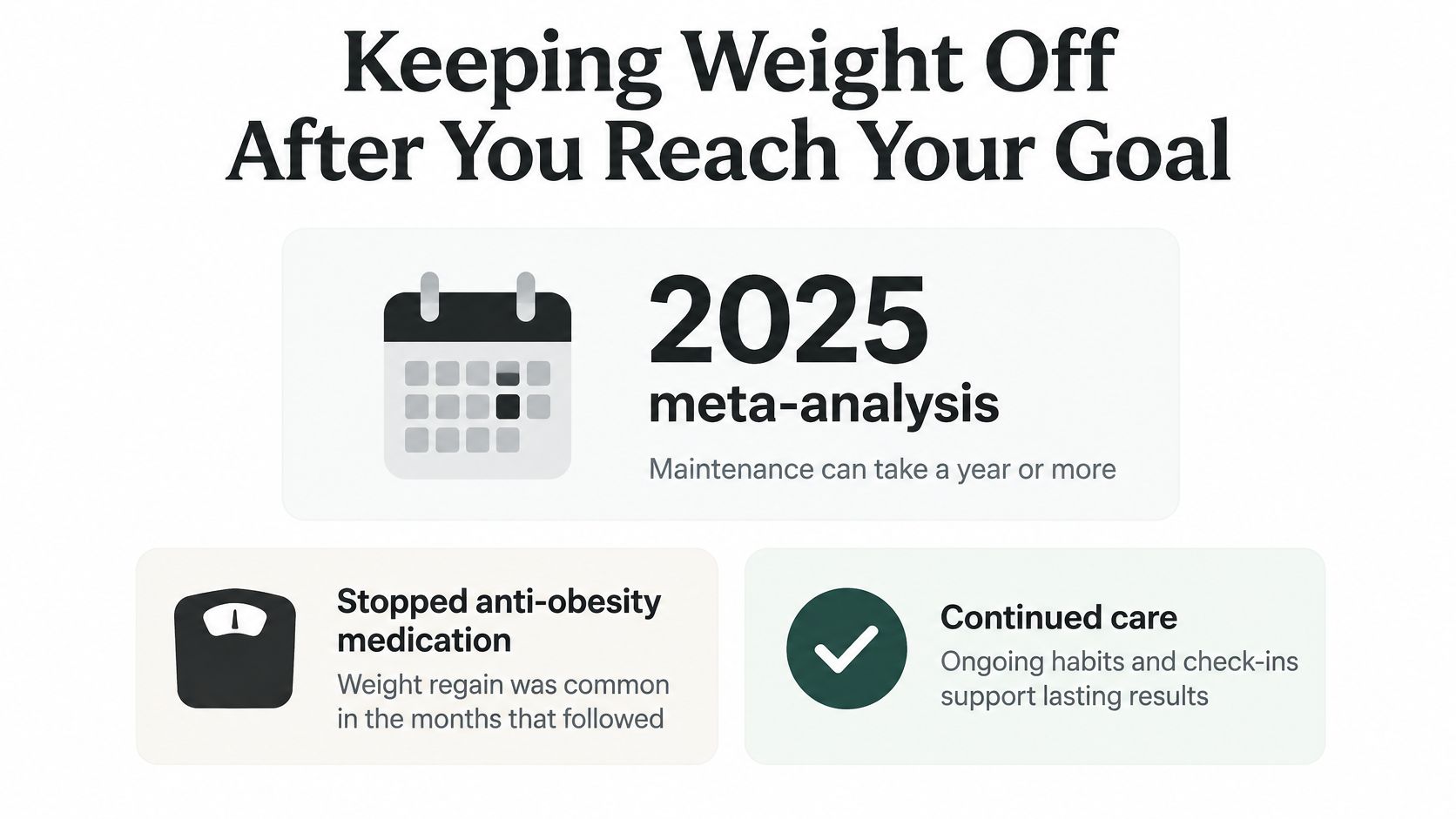
Stopping is a separate phase, and the evidence is blunt. In STEP 4, people who switched from semaglutide to placebo regained 6.9% of body weight over 48 weeks, while those who continued lost another 7.9%, according to trial data summarized by the National Library of Medicine. In SURMOUNT-4, people who stopped tirzepatide regained 14.0% over 52 weeks, while continued users lost an additional 5.5%. Weight regain is expected after discontinuing any semaglutide formulation, including oral Wegovy. Not everyone snaps back to their start weight, but obesity is chronic, and an exit without a plan is how regain starts.
Practices that hold the loss
Decide the transition with a clinician. Don't stop abruptly because a bottle ran out or a copay jumped. Ask for a bridge plan if supply or cost changes, rather than skipping doses on your own.
Eat and train for the new weight. Protein and fiber at each meal, plus resistance training two or three times a week, support the body you are trying to keep.
Watch the weekly average. A sustained upward trend over several weeks is the signal to call. Our guide on what happens when you stop GLP-1 treatment covers that handoff in more detail. Daily weigh-ins mostly show fluid. Write down what you will do if hunger returns, before it returns.
Set Your 6-Month Target and Start Tracking
Set the first target as 5–10% of your starting weight at about six months. For a 200-pound adult, a 12-week checkpoint of roughly 5–10 pounds matches that six-month pace. Record a baseline weight and a waist measurement this week. Track weekly averages for four weeks before you judge anything.
Schedule reviews at 3 months and 6 months, and compare them with the milestone ranges above. Weight loss is not guaranteed. Diet, exercise, and individual biology all shape the result. From assessment to medication delivery, our telehealth process averages about 7 days, and a licensed clinician reviews the plan with you.
- Set a start date you can keep, not a Monday you already know you'll skip.
- Record baseline weight and waist the same morning, before you change the plan.
- Book the 3-month review on the calendar now, so the checkpoint isn't a guess.
If you want to see whether GLP-1 treatment is an option, take our 2-minute quiz and bring those baseline numbers to the visit.
Weight Method connects you with licensed providers for medically supervised GLP-1 care, dose check-ins, and a timeline built around your own milestones rather than a fixed monthly promise. If you are ready to map a six-month target with clinical follow-up, visit Weight Method and start with the online assessment.