Yes, but only as Wegovy (semaglutide 2.4 mg once weekly), which the FDA approved on June 4, 2021 for chronic weight management in adults with obesity, or with overweight plus a weight-related condition. Ozempic and Rybelsus are approved for type 2 diabetes, and compounded semaglutide is not FDA-approved.
So what exactly did the FDA approve? Not semaglutide the molecule. It approved a finished product, from a specific manufacturer, at a specific dose, for a specific group of patients, made a specific way. That's where most confusion starts, because a prescription that says "semaglutide" can be approved, unapproved, or approved for something else entirely.
If a label, a telehealth intake form or an advertisement says "FDA-approved semaglutide," the useful follow-up question is quieter: approved as what, for whom, and at which dose? Read the brand name and the dose, not the active ingredient, and the answer usually becomes clear.
Which Semaglutide Products Are FDA-Approved
The FDA approved semaglutide for chronic weight management under the brand name Wegovy on June 4, 2021, and that approval is narrower than commonly assumed. The FDA's approval summary sets out the specifics: Wegovy is the 2.4 mg once-weekly injection indicated for adults with obesity, generally a body mass index of at least 30, or adults with overweight, generally a BMI of at least 27, who also have at least one weight-related condition. It's meant to supplement a reduced-calorie diet and increased physical activity, not replace them. The approval rested on a Phase 3 program of roughly 4,500 participants across four STEP trials, and it did not extend to every semaglutide product, every dose, every compounded preparation, or cosmetic weight loss in people who don't meet the criteria.
Here's how the products line up.
| Product | Form | FDA-approved use | Dose or frequency |
|---|---|---|---|
| Wegovy | Injection | Chronic weight management in adults with obesity, or overweight with a weight-related condition | 2.4 mg once weekly |
| Oral Wegovy | Daily tablet | Chronic weight management | Once daily; dose set by its own label |
| Ozempic | Injection | Type 2 diabetes and cardiovascular-risk reduction | Once weekly; diabetes dosing per its label |
| Rybelsus | Oral tablet | Type 2 diabetes | Once daily; diabetes dosing per its label |
| Compounded semaglutide | Varies by prescriber | Not FDA-approved | Set by prescriber |
Why approval follows the product, not the molecule
Four variables have to line up before the word "approved" means anything: the brand, the dose, the population and the manufacturing route. Change any one of them and you're looking at a different regulatory object.
So is semaglutide FDA approved for weight loss? Yes, when the prescription names Wegovy at its labeled dose for an eligible patient. No, when the answer is a compounded vial of the same active ingredient with no approved indication behind it.
The FDA-approved labeling for Wegovy draws three lines that get lost in conversation. Ozempic and Rybelsus are semaglutide products approved for type 2 diabetes, not general weight loss. Lower semaglutide doses have not been established for chronic weight management. And compounded drugs are not FDA-approved. That last point has practical weight now that the FDA determined the semaglutide injection shortage resolved in February 2025, while noting that localized supply disruptions can continue.
Off-label is not the same as compounded
Off-label means a licensed prescriber uses an FDA-approved product outside its labeled use. It's legal, it's sometimes appropriate, and the product itself still went through review.
A compounded preparation is a different category: it's an unapproved drug, and a provider can't legally substitute one just because it contains the same active ingredient. Approval status isn't a property of the molecule.
The label check: ask which brand is on the prescription, what condition it's approved for, and whether the product is manufactured or compounded. Those three answers tell you more than the word "semaglutide" ever will.
If you're comparing the two routes, this guide to compounded versus brand-name GLP-1 medications walks through the practical differences.
Who Qualifies for Wegovy and How the Dose Is Set
Eligibility comes down to two numbers on the label.
| BMI | Indication status | Condition needed |
|---|---|---|
| 30 or higher | Eligible for chronic weight management | None beyond BMI |
| 27 to 29.9 | Eligible only with at least one weight-related condition | Hypertension, dyslipidemia or type 2 diabetes |
| Below 27 | Not covered by the Wegovy weight-management indication | Discuss other options with a provider |
A BMI of 30 or higher qualifies on its own. A BMI of 27 or higher qualifies only when a weight-related condition is documented, and the label names hypertension, dyslipidemia and type 2 diabetes among the examples. Below 27, the approved weight-management use doesn't apply and the conversation shifts to other options.
Those thresholds match how GLP-1 treatment is assessed more broadly: eligibility requires a BMI of 30 or higher, or a BMI of 27 or higher with qualifying comorbidities. At that scale, the eligible population is large, and sourced obesity figures from Statlyst show how many adults fall inside these bands.
The provider's job doesn't stop at the number. Semaglutide or tirzepatide is selected based on BMI, medical history and expected response, with gradual escalation dosing built into the plan. Two people with identical BMIs can land on different medications because their histories differ.
How the dose is set
Wegovy starts low and climbs. Gradual dose escalation is deliberate: it improves tolerability and reduces gastrointestinal adverse effects, which is why the schedule stretches across weeks rather than days. The adult maintenance dose is generally 1.7 mg or 2.4 mg injected subcutaneously once weekly, per the Wegovy prescribing information filed with the FDA.
Before the first dose, expect screening for contraindications and for any other GLP-1 therapy already in use. Stacking products isn't a shortcut. It's a safety problem.
Bring these to the first appointment: a current BMI, a written list of weight-related conditions and when they were diagnosed, and every medication you take, including supplements and anything prescribed by another clinician.
Diet and activity aren't optional extras in this arrangement. The indication is written for use alongside reduced-calorie eating and increased physical activity, so a plan that ignores both is only half the therapy. If you want to check yourself against the criteria before booking anything, this GLP-1 eligibility guide runs through the same questions a prescriber asks.
Side Effects and Safety Checks Before Starting
A prescriber reads the label before writing the prescription, and you should know what's on it.
Start with the boxed warning. Semaglutide carries a warning about the risk of thyroid C-cell tumors, and it's contraindicated in anyone with a personal or family history of medullary thyroid carcinoma or multiple endocrine neoplasia type 2. That's a family-history question, so answer it carefully rather than quickly. It's also the reason a thorough intake asks about relatives' cancer diagnoses, not just your own.
Other label warnings cover pancreatitis, gallbladder disease, low blood sugar when combined with insulin or a sulfonylurea, and acute kidney injury from dehydration after prolonged vomiting or diarrhea. Most of these are uncommon. All of them shape what your prescriber watches for during treatment.
The effects you're most likely to feel
Nausea, diarrhea, constipation and vomiting top the list. They cluster around dose increases and often ease when escalation slows down. Reporting them early is more useful than toughing them out, because the usual fix is a longer stay at the current dose rather than stopping altogether. A prescriber who knows you're struggling can hold the dose, split the schedule or reassess the plan.
Two more items belong in the pre-start conversation. Labeling directs patients to stop semaglutide in advance of a planned pregnancy and to discuss contraception with the prescriber. And because other GLP-1 products shouldn't be combined with semaglutide, the medication review has to include anything prescribed elsewhere, including weight-loss drugs from a different clinic.
Ask for the monitoring plan in writing: which weight checks, which symptom reviews and which lab tests will be tracked, and at what intervals.
How Much Weight Loss to Expect on Wegovy
The number many people want is an average, and averages deserve context.
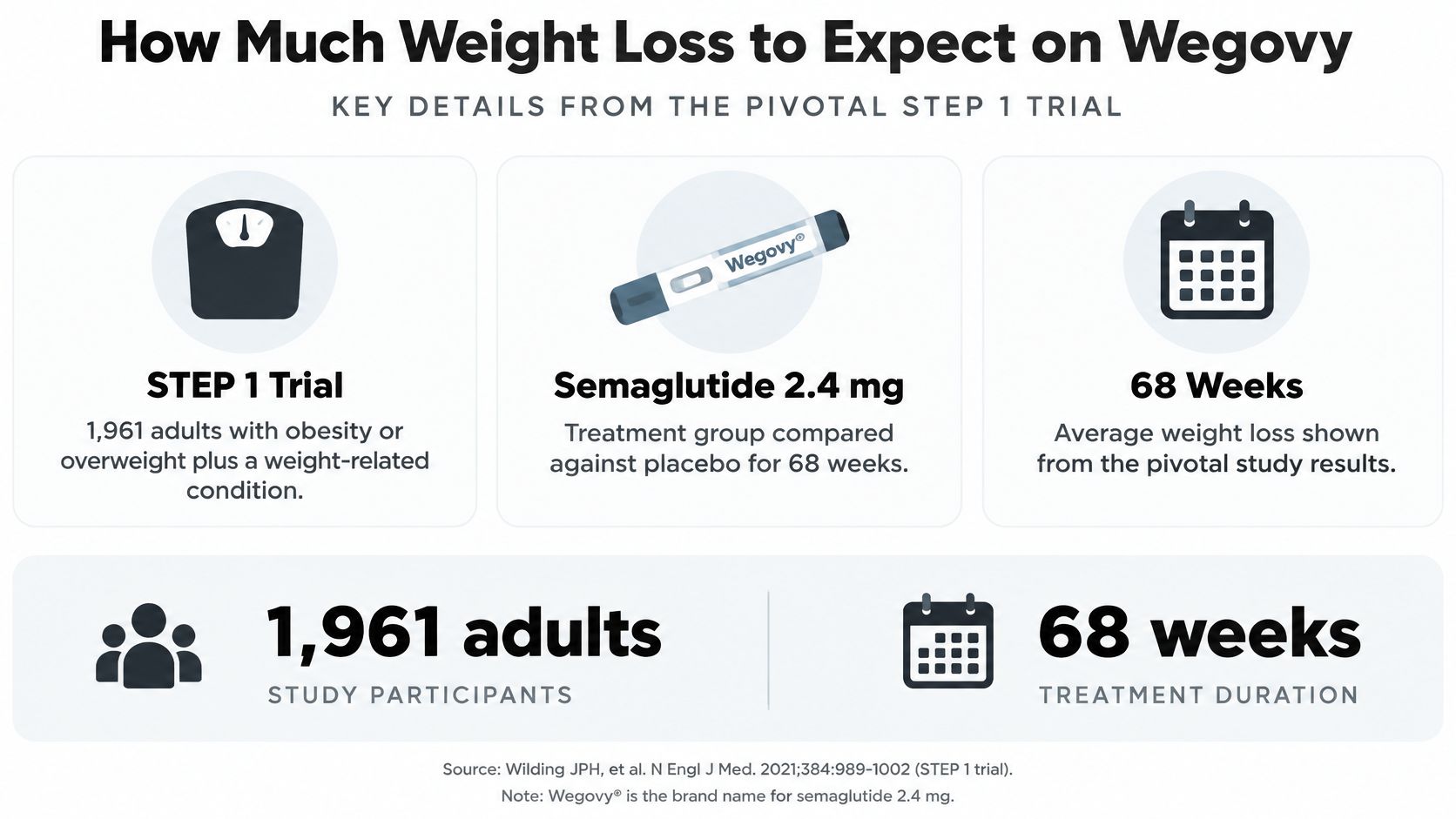
In the STEP 1 trial, published in the New England Journal of Medicine, 1,961 adults without diabetes who had obesity, or overweight plus at least one weight-related condition, received either once-weekly semaglutide 2.4 mg or placebo for 68 weeks, both groups alongside lifestyle intervention. Average body weight declined 14.9% from baseline in the semaglutide group versus 2.4% with placebo, an estimated treatment difference of 12.4 percentage points (P<0.001).
The trial's headline numbers, side by side.
The FDA's statistical review adds a second angle: the estimated active-treatment effect on percentage change in BMI at week 68 was approximately −16.75%, and 73.2% of semaglutide-treated participants reached the prespecified responder threshold reported in the review, according to the FDA statistical review.
| Measure | Result |
|---|---|
| Average body weight change, semaglutide 2.4 mg | -14.9% from baseline |
| Average body weight change, placebo | -2.4% from baseline |
| Estimated treatment difference | 12.4 percentage points (P<0.001) |
| Estimated active-treatment effect on BMI change | about -16.75% |
| Semaglutide participants reaching the prespecified responder threshold | 73.2% |
What those numbers mean for a real person
Take someone starting at 200 lb. A 14.9% average decline works out to roughly 30 lb over 68 weeks. That's the shape of the result, not a guarantee.
Two caveats keep the figure honest. Both arms received lifestyle intervention, so the 12.4-point gap reflects what semaglutide added, not medication versus nothing. And the averages describe a population after 68 weeks, not one person's curve, which is why the study doesn't predict your individual outcome.
Progress rarely moves in a straight line either. Early weeks often show fast movement, then a plateau while the dose climbs, then a slower trend. A provider should be measuring against milestones you set together rather than against a headline average, and adjusting only when the trend, tolerability and adherence justify it.
Appetite changes do part of the work, and how you eat around them matters. If hunger management is the missing piece, this appetite guide for busy professionals covers the day-to-day side of eating well during treatment.
What Happens to Your Weight After You Stop
Approval confirms an indication. It doesn't promise permanence.
The STEP 1 extension followed participants after treatment ended, and the pattern is consistent: people who stopped weekly semaglutide 2.4 mg regained about two-thirds of the weight they had lost within one year, alongside reversals in some cardiometabolic improvements, as reported in the STEP 1 extension study. Mean regain during the withdrawal period was 11.6 percentage points of body weight in the semaglutide group versus 1.9 percentage points with placebo.
That isn't a failure of discipline. It's what happens when the pharmacologic brake on appetite comes off and the underlying physiology reasserts itself.
Regain applies to every formulation
Weight regain is expected after discontinuing any semaglutide formulation, including oral Wegovy. Patients who stop often notice appetite returning within weeks, and the eating pattern built during treatment is what decides how much comes back.
What the data don't establish is that every patient must stay on medication indefinitely. Some people hold a loss with sustained changes to diet, activity and sleep. Others regain steadily. Duration is an individual clinical decision, reviewed over time.
Plan the exit before you start: the most useful question at the first visit isn't only whether you can begin, but what happens to your plan if you respond, plateau, pause or stop.
Bring those four scenarios to your prescriber: continued treatment, a plateau, an interruption such as a supply gap or an insurance change, and full discontinuation. Each needs a defined response, whether that's a dose review, a nutrition reset or a maintenance schedule.
Habits carry what medication was carrying, and building them during treatment rather than after is what makes a stop survivable. This habit guide for busy beginners is a reasonable starting point if structure is the missing piece. Treat the withdrawal figures as what they are, too: they describe the 2.4 mg injection, so confirm any oral Wegovy discontinuation numbers on its own label before applying them to a tablet.
Confirm Your Options With a Licensed Provider
You now have a usable filter. The last step is applying it in a real conversation.
Write the questions down before the appointment: which exact product and brand is being prescribed, and is it FDA-approved or compounded; does your BMI and medical history fit the approved indication; what does the titration schedule look like and how will side effects be managed during increases; and what is the maintenance plan if treatment stops. Ask about nausea, diarrhea and constipation specifically, since those are the effects most likely to derail a dose increase.
Semaglutide and tirzepatide are prescription medications, and the dose is selected and managed by a licensed provider. Nobody should be choosing a starting dose from a forum thread or a friend's leftover pen.
Telehealth is one legitimate route to that conversation. Weight Method connects patients with licensed healthcare providers for the evaluation, prescription and delivery of GLP-1 weight loss medications, semaglutide and tirzepatide, using the same eligibility thresholds described above. Be clear about what you're receiving, though: its compounded semaglutide is not FDA-approved, so confirm which product type is being prescribed, and why, before you decide. Brand-name Wegovy and a compounded preparation are not interchangeable just because both contain semaglutide.
Then book the consultation with three things in hand: your current BMI, your condition list and your medication list. The answer you're looking for isn't "semaglutide." It's a specific brand, a specific dose, and a specific reason it was chosen for you.
Weight Method pairs you with a licensed provider who can tell you exactly which option fits your BMI and history, whether that's an FDA-approved brand-name product or a compounded one, and then ships it to your door with monitoring built in. Every plan includes the consultation, ongoing messaging and dose adjustments rather than a one-time prescription. Take the short online quiz at Weight Method and bring your three questions to the video visit.