Compounded tirzepatide is not FDA-approved and cannot be assumed as safe as, or equivalent to, Mounjaro or Zepbound. The fact that an approved medicine contains tirzepatide doesn't establish the safety of a pharmacy-prepared vial bearing the same ingredient name.
That distinction matters when you're comparing an established prescription with a lower-cost online offer. The useful question isn't whether tirzepatide works. It's whether the exact preparation you'll receive has a lawful prescribing basis, a verifiable source, and dosing instructions that match its concentration.
Is Compounded Tirzepatide Safe Right Now
Compounded tirzepatide doesn't have the same premarket assurances as an FDA-approved finished medicine. The FDA doesn't review each compounded preparation for safety, effectiveness, purity, potency, or manufacturing quality before it reaches patients. That doesn't prove every compounded vial is defective, but it prevents a blanket conclusion that these preparations are equally safe.
The FDA's clarification of its compounding policies states that the national tirzepatide injection shortage was resolved on December 19, 2024, with shortage-based enforcement discretion ending after February 18, 2025, for traditional state-licensed pharmacies operating under section 503A, and after March 19, 2025, for FDA-registered outsourcing facilities operating under section 503B.
Those were transition periods, not approvals of compounded tirzepatide. Previous availability during a shortage doesn't establish that a preparation is equivalent to Mounjaro or Zepbound, and it doesn't provide an indefinite shortage-based justification for continued copying.
FDA-approved tirzepatide versus compounded tirzepatide
Start with who supplies the medicine, then consider what was reviewed and how you'll measure the dose. A familiar ingredient name doesn't answer those questions.
| Question | Mounjaro or Zepbound | Compounded tirzepatide |
|---|---|---|
| Who supplies it | Eli Lilly supplies the FDA-approved finished product | A compounding pharmacy prepares it under applicable legal conditions and a patient-specific prescribing basis |
| FDA review before marketing | Reviewed for safety, effectiveness, and manufacturing quality | Not reviewed by FDA for safety, effectiveness, purity, potency, or quality |
| How the dose is given | Product-specific delivery instructions and labeled milligram doses | May require measuring liquid from a vial using its written mg/mL concentration |
| Can brand trial results be assumed | Evidence applies to the approved product studied | No. Brand outcomes shouldn't be assumed to transfer |
| Shortage status in 2026 | The FDA determined the national injection shortage was resolved | The shortage-based transition periods have ended |
Mounjaro and Zepbound are named approved products, not general labels for any tirzepatide injection. When a seller describes a compounded vial using a brand's results, ask whether the evidence concerns the preparation being offered.
Cost and convenience are understandable concerns. Neither answers whether an available approved medicine could meet your medical need, or whether the compounder has a lawful basis to prepare something different.
What a meaningful safety assessment includes
A careful prescriber considers lawful sourcing, pharmacy controls, accurate formulation, storage, labeling, and clinical supervision together. Good instructions can't compensate for an unverified ingredient source. A licensed pharmacy can't compensate for a patient measuring the wrong volume.
For broader context about injectable preparations, Restore Osteopathic Medicine's discussion of are compounded peptides safe is a useful companion to a product-specific conversation. It shouldn't replace verification of the actual pharmacy and prescription.
Practical rule: Ask why your medical need can't be met by an available FDA-approved medicine before comparing compounded offers.
The answer should describe your situation, not repeat that compounding was available during the shortage.
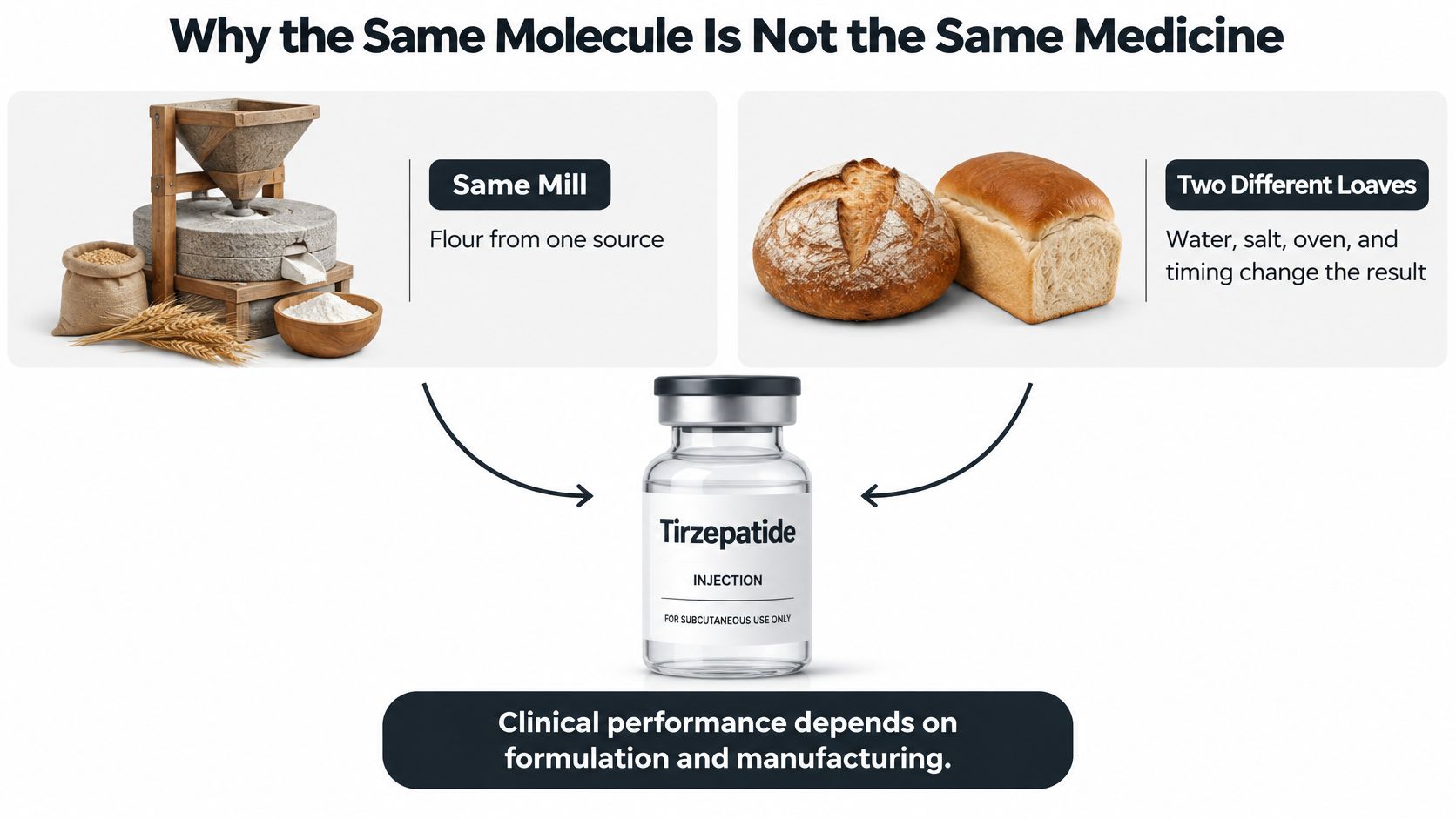
Why the Same Molecule Is Not the Same Medicine
Flour from the same mill can become different loaves when the baker changes the water, salt, oven, or timing. Knowing where the flour came from tells you something about the ingredients, but not everything about the finished bread.
A medicine requires far tighter controls than bread, but the distinction is useful. Ingredient identity is only part of product quality. With a peptide injection such as tirzepatide, concentration, sterility, impurities, stability, added ingredients, storage, and delivery accuracy all matter.
Follow the preparation, not just the ingredient
Say a patient receives a pharmacy-prepared vial instead of a manufacturer's finished product. The clinician needs to establish more than whether the label says tirzepatide. They need to know how much is in each milliliter, how the preparation was handled, and whether the instructions match the supplied injection device.
The FDA's guidance on unapproved GLP-1 medicines explains that compounded drugs aren't reviewed before marketing for safety, effectiveness, or quality. Compounded tirzepatide should not be treated as therapeutically interchangeable with Mounjaro or Zepbound.
Compounding means preparing a medicine for an individual medical need rather than supplying a pre-reviewed manufactured formulation. Traditional state-licensed compounding pharmacies generally work from patient-specific prescriptions. FDA-registered outsourcing facilities occupy a separate legal category with different statutory conditions.
Registration describes a facility's regulatory status. Approval concerns a particular medicine. A facility's registration doesn't mean the FDA validated its tirzepatide formula before sale.
Make quality questions concrete
For that hypothetical patient, the clinician should first determine whether an approved product is available and medically appropriate. If a compounded preparation is still being considered, the review should address:
- Legal category and prescription basis. Identify the actual preparing facility and the patient-specific reason for the prescription.
- Lot-specific controls. Ask what testing addresses sterility and preparation quality for the lot being supplied.
- Beyond-use date. Confirm when the pharmacy says the preparation must no longer be used.
- Cold-chain handling. Establish how storage conditions are maintained during shipment and after arrival.
- Written concentration. Require a clear statement in milligrams per milliliter, not just an instruction expressed in syringe units.
These are separate checks. A clear label doesn't demonstrate sterility, and a cold package doesn't establish ingredient identity.
Our compounded versus brand-name GLP-1 guide can help you organize the product comparison before an appointment. Avoid preparations sold without a prescription or with an unclear active-ingredient source, rather than trying to resolve those gaps after delivery.
Claims That Do Not Make It Safe
An advertisement can sound reassuring while leaving the most important questions unanswered. Listen for claims that substitute a credential, a price, or a familiar name for verification of the actual preparation.
Registration and shortage claims
FDA-registered means FDA-approved. It doesn't. Ask whether the claim concerns the facility or the medicine, because those are different regulatory questions.
The shortage made compounding acceptable indefinitely. A temporary shortage policy isn't permanent permission to supply copies. A current prescription needs a current legal and clinical basis, not an explanation of what sellers could supply in the past.
These claims often appear together: a seller points to its pharmacy's status, then describes the shortage as though nothing changed. Neither statement answers why that particular patient should receive that particular compounded preparation today.
Price, symptoms, and research products
A lower cash price means it's the same pen without the brand premium. A price tells you what you'll pay, not what manufacturing evaluation the preparation received. It also doesn't transfer the brand's clinical-trial outcomes to a pharmacy-made formulation.
Side effects are only an upset stomach, so monitoring is optional. That description leaves out potentially serious problems and the possibility of a dosing mistake. A responsible plan identifies who will respond to symptoms and when the patient needs in-person care.
A research vial or no-prescription powder is a workaround. Those products bypass the prescription and pharmacy safeguards that should be minimum expectations for an injectable medicine. Don't treat instructions from a seller or an online discussion as a substitute for a pharmacy-dispensed prescription.
The molecule being approved is not a safety certificate for every copy of it.
You don't need to prove a seller's claim false before deciding not to inject a product. If the seller can't identify the dispensing pharmacy, explain the prescription process, or provide usable labeling, that uncertainty is enough to pause.
A convincing explanation should let your clinician verify the product independently. Testimonials, packaging photos, and assurances that other customers have used it aren't a substitute.
Adverse Reports and Dosing Errors
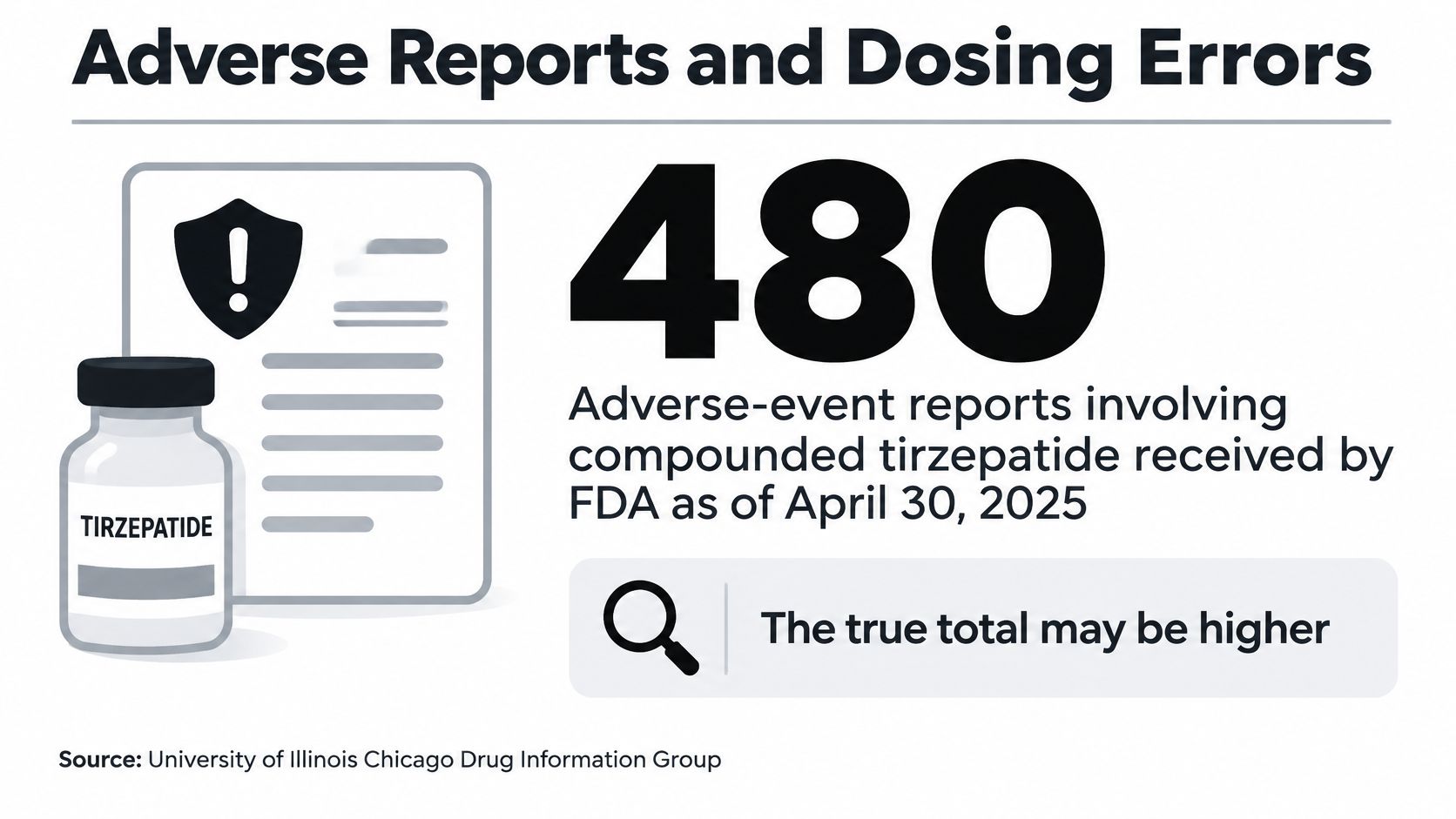
The University of Illinois Chicago Drug Information Group summary of FDA safety concerns about unapproved GLP-1 drugs reported that, as of April 30, 2025, the FDA had received 480 adverse-event reports involving compounded tirzepatide. The summary also cautioned that the true total may be higher because some state-licensed pharmacies aren't required to report in the same way as manufacturers.
That figure deserves attention, but it isn't a complication rate. Reports alone can't establish that the medicine caused every event, and the count doesn't tell you how many people used compounded tirzepatide without a reported problem.
What the reports can tell patients
Reported problems included gastrointestinal symptoms, fainting, dehydration, pancreatitis, and gallbladder-related illness, with some cases requiring hospitalization. These are reports of problems involving the products, not proof that every case had the same cause.
The FDA has also warned about patients and clinicians administering compounded GLP-1 doses substantially above the intended amount. Its concerns include reports involving compounded tirzepatide doses beyond the FDA-approved label.
That makes the prescribing process important even when someone has previously tolerated treatment. Increasing the amount, changing the vial concentration, or misunderstanding an instruction can create a new risk.
Approved weekly tirzepatide dose ladder
The weekly milligram steps below provide a reference for discussing tirzepatide prescriptions. They are not a self-directed escalation schedule, and they don't tell you what volume to withdraw from any compounded vial.
| Approved step | Weekly dose |
|---|---|
| Step 1 | 2.5 mg |
| Step 2 | 5 mg |
| Step 3 | 7.5 mg |
| Step 4 | 10 mg |
| Step 5 | 12.5 mg |
| Step 6 | 15 mg |
Our providers select and manage doses with gradual escalation based on the patient's medical history and response. Seeing a higher dose in a table doesn't mean it's appropriate for you, and it doesn't authorize an increase.
The relevant risk controls are written milligram and milliliter instructions, conservative titration, verified pharmacy preparation, and clinician monitoring. Patients also need an explicit contact route for suspected errors, rather than waiting until their next routine refill.
An approved molecule doesn't make every compounded copy safe. The adverse-event reports reinforce the need to evaluate the entire preparation and administration process without pretending the reporting system can calculate an individual patient's exact risk.
What a Units Mix-Up Looks Like
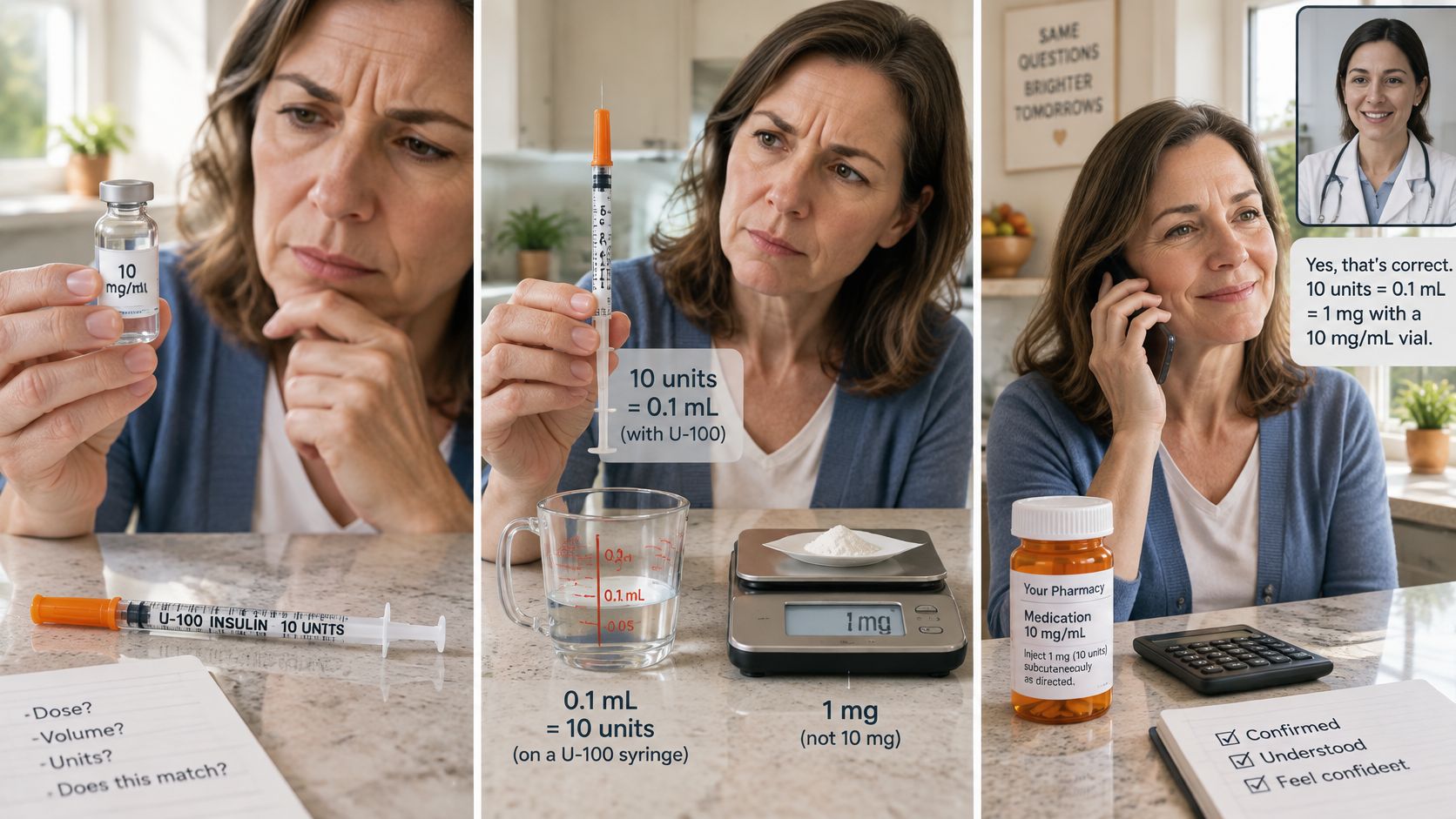
A syringe marking can look precise while leaving the actual drug amount unclear. Units describe a measurement on the syringe, not a universal tirzepatide dose. The amount of medicine represented by that marking changes with the liquid's concentration.
The following examples are hypothetical illustrations of errors, not instructions for measuring your prescription.
The familiar mark with an unfamiliar meaning
Say an instruction names a syringe marking without stating the prescribed milligrams. The patient recognizes the mark and assumes that's all they need to know.
In this hypothetical U-100 syringe example, 10 units represents 0.1 mL. The arithmetic shows why a concentration change matters.
Same units, different milligrams
| Label and vial | Milligrams delivered |
|---|---|
| Hypothetical 10 units, 10 mg/mL vial | 1 mg |
| Hypothetical 10 units, 20 mg/mL vial | 2 mg |
These example concentrations aren't recommended prescriptions. The visible warning is an instruction that names only units, with no clear connection to the prescribed milligrams and the vial's mg/mL concentration.
The replacement vial that looks the same
Another patient changes pharmacies and receives a similar-looking vial. They continue drawing the familiar volume without noticing that the concentration has changed.
The clue might be a different label, lot, vial size, or supplied syringe. Don't carry an old volume instruction forward automatically. A pharmacist or prescriber needs to reconcile the replacement product against the prescription.
Our guide to converting tirzepatide units to milligrams explains the distinction between these measurements. It doesn't replace confirmation of the exact vial and device in your hand.
The attempted catch-up dose
A patient misses an injection and tries to catch up by taking extra draws. Their written plan doesn't authorize that change, but they assume the missed amount should be added.
The warning is the absence of product-specific missed-dose instructions. Pause, photograph the label, and contact the prescribing clinician or pharmacist before injecting, rather than guessing a correction.
Severe persistent abdominal pain, repeated vomiting, fainting, or signs of dehydration need urgent medical assessment, not a prolonged message thread. Any change in pharmacy, concentration, vial size, or injection device warrants a fresh medication reconciliation.
Checks Before You Accept a Vial
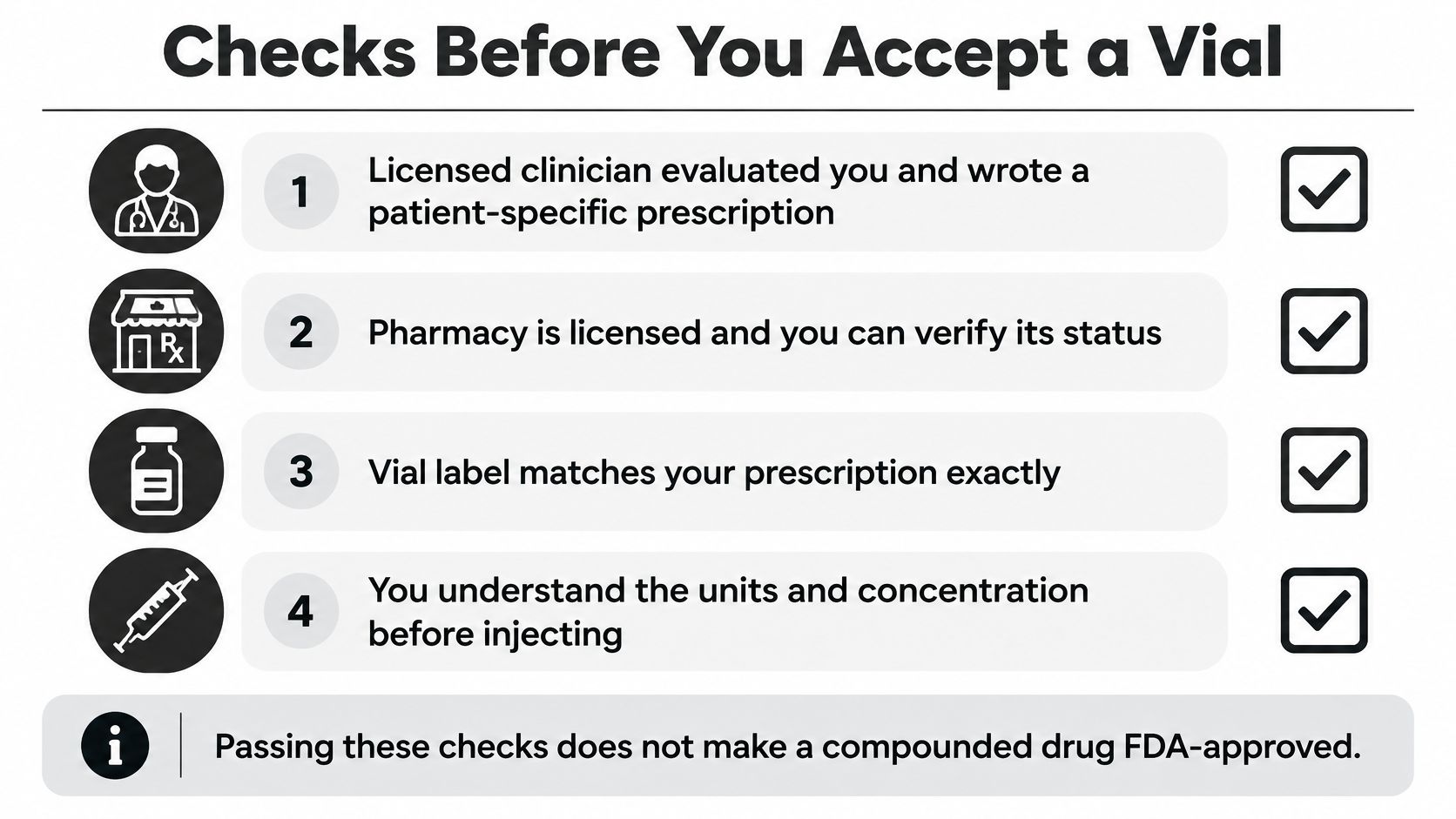
Use these questions to decide whether the prescription is ready to use, not to certify that a compounded preparation is equivalent to an approved medicine. Passing a checklist doesn't make a compounded drug FDA-approved.
Have the prescription, vial label, supplied device, and written instructions available together. If they don't agree, ask the pharmacy and prescriber to resolve the discrepancy before you inject.
Questions to ask out loud
-
Who evaluated me, and why is this preparation being prescribed? Confirm that a licensed clinician reviewed your individual medical history and issued a patient-specific prescription. Ask why an FDA-approved product isn't being used.
-
Which pharmacy prepares and dispenses it? Get the pharmacy's name and verify its licensing status through the relevant state board of pharmacy. Our compounded prescriptions are prepared by U.S.-licensed 503A pharmacies under patient-specific prescriptions.
-
What are my dose, concentration, and matching volume? The instructions should state the prescribed milligrams, the vial concentration in mg/mL, and the corresponding volume for the supplied device. Don't accept an unexplained units-only instruction.
-
How should I store it, and what if it arrives warm? Read the beyond-use date and written storage requirements. If shipping conditions are uncertain, ask the dispensing pharmacy whether the preparation remains usable rather than assuming refrigeration afterward fixes the problem.
-
What quality checks apply to this lot? Ask how the pharmacy addresses sterility and preparation quality. A general statement about careful practices isn't the same as a clear answer concerning the supplied lot.
-
Can you identify the active-ingredient source? Avoid products with unclear provenance, research-use labeling, or no prescription requirement. Don't accept a seller's suggestion that you can make an injectable preparation yourself.
-
Have you reviewed everything else I take? Bring prescription medicines, supplements, and any other weight-loss or GLP-1 products. The clinician needs a complete list to identify overlapping treatment and plan safe changes.
Don't use symptoms as a quality test
Nausea, diarrhea, or vomiting don't authenticate a compounded product. Feeling an effect doesn't establish that the vial has the intended concentration, appropriate purity, or acceptable sterility.
Before you inject: An unanswered question about the prescription, concentration, or cold chain is a reason to pause, not a reason to find a cheaper vial.
Keep copies of the label and instructions so the clinician can identify what you received if a concern arises. Retain the lot information when discussing a suspected product problem with the pharmacy.
Ask a Licensed Provider Before You Start
Book a clinical visit before the first injection, whether you're seeking diabetes care or weight-loss treatment. Bring your weight history, BMI if known, medical conditions, previous treatment response, and a full medication list.
For our GLP-1 treatment evaluation, eligibility requires a BMI of 30 or higher, or 27 or higher with qualifying comorbidities. Meeting that threshold doesn't determine which medicine is appropriate, establish a reason to compound, or replace an individual safety review.
Make the appointment a treatment decision
Ask the clinician to decide these questions in order:
- Approved option first. Is an FDA-approved medicine available and medically appropriate?
- Individual need next. If a compound is being considered, what patient-specific need supports that choice?
- Monitoring before delivery. Who will manage dose changes, side effects, missed doses, and any transition between products?
If a compounded prescription is issued, confirm the preparing pharmacy and make sure the concentration is written in mg/mL. Your clinician should reconcile the product you receive, not merely approve the ingredient name.
Our telehealth weight-loss medication overview describes the remote-care route. We connect adults with licensed providers who evaluate whether semaglutide or tirzepatide is appropriate and prescribe when indicated.
Our compounded tirzepatide monthly plan costs $119 for the first month, then $329 per month, is billed monthly, and can be canceled anytime. Provider review, medication, care-team support, and shipping are included, but compounded medications aren't FDA-approved, and brand-trial results shouldn't be assumed to apply.
The answer to “Is compounded tirzepatide safe?” therefore requires more than an online offer or a familiar molecule name. Don't start, switch, or measure a vial until a licensed clinician has reconciled the exact product in your hand.
Weight Method connects adults with licensed providers for individualized weight-loss medication evaluation and ongoing care. Visit Weight Method to discuss whether an FDA-approved option can meet your needs and whether any proposed compounded prescription has an appropriate patient-specific basis before you begin.