If you've typed what are the weight loss injections into a search bar, you're probably after a straight answer, not a sales page. Most articles hand you an average percentage and stop there, which leaves the harder questions untouched. What happens if the pharmacy can't fill your dose? What happens when you stop?
The average is the easy part. The decisions around it are where people get stranded, three months in, when a plateau arrives or a prescription costs more than expected. So this guide builds from the basics: which drugs exist, what they do inside the body, who qualifies, how a course unfolds, and, the part most explainers skip, what stopping looks like. Every trial number comes with the study and the population behind it, and every one describes an average rather than a promise.
What Weight Loss Injections Are and How the Main Options Compare
Weight loss injections are prescription medicines given once a week under the skin. They are used for long-term weight management alongside a reduced-calorie diet and increased physical activity. The two main options work through different hormone receptors: semaglutide acts on GLP-1 receptors, while tirzepatide acts on both GIP and GLP-1 receptors.
Brand names can make the comparison confusing. Semaglutide is sold as Wegovy for chronic weight management and Ozempic for type 2 diabetes. Tirzepatide is sold as Zepbound for weight management and Mounjaro for diabetes. The active ingredient and the approved use depend on the product, so check the name on the prescription.
| Drug | Mechanism | Weight-management brand | Dosing | Average weight loss (72 weeks) |
|---|---|---|---|---|
| Semaglutide | GLP-1 receptor agonist | Wegovy | Once-weekly injection | 13.7% at 1.7 or 2.4 mg |
| Tirzepatide | Dual GIP and GLP-1 receptor agonist | Zepbound | Once-weekly injection | 20.2% at 10 or 15 mg |
In a 72-week head-to-head trial, the average reductions were 13.7% with semaglutide and 20.2% with tirzepatide. Because both medicines were tested in the same trial, these results can be compared more directly than results from separate studies. The difference favoring tirzepatide was statistically significant (NEJM head-to-head trial). These are trial averages, not predictions for an individual.
The FDA approved tirzepatide as Zepbound for chronic weight management in November 2023. In the larger of two randomized trials involving 2,519 adults receiving weekly injections and 958 receiving placebo, participants without diabetes who took 15 mg weekly lost an average of 18% of their starting body weight over 72 weeks (FDA approval announcement). Individual results vary.
In 2024, 12% of U.S. adults said they had ever taken a GLP-1 drug, and 6% said they were currently taking one, according to KFF's nationally representative Health Tracking Poll.
Why the brand name on the prescription matters
Before comparing results, identify the active ingredient and the product prescribed. A comparison of tirzepatide and semaglutide for weight loss can help clarify which trial results apply to each medicine.
How GLP-1 Injections Work in the Body
After you eat, your gut releases a hormone called GLP-1. It travels to your brain and signals, in effect, that you've had enough. The injection is a lab-made version of that signal, built to stay active for a full week instead of fading within minutes. That's the honest one-line model.
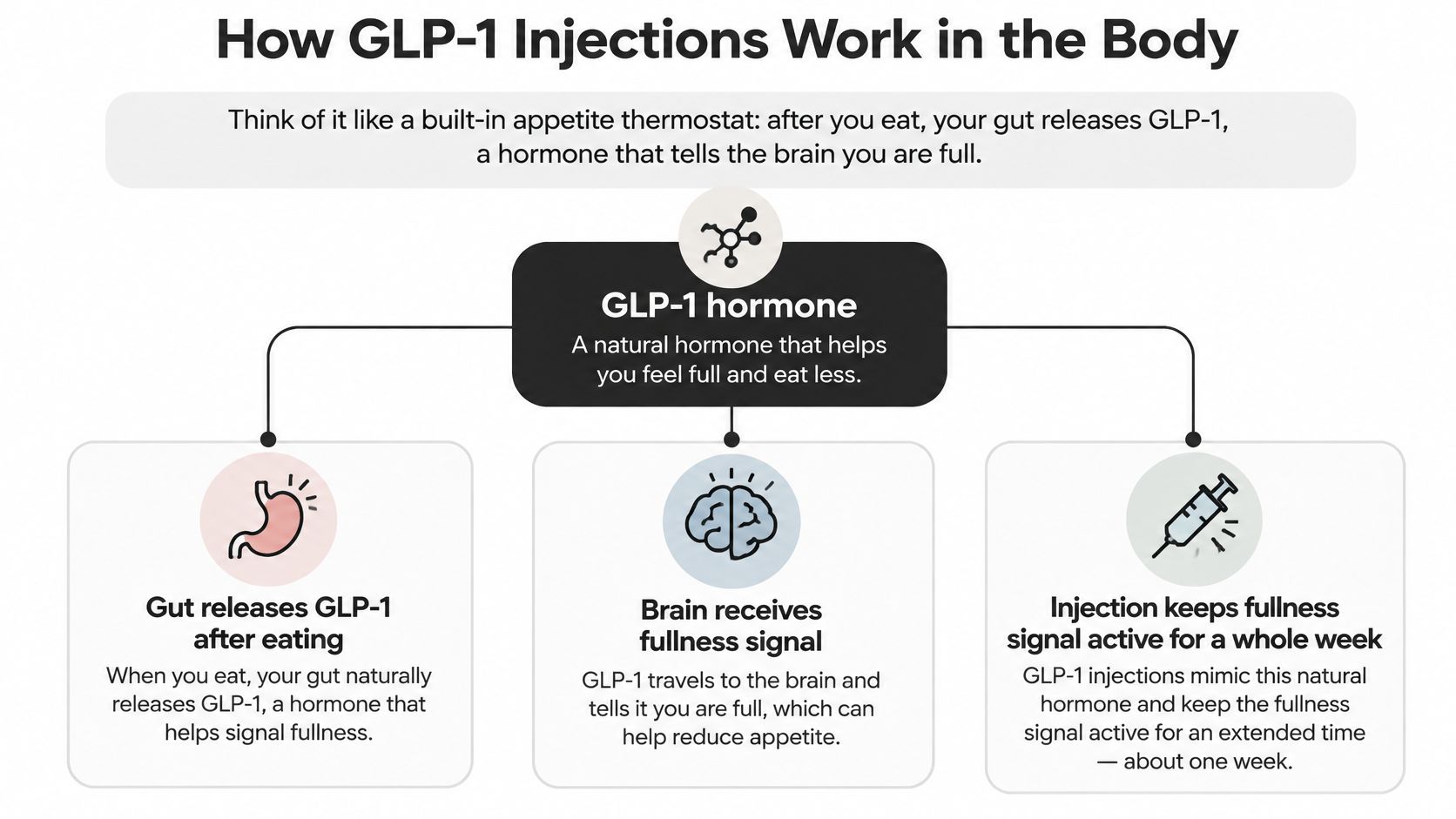
The four jobs the medicine does
Insulin release, only when needed. GLP-1 signaling enhances glucose-dependent insulin secretion, so the pancreas responds when blood sugar is high and stays quiet when it's already normal.
Less glucagon. It reduces inappropriate glucagon release, the hormone that pushes blood sugar up between meals.
A slower stomach. Gastric emptying slows, so food sits longer and a smaller portion registers as a full meal.
A quieter appetite center. GLP-1 acts on central appetite pathways (NEJM trial report). That's why people describe the background food chatter going quiet rather than just white-knuckling dessert.
Tirzepatide adds a second signal by activating GIP receptors as well as GLP-1 receptors, which is why the two drugs aren't interchangeable in expected response. In a 72-week head-to-head trial of 751 adults with obesity but without diabetes, waist circumference fell by 18.4 cm with tirzepatide at 10 or 15 mg versus 13.0 cm with semaglutide at 1.7 or 2.4 mg.
Nausea is the most common early complaint, and it isn't a sign of allergy or overdose. The same slowed stomach that makes you feel full can make you queasy, and gastrointestinal effects including nausea, vomiting, diarrhea and constipation are commonly dose-related. Doses climb slowly for exactly that reason.
What you'll notice first: smaller portions feel satisfying, and the urge to snack between meals eases well before the scale moves much.
What the medicine does is lower how much you eat and make eating easier to steer. It doesn't pick the food, build the muscle, or replace the walking.
Who Can Get a Prescription and What Affects Access
Eligibility is mostly a numbers conversation with a clinical overlay. A prescriber checks the relevant factors.
| Factor | Threshold or case | What it means |
|---|---|---|
| Body mass index | 30 or higher | Usually qualifies on weight alone |
| Body mass index with condition | 27 to under 30 plus a weight-related condition | Qualifies when a condition such as high blood pressure, type 2 diabetes or sleep apnea is present |
| Thyroid cancer history | Personal or family history of medullary thyroid carcinoma or MEN 2 | Generally excluded |
| Pregnancy | Pregnant or planning pregnancy | Not used during pregnancy; a stop plan is set beforehand |
| Insurance | Coverage varies by plan and employer | Prior authorization may be needed; cash pay is a common alternative |
The BMI line starts the conversation, it doesn't end it. A prescriber also weighs what else is going on. A personal or family history of medullary thyroid carcinoma or multiple endocrine neoplasia syndrome type 2 is a standard contraindication, and these medicines aren't used during pregnancy. If you take insulin or an insulin secretagogue such as a sulfonylurea, expect closer glucose monitoring, because the combination can push blood sugar too low.
The gap between qualifying and getting the drug
Cost is the wall hit second. In 2024, 54% of U.S. adults who had taken a GLP-1 drug said the medications were difficult to afford, including 22% who said they were very difficult to afford, according to KFF's Health Tracking Poll.
Employer coverage explains part of that gap. In 2024, 18% of U.S. firms with at least 200 employees covered GLP-1 agonists when used primarily for weight loss, rising to 25% among firms with at least 1,000 employees (KFF Employer Health Benefits Survey). If your plan excludes weight-loss drugs, the diagnosis on the prescription can matter as much as the drug itself.
One more fork in the road is the product. FDA-approved pens are manufactured and packaged by the drugmaker. Compounded versions are mixed by pharmacies and are not FDA-approved, so concentration and ingredients can differ from what the trials studied. Confirm which one you're being prescribed and which pharmacy is dispensing it.
Before you book: write down your height, weight, current medicines, any family history of thyroid cancer, and whether your plan covers obesity medications. That's most of the first appointment done.
If you'd rather check the thresholds against your own numbers first, this walkthrough of GLP-1 eligibility covers the same criteria in plain language.
Dosing Schedule and How a Course Unfolds
Both drugs start low and climb. The schedule is the treatment, not a delay before it.
| Drug | Starting dose | How it climbs | Maintenance range |
|---|---|---|---|
| Semaglutide (Wegovy) | 0.25 mg once weekly | 0.5 mg after four weeks, then steps every four weeks | Up to 2.4 mg weekly |
| Tirzepatide (Zepbound) | 2.5 mg once weekly | 2.5 mg steps at intervals of at least four weeks | 5 mg to 15 mg weekly |
Why the climb is slow
Titration lets your gut adapt and lets the prescriber find the highest dose you tolerate rather than the highest dose on the label. FDA trial protocols titrated participants over as long as 20 weeks before maintenance, pairing the drug with diet counseling aimed at roughly a 500-kcal daily deficit and activity counseling targeting at least 150 minutes per week (NEJM trial protocol).
Here's the course as it usually runs.
- Pick one day and stick to it. A weekly injection on a fixed day is easy to remember and easy to check against a calendar when symptoms or questions come up.
- Start the food and movement changes in week one. The medication complements a reduced-calorie diet and regular activity; it doesn't substitute for either, and pairing it with nothing is how muscle and nutrition get lost.
- Report every dose change and every symptom at follow-up. That's what tells the prescriber whether to hold, step down, or continue climbing.
- Settle into a maintenance dose, usually several months in. Confirm the target with your provider rather than assuming the top dose is the goal.
- Review progress on a schedule. Regular visits catch plateaus, side effects and supply problems before they become a crisis.
A plateau is information, not failure. It means intake and output have met. The prescriber decides whether that calls for a dose change, a nutrition review, or nothing at all.
Side Effects, Limits and What Happens After Stopping
The part that surprises people is what happens when the injections stop. In a large real-world U.S. study, 81,919 adults discontinued a GLP-1 receptor agonist, and among those with follow-up weight data, greater regain was linked to a higher chance of restarting treatment. Each 1% of regained weight was associated with a 2.3% higher reinitiation hazard in people with type 2 diabetes and a 2.8% higher hazard in people without it. Participants who stopped tirzepatide regained 14% of body weight over the following year, while those who continued lost an additional 5.5% (JAMA Network Open study).

Set the side effects beside that. Nausea, vomiting, diarrhea and constipation are common and tend to follow the dose. Severe symptoms can dehydrate you, and combining these drugs with insulin or insulin secretagogues raises the risk of low blood sugar. Weight loss is not guaranteed, on these medicines or any others, because diet, exercise and individual biology all shape the outcome.
Protect lean mass while the scale moves. Fast loss without resistance training and enough protein can cost muscle, and Venus Health Co.'s guidance on maintaining muscle while losing fat covers the training and protein side of that.
Stopping isn't automatically a failure. Obesity is a chronic condition, and appetite regulation returning after withdrawal is biology, not weak will. That's the argument for planning the maintenance phase before the first injection, and for reading what happens when you stop GLP-1 treatment before the last one.
Ask before you start: if I stop in a year, what's the plan for the twelve months after that?
Your Provider's Role and How to Start Safely
The risks that matter most with these medicines are the ones you can't feel. You can feel nausea. You can't feel dehydration building over three days of vomiting, or blood sugar dropping after an insulin dose that was correct before you started. A licensed prescriber is the person watching for exactly those.
Before prescribing, that provider reviews your medical history, current medicines and family history, which is where thyroid cancer history, pregnancy plans and interacting drugs surface. Through titration, they track tolerance and weight at each dose change, watch for dehydration and low blood sugar, and help you through plateaus. Decisions about going up, pausing or stopping belong to the prescriber, who can adjust the plan instead of leaving you to guess.
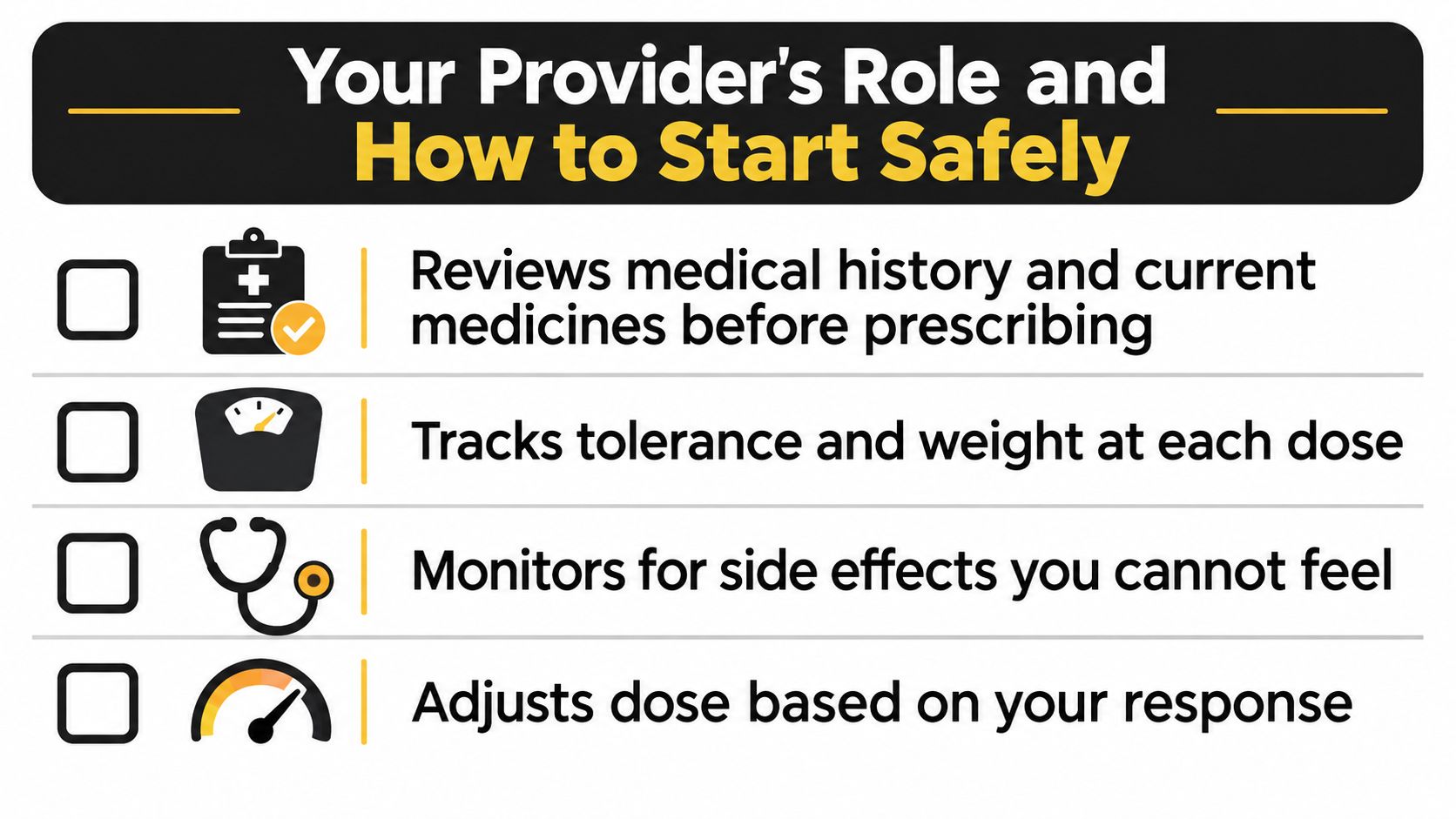
What supervision actually looks like across a year
Expect regular check-ins rather than a single prescription, a way to message about side effects between visits, and a written maintenance plan covering what happens if treatment ends or a dose becomes unavailable. Nutrition support belongs in there too, since sorting out what to eat is a separate skill from taking a weekly shot; a shortlist of top weight loss meal planning apps can do more for your results than a dose increase.
Five questions to ask at the first visit
- Is the product FDA-approved or compounded, and which pharmacy fills it?
- How will you check my hydration and blood sugar, and how often?
- What do I do if my dose is unavailable?
- What is the maintenance plan if I stop?
- Who do I call for severe symptoms, and what counts as severe?
A good answer is specific, written down, and tied to your own history. "We'll monitor you" isn't an answer. "We'll check weight and side effects at each dose change, and here's the number to call if you can't keep fluids down" is.
Three steps before your first injection
Gather the facts. Height, weight, current medicines, past diagnoses, family history and insurance details, in one place.
Book a consultation with a licensed provider, in person or by video, and bring those notes.
Start only after the plan is confirmed in writing, including the titration schedule and the stop plan.
Weight Method is one U.S. telehealth option that connects patients with licensed providers who specialize in obesity medicine, and a two-minute quiz shows whether GLP-1 treatment is worth a consultation at all. The provider, not the quiz and not any online tool, decides whether treatment is appropriate.
Weight Method pairs you with licensed providers who specialize in obesity medicine, reviews your history before anything is prescribed, and ships GLP-1 medication to your door with ongoing support through every dose change. If this guide answered your questions about what the weight loss injections are, the next useful step is finding out whether they're appropriate for you. Take the two-minute quiz and book a consultation at Weight Method.