You've done the injections on schedule for eight weeks. You've kept the food log, walked on the days you said you would, and turned down the office birthday cake twice. Then the scale moves one pound, and the whole effort looks like it failed. At that point, negotiating with yourself gets tempting: skip a dose, eat less, quit the log.
Your provider reads the same number differently. They pull up the last three check-ins, hold that one-pound week against the target you set in week one, and ask about nausea, missed doses and what changed in the last fortnight. The scale number becomes one input among several, and the conversation turns into a decision: continue, adjust, or investigate.
That decision-making habit is progress monitoring, and it's what separates a scoreboard from a treatment plan.
What Progress Monitoring Means in Weight-Loss Care
A single reading on a bathroom scale is a snapshot. Progress monitoring is a series of snapshots read against each other and against a target, with a rule for what happens when the two diverge.

In clinical care, the term describes a structured system for repeatedly collecting and evaluating data to determine whether a person is moving adequately toward a defined goal and whether the intervention should be changed. Pamela Stecker's overview of progress monitoring for WestEd traces that practice to curriculum-based measurement at the University of Minnesota's Institute for Research on Learning Disabilities in the mid-1970s and early 1980s, where a 1984 study by Fuchs, Deno and Mirkin was the first large-scale experimental-contrast study to show significantly improved student achievement when progress-monitoring data guided instructional decisions in New York City schools. The feedback-and-adaptation logic later carried into clinical care, rehabilitation and behavioral health.
So what is progress monitoring in a weight program? Three parts, working together. A goal you and your provider define. Repeated measurements on a schedule you both know. And a decision rule that says what happens when the numbers miss the goal.
Two details in that definition deserve a closer look, because they change what counts as data. First, "measurements" is plural on purpose. Weight belongs in the record, but so do the non-scale entries: waist measurements, energy and sleep notes, side-effect reports, and the behavior log itself, meaning what you ate, when you moved, and which doses you took as prescribed. Second, "moving adequately" is judged against expectation, not against perfection. A week where the scale barely moves can still show a full log, consistent dosing and shrinking measurements, and that week counts as progress in a monitored system.
A paper map and a navigation app capture the difference. The map only shows where you are. The navigation system compares your position with your destination, notices when you drift off route, and recalculates. It doesn't scold you for the wrong turn. It reroutes.
That is the shift worth holding onto. A checkup is a measurement. Monitoring is a relationship between measurements, where each new reading changes what the next decision should be.
What makes it monitoring: a target, a schedule, and an agreed consequence for missing the target. Remove any one of the three and you're just keeping records.
If you don't yet have a clinician running that loop with you, it makes sense to book a weight loss consultation so the goals and decision rules are set before the data starts arriving.
How the Monitor-and-Adjust Loop Works
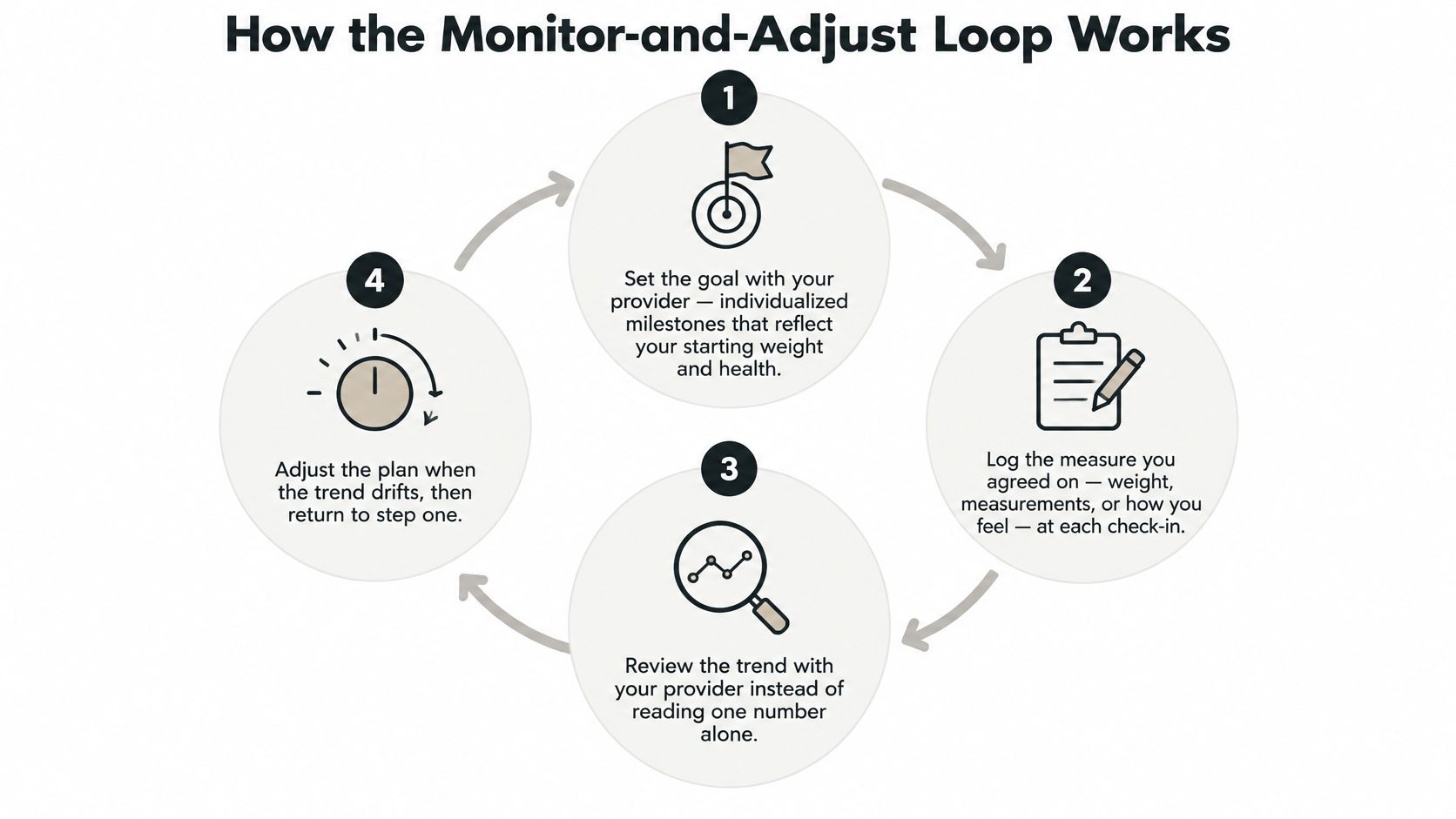
The loop repeats at every check-in, in the same order, whether you're three weeks in or eighteen months in.
-
Set the goal with your provider. Milestones should reflect your starting weight, health profile and early response. A Weight Method provider sets individualized milestones based on how you respond, so the target comes from your own trajectory rather than a borrowed figure. You can't call a reading off track without a track.
-
Measure at each scheduled check-in. Log weight as a weekly average rather than a single morning number. A one-day reading carries too much noise to compare month over month; an average carries the direction of travel. The log also captures what the scale can't: doses taken, side effects, eating patterns, activity. Those entries are what turn step four from guesswork into diagnosis.
-
Compare against the expected trend for your dose stage. Dose escalation usually runs over 8-16 weeks, so a slow fortnight in week three gets read differently from a slow month in week twelve. Early visits test tolerance; later visits test response. Comparison also protects you from memory, which flatters. Research on progress monitoring summarized by AdLit reports studies in which clinicians estimated improvement for 85% of patients while actual improvement rates sat closer to 40%-60%.
-
Decide. On track, continue. Stable or worsening, review adherence, side effects, eating and activity before touching the dose, because a higher dose doesn't fix doses that keep getting missed. The behavior log earns its place at this point. If the record shows consistent injections and a stable routine, the plateau is a dosing question. If it shows gaps, the plateau is an adherence question, and the two call for different answers.
-
Adjust one variable, then return to the top. Change three things at once and the next result tells you nothing about which change did the work.
Notice what the loop tolerates. A slow week passes through steps two and three and comes out as "continue," because the comparison step reads it against the full trend rather than against hope. That is how a flat reading can still count as progress: it confirms tolerance, holds the routine, and keeps the data series clean for the next decision.
The rhythm matters as much as the steps. Check-ins are typically monthly, and providers often schedule more frequent visits during the first weeks of treatment while tolerance is still being established. Each visit closes one loop and opens the next, so the schedule is part of the mechanism rather than a formality around it.
A check-in that changes nothing, or changes everything at once, isn't a check-in. It's a guess with a date on it.
Here's a test you can run on your last appointment. Can you name, in one sentence each, the goal, the reading, the decision and the change? If any of the four is missing, ask for it at the next visit.
What Providers Track Beyond the Scale
Two patients can log the same weight and leave a visit with completely different information, depending on what else sits in the record. A useful monitoring plan reads less like a scoreboard and more like a feedback loop: behavior indicators show what was done, outcome indicators show what changed, and the provider compares the two before deciding what happens next.
The two layers of a complete record
Behavior indicators describe the inputs: injections completed, dose timing, food records, activity, side-effect notes and replies to care-team messages. Outcome indicators describe the results: weight trend, waist, blood pressure, metabolic labs, symptoms and function. Behavior indicators work like the steering inputs. Outcome indicators are the dashboard readout. A flat reading means little until the provider knows whether the plan was followed.
The layers are not interchangeable. A review summarized in the behavior-change literature found that monitoring behavior had a large effect on behavior change (d = 0.79) but only a small, unreliable effect on outcomes (d = 0.14), while monitoring outcomes had a medium-to-large effect on outcomes (d = 0.62) but little reliable effect on behavior (d = 0.17), per this analysis of self-monitoring in weight management. Track only outcomes and habits can drift without explanation. Track only habits and the record loses sight of whether those habits are working.
Adherence to the log itself predicts results. The same review reports greater weight loss among people who monitored their diet consistently, including evidence that participants monitoring at least 60% of the time lost more weight than those monitoring less than 30% of the time (p < .001). The practical lesson is plain: a simple log kept most weeks beats an ambitious log abandoned after four days.
The measures worth tracking
Schedules are not arbitrary. Clinical guidance recommends assessing anthropometric measures at least annually in routine care and stepping that up to at least every three months during active treatment, as this review of progress monitoring in weight management sets out. A provider guide summarized in Swiss Medical Weekly recommends reassessing treatment response every 1-3 months and considering body-composition monitoring every 3-6 months when available.
| Measure | What It Shows | Typical Frequency |
|---|---|---|
| Weight trend (weekly average) | Direction of change over weeks | Weekly |
| Injection and dose-timing log | Whether doses are taken on schedule | Weekly |
| Medication side effects (nausea, vomiting, diarrhea) | Tolerability and whether the dose fits | Every check-in |
| Waist circumference | Abdominal fat change | At least every 3 months during active treatment |
| Blood pressure and heart rate | Cardiometabolic response and safety | At follow-up visits |
| Glucose, lipids and liver function | Metabolic response and safety | As ordered by the provider |
| Appetite, sleep and physical function | Non-scale progress and quality of life | Every 1-3 months |
| Body composition | Fat versus lean mass change | Every 3-6 months when available |
Three habits make the table usable. Keep the log low friction: one weekly entry with the average, not a nightly spreadsheet. If you compare screen time tracker apps, the design lesson is the same: reduce noise, show the week clearly and ask for less constant attention. Record side effects the day they happen, because recall at a monthly visit compresses three bad days into "some nausea." Bring the log to every visit, even when it looks unremarkable, because an ordinary week still tells the provider whether the plan is stable enough to continue or needs one careful adjustment.
Body composition belongs on the list when the equipment exists, because scale weight can't separate fat from lean mass. BIA body fat measurement explains what those readings do and don't tell you.
A slow week can still count as progress when the wider record moves in the right direction. The injection log may be complete, nausea may be easing, waist may be down slightly and sleep may be better even while the weekly average barely moves. That is why the provider reads behavior and outcomes together before changing anything. If you only raise three rows at your next visit, raise the weight trend, the side-effect log and whichever labs your provider has ordered.
Why Progress Can Continue When the Scale Slows
A flat week is not a failed plan. It's a data point that needs context, and context is exactly what monitoring supplies.
Clinically meaningful monitoring combines weight trends with waist circumference, blood pressure, glucose control, lipid levels, liver function, medication tolerability, adherence barriers and psychosocial factors, and recent guidance recommends follow-up that evaluates efficacy, safety and tolerability together rather than weight alone, as this clinical review of progress monitoring in obesity care describes. These same measures, including blood pressure, heart rate, lipids, glycemic control and electrocardiography, are commonly assessed in obesity drug research because a single number on the scale can't capture what treatment is doing to the body.
What a plateau actually means
Progress can improve while weekly weight loss slows. Blood pressure drops. Fasting glucose settles. Stairs get easier. Sleep deepens. A dose that made you miserable in week two becomes tolerable in week five, which is its own kind of progress because it means the treatment can continue.
The scale works like the fuel gauge in a car. It tells you one thing accurately and nothing else at all. The rest of the dashboard, the waist measurement, the blood pressure cuff, the lab results, the side-effect log, is what tells you whether the engine is running well. A plateau is a prompt to look at that dashboard, not a verdict on the plan.
When a plateau does need action, your provider reviews the nutrition plan, looks at activity, considers a dose change within the prescribed range, and checks whether something outside the plan changed. Weight Method provides ongoing clinical support specifically to help patients work through plateaus and sustain progress, so a slow month becomes a conversation rather than a dead end.
Expectations should come from your own profile. A Weight Method provider sets expectations based on each patient's individual clinical profile rather than on brand-product trial figures, because starting weight, health history and early response all shift what a realistic month looks like. A slow week measured against your own trajectory reads very differently than a slow week measured against an average from a trial population you don't resemble.
When to call before the next visit
Most fluctuation can wait for the scheduled check-in. Some patterns shouldn't.
| Pattern | Typical response | Contact needed |
|---|---|---|
| Weekly average trending down | Continue the current plan | Routine check-in |
| Weight flat, waist or blood pressure improving | Continue, review nutrition and add activity | Next scheduled visit |
| Weight stable or rising with adherence gaps | Fix adherence and side effects before any dose change | Next scheduled visit |
| Weight stable with a dose that isn't tolerated | Consider a dose change within the prescribed range | Next scheduled visit |
| Sustained weight gain | Review the plan with the provider | Prompt call |
| Persistent vomiting, dizziness or fainting | Stop and seek provider guidance | Prompt call |
The first four rows share a logic worth understanding. When weight stalls but other measures improve, the treatment is doing its job and the plan mostly needs patience. When weight stalls alongside adherence gaps or poor tolerance, the numbers are describing a different problem, one a dose change alone won't fix. The last two rows break the pattern because they suggest harm rather than stall, and harm can't wait for a calendar slot.
Bring a plateau to the visit as a package: the weekly averages, the non-scale readings, and any side effects, written down. That bundle turns "my weight stopped" into a question your provider can answer, because the answer almost always lives in the rows the scale never shows.
Three Cases Where Monitoring Changes the Plan
Each of these is illustrative, and each follows the same three beats: what was measured, what the provider changed, and what the patient did next.
Case one, nausea that follows a pattern. The log shows nausea landing the day after each weekly dose and fading by day four. Rather than pushing the next escalation through, the provider holds the dose where it is for a period and lets tolerance catch up, staying inside the prescribed range. The patient eats smaller meals on dose day and reports back at the next check-in. The measurement didn't just describe the problem. It timed it.
Case two, a slowdown at week ten. Weight loss flattens, but the waist measurement is down and blood pressure has improved since the start. That combination says the plan is working, just not on the scale this month. A Weight Method provider can adjust the dose within the 2.5-15mg range, review the nutrition plan and recommend exercise modifications to restart progress. The patient keeps the dose, tightens protein at breakfast and adds two short walks. If the same thing happens to you, the pattern behind a GLP-1 weight loss plateau is worth reading before you assume the medication stopped working.
Case three, missed doses with a reason. The injection log shows two missed weeks, and the patient mentions a shift change at work. The provider moves the injection day and asks about the barrier again at the next visit, because a schedule fix that isn't checked is a guess. Where an oral option has produced too little progress across several check-ins, a Weight Method provider monitors the trajectory and can discuss switching to injectable options.
The shared pattern is the point. One variable changes, the same measures get rechecked, and the next decision is built on that comparison rather than on how the month felt.
Start Monitoring With a Clear Review Schedule
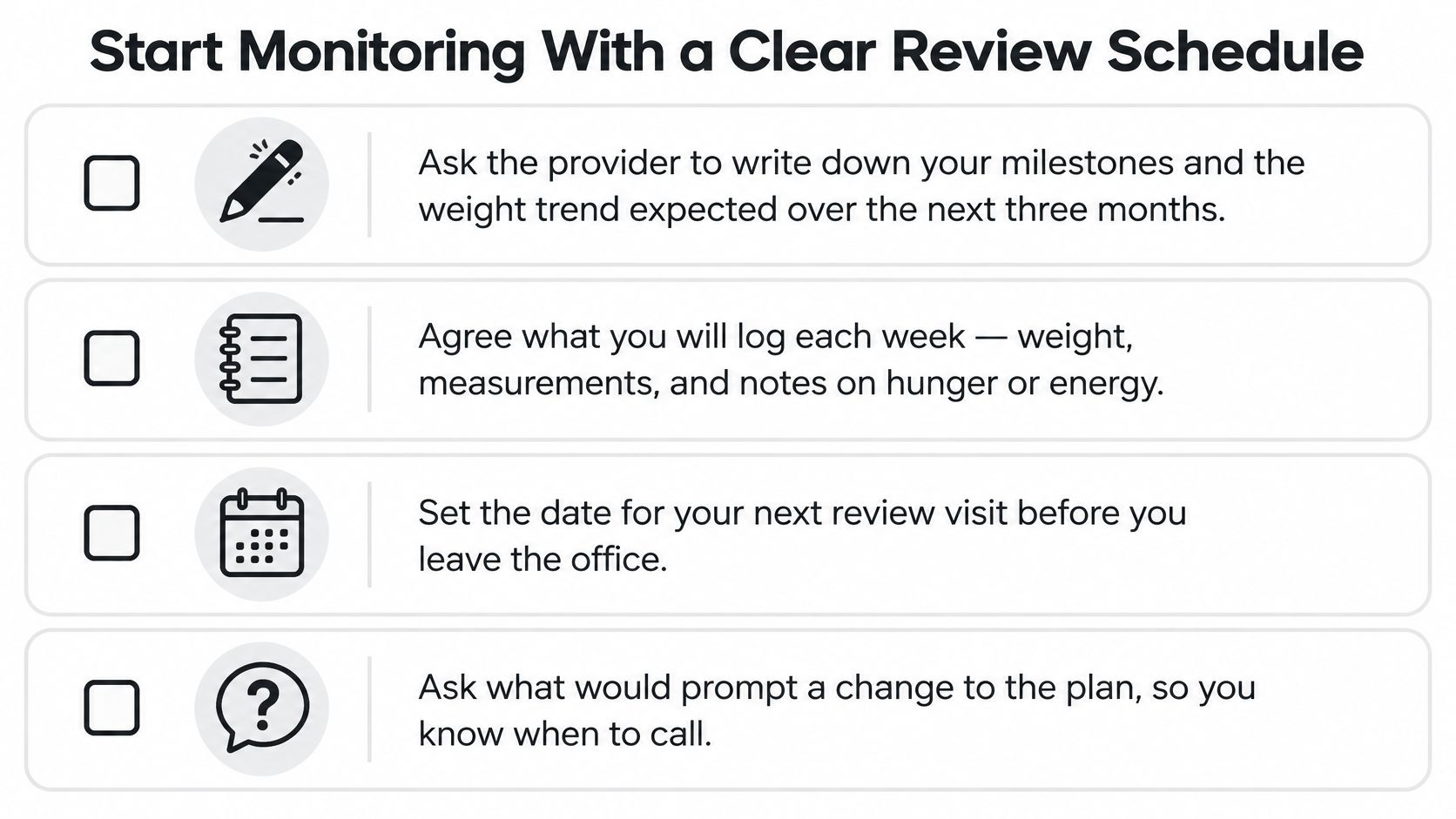
You don't need a new app or a perfect record. You need five things settled before you leave your next appointment.
-
Ask for the milestones in writing. What weight trend does your provider expect over the next three months, and what would count as falling short? A number you can't remember isn't a goal.
-
Agree on the weekly log. Average weight, injection dates, side effects, and any non-scale changes worth noting. Keep it to fields you'll fill.
-
Confirm the check-in schedule. Typically monthly, with more frequent visits early in treatment. Put the dates in your calendar before you leave.
-
Ask which labs and vital signs are planned, and what each one decides. Blood pressure might be there to guide dose decisions. A liver panel might be there for safety. Knowing the purpose makes the result less alarming.
-
Confirm the decision rules. Which readings mean call today, which mean adjust the plan, and which mean keep going. You should be able to answer that without guessing.
Three actions you can take this week, before any of that: record a baseline weight on the same scale you'll use, measure your waist with a tape if you have one, and take a blood pressure reading if you have a cuff at home. Then write your first target somewhere you'll see it.
A structured baseline is what makes later comparisons meaningful, which is why a comprehensive health assessment belongs at the start rather than after the first stall. Weight Method's programs include virtual consultations with licensed providers who monitor progress, and the assessment can be completed at any time on any device with no appointment to schedule. A physician or nurse practitioner licensed in your state reviews it, typically within 24 hours of submission.
Progress monitoring turns a frustrating number into a decision you and your provider make together, and Weight Method builds that loop into every plan: a licensed provider sets your milestones, reviews your response at regular check-ins, and adjusts dosing, nutrition and activity as your trajectory changes. If you're ready to stop guessing from a single morning weigh-in, visit Weight Method to start an assessment and see what medically supervised GLP-1 care looks like for your profile.