In the head-to-head phase 3b SURMOUNT-5 randomized trial published in the New England Journal of Medicine, adults with obesity and no type 2 diabetes lost an average of 20.2% of their body weight at week 72 on once-weekly tirzepatide, compared with 13.7% on semaglutide, a statistically significant 6.5-percentage-point difference (P<0.001). That single comparison explains why patients often assume one drug wins for everyone. In practice, average weight loss across GLP-1 therapies spans a wide spectrum, from modest single-digit reductions on older daily injections to more than a fifth of starting body weight on newer dual-pathway treatments.
Figuring out which GLP-1 is best for weight loss starts with dropping the search for a universal trophy winner. The stronger clinical match depends on your target weight reduction, eligibility, comfort with needles, monthly budget, and conditions like sleep apnea or type 2 diabetes. One patient thrives on a weekly injection, while another quits after three weeks because of nausea, cost, or needle anxiety.
This clinical guide compares six GLP-1 options across effectiveness, dosing, side effects, and real-world access. Each drug is matched to a specific patient profile, and I flag which oral and pipeline options require checking current prescribing status before you build a plan around them.
1. Wegovy (semaglutide 2.4 mg)
Best for: Adults who want the most thoroughly studied weekly GLP-1 built specifically for chronic weight management and cardiometabolic risk reduction.
Wegovy delivers a once-weekly subcutaneous injection of semaglutide, a GLP-1 receptor agonist made by Novo Nordisk. It mimics a natural gut hormone that slows stomach emptying, quiets food noise, and signals fullness to the brain after smaller portions. Clinicians prescribe it for adults with a BMI of 30 or higher, or a BMI of 27 or higher with at least one weight-related condition such as high blood pressure or high cholesterol.
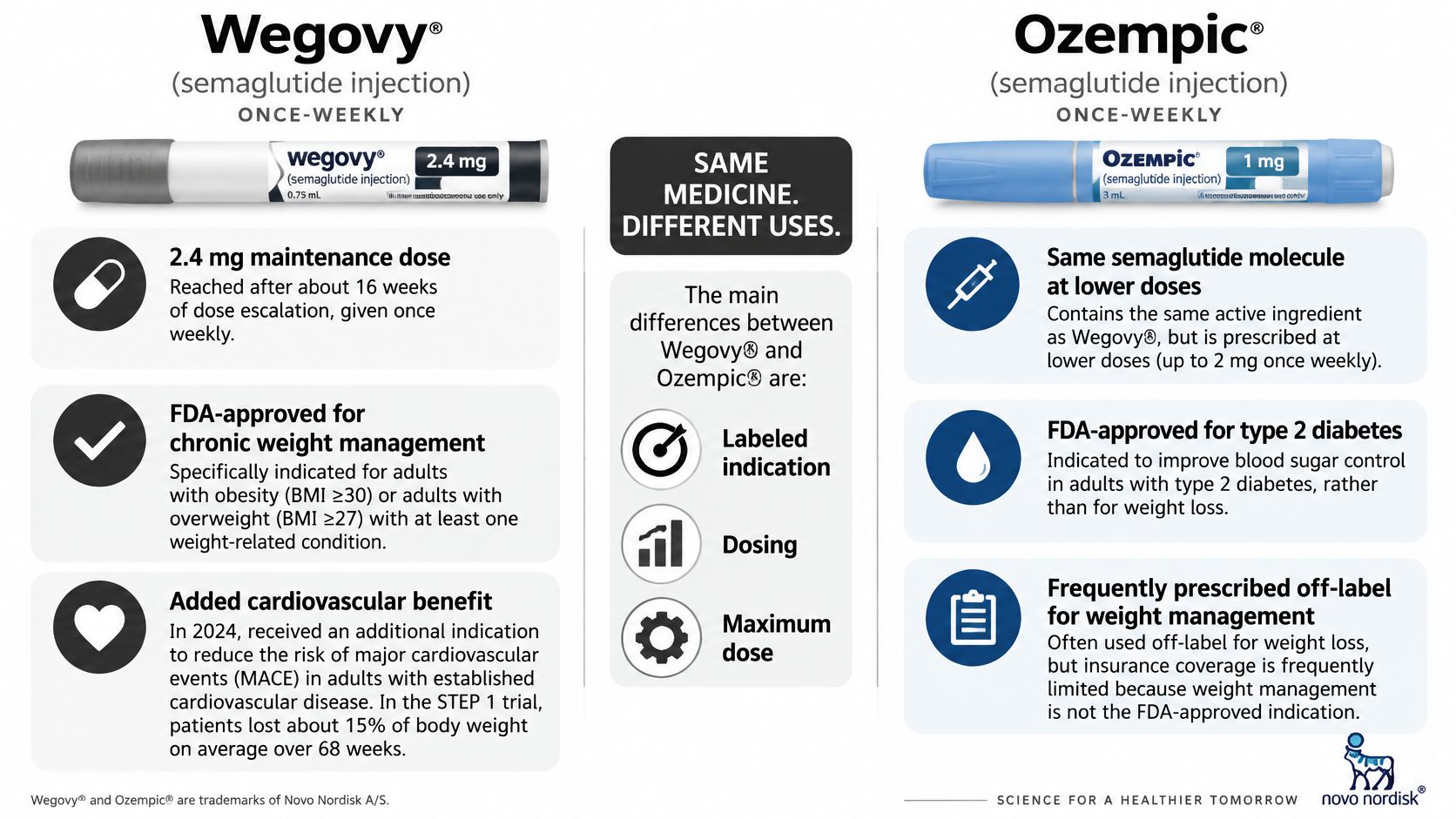
Because semaglutide is sold under more than one brand name, patients frequently mix up dosing schedules and insurance rules across products. The chart below outlines how Wegovy compares with its diabetes-labeled counterpart before you review your options with a clinician.
Why trial averages don't predict your personal result
Head-to-head trial summaries make it tempting to dismiss semaglutide as second place, yet clinical reality is far less rigid. As noted in the New England Journal of Medicine trial abstract, the direct comparison used an open-label design, evaluated only specific maximum tolerated doses, and measured people who stayed on therapy for the full 72 weeks. Trial averages never predict an individual outcome. Some patients respond strongly to semaglutide at lower maintenance doses and see meaningful improvements in blood pressure, cholesterol, and blood sugar without ever needing a dual-receptor drug.
Say a 52-year-old executive with a BMI of 32 and high cholesterol wants a predictable once-weekly routine backed by years of cardiovascular data. Wegovy fits that profile well, and reviewing the difference between Wegovy and Ozempic clarifies why the 2.4 mg weight-management dose behaves differently from lower diabetes strengths.
To keep gastrointestinal side effects like nausea, bloating, or constipation manageable on Wegovy, build these habits from week one:
- Respect the gradual titration: Start at the lowest strength and stay on each step until nausea settles before moving up.
- Downsize heavy meals: Choose smaller, lower-fat portions and stop eating the moment comfortable fullness arrives, since greasy meals sit longer in the stomach.
- Prioritize fluids early: Drink water steadily throughout the day, especially if mild diarrhea or reflux shows up after an injection.
- Log weekly patterns: Track your injection day, appetite shifts, and side effects in a simple notebook so your clinician can adjust pacing accurately.
2. Zepbound (tirzepatide)
Best for: Adults prioritizing maximum average weight reduction, or patients managing both obesity and moderate-to-severe obstructive sleep apnea.
Say a 46-year-old patient with a BMI of 36 uses a CPAP machine every night for obstructive sleep apnea and has already plateaued after months of calorie tracking. That is the exact profile where Zepbound stands apart. While Wegovy targets GLP-1 receptors alone, FDA prescribing information for Zepbound explains that tirzepatide is a dual GIP and GLP-1 receptor agonist made by Eli Lilly. Activating both incretin pathways typically drives stronger appetite suppression and greater average body-weight reduction than single-pathway therapy.
According to that same FDA labeling, Zepbound's 72-week obesity trial enrolled 2,539 adults with obesity, or overweight plus a weight-related comorbidity, while excluding people with type 2 diabetes. Participants achieved statistically significant weight reduction versus placebo, with greater proportions losing at least 5% of body weight across the 5-mg, 10-mg, and 15-mg maintenance doses. Zepbound also carries FDA approval for moderate-to-severe obstructive sleep apnea in adults with obesity, which can strengthen insurance prior-authorization requests for eligible patients.
Weekly home injections take only a few seconds once you establish a fixed day on your calendar, as pictured below.
Making the titration schedule work in daily life
Stronger appetite suppression brings a real practical trade-off: patients sometimes undereat protein and lose lean muscle alongside body fat. Follow the standard four-week dose-escalation rhythm, and don't jump ahead trying to speed up results. Keep unopened pens refrigerated away from direct light, and build meals around lean protein and fiber so smaller portions still support energy and strength training.
Clinical rule: Do not rush to the 15-mg dose if you're already losing weight steadily and feeling well at 5 mg or 10 mg. The best maintenance dose is the lowest one that delivers steady progress with tolerable side effects.
Patients who also have type 2 diabetes often wonder how Eli Lilly's two tirzepatide brands overlap. Reading a breakdown of Zepbound versus Mounjaro helps you verify which FDA indication aligns with your diagnosis and pharmacy benefits before requesting a prescription.
3. Saxenda (liraglutide 3 mg)
Best for: Adolescents aged 12 and older with obesity, or adults who want an older GLP-1 with a long clinical track record and shorter daily clearance.
Most modern GLP-1 conversations skip right past Saxenda, yet it still solves specific clinical problems that weekly pens don't always cover. Saxenda is a once-daily subcutaneous injection of liraglutide made by Novo Nordisk, approved for chronic weight management in adults and in adolescents aged 12 and older with obesity. It was one of the earliest GLP-1 medications approved specifically for weight management, giving prescribers years of real-world safety experience.
Daily injections require a steady bedside or morning habit so missed doses don't pile up, as shown in the setup below.

When daily dosing is a feature, not a drawback
Be upfront about the efficacy gap. Average weight loss on liraglutide 3 mg is noticeably more modest than what patients typically achieve on weekly semaglutide or tirzepatide. If your goal is losing a large share of your starting weight, a weekly drug usually makes more sense.
Still, daily clearance has genuine advantages for certain profiles. Say a parent and pediatrician are evaluating medication for a 14-year-old with obesity who needs an established pediatric-approved option, or an adult with a sensitive stomach wants a medication that clears the body faster if side effects feel too intense. Liraglutide's shorter half-life lets clinicians adjust or pause therapy more quickly than with a long-acting weekly shot. For patients exploring options beyond semaglutide, comparing semaglutide alternatives puts daily liraglutide and dual-pathway drugs in clear context.
If you and your clinician decide Saxenda fits your goals, approach the first three months methodically:
- Anchor the shot to one daily cue: Inject at the same time every morning or evening, right after brushing your teeth, so daily adherence stays automatic.
- Plan for multi-week titration: Step up the daily dose gradually over several weeks until you reach 3 mg, pausing if nausea lingers.
- Set realistic milestones: Evaluate overall response after roughly three months at your target dose rather than judging progress in the first few weeks.
- Pair with strength and nutrition habits: Because average loss is milder, consistent protein intake and resistance exercise carry extra weight in your final results.
4. Ozempic (semaglutide, off-label for weight loss)
Best for: Adults with type 2 diabetes who also want steady weight reduction, or cost-constrained patients working with a clinician on lower-dose off-label semaglutide.
Ozempic contains the same active molecule as Wegovy, once-weekly semaglutide from Novo Nordisk. Its approval is for type 2 diabetes and cardiovascular risk reduction in adults with diabetes. Prescribers still write it off-label for weight management when insurance, supply, or clinical history points in that direction. The practical trade-off is the dosing ceiling. Ozempic tops out below Wegovy's 2.4 mg obesity maintenance dose, so average weight loss is typically smaller than what patients achieve on full-dose Wegovy.
A 55-year-old patient with newly diagnosed type 2 diabetes and a BMI of 31 may do well with one prescription that supports blood sugar control and weight reduction. Ozempic often fits that profile when insurance approval is more straightforward. A patient without diabetes often faces insurer denials when trying to fill Ozempic off-label. That does not make the drug ineffective. It means the prescription path matters as much as the molecule.
Sourcing safely and planning for treatment gaps
High retail prices have pushed some shoppers toward questionable online listings promising cheap semaglutide. FDA records show the semaglutide injection shortage was determined resolved on February 21, 2025, and ongoing scrutiny around compounded GLP-1 products and adverse-event reporting makes pharmacy verification essential. Never order unverified vials from social media ads or cash-only websites that skip medical screening. Weight Method offers compounded GLP-1 medications prescribed by licensed providers and dispensed by U.S. 503A pharmacies. Licensed clinicians evaluate medical history before eligibility is determined.
A BMJ rapid response raises a point that belongs in any drug comparison: obesity is a chronic biological condition, and stopping therapy is not a failure of willpower. When a GLP-1 is interrupted, hunger signals and weight-regulation mechanisms can reassert themselves. Weight regain becomes more likely without a continuity plan.
Treat your exit and pause plan as part of day one. Before filling your first pen, ask how your prescriber handles missed weeks, dose step-downs, or switching medications if coverage changes.
If a patient has been off GLP-1 medication for more than three months, Weight Method restarts two steps below the previously reported dose. That approach reduces the chance of severe gastrointestinal distress. Check the exact product name and milligram strength on your pen label. Report persistent vomiting or sharp abdominal pain to your clinician right away.
5. Wegovy pill (oral semaglutide 25 mg)
Best for: Needle-averse adults who refuse weekly injections and have a predictable, disciplined morning schedule.
Fear of needles stops plenty of eligible adults from starting GLP-1 therapy. The Wegovy pill addresses that barrier directly by packing semaglutide 25 mg into a daily oral tablet from Novo Nordisk. Because stomach acid breaks down peptide hormones quickly, the tablet relies on a specialized absorption enhancer and strict morning timing to get enough active medication into your bloodstream.
Here is the adherence reality: taking an oral peptide takes noticeably more daily discipline than a five-second Sunday injection.

Checking whether the morning routine fits your schedule
Say a 39-year-old consultant travels weekly for work, dislikes carrying refrigerated injection pens through airport security, and wants a discreet pill. Oral semaglutide sounds ideal until you map out her mornings. If she wakes up and immediately drinks coffee or takes daily thyroid medication, absorption drops sharply and results disappoint. On the other hand, if she can swallow the tablet upon waking with a small sip of plain water and wait before eating or taking other pills, oral therapy becomes a practical needle-free path.
With consistent daily use of oral Wegovy, visible weight loss generally appears by months 2 to 3, and peak results tend to arrive around 12 to 16 months. Because product labeling, dosing steps, and local pharmacy stock for oral obesity formulations continue to evolve, confirm current availability and exact dosing instructions with your prescribing clinician before switching off an injectable plan.
Use this checklist to test whether an oral peptide suits your lifestyle:
- Keep water minimal: Take the tablet first thing in the morning on an empty stomach with only a small amount of plain water, never coffee, juice, or sparkling drinks.
- Guard the fasting window: Wait the full recommended period before eating breakfast, drinking other beverages, or swallowing other oral prescriptions.
- Automate daily reminders: Set a recurring phone alarm and keep your pill bottle next to a small glass on your nightstand so travel doesn't break the streak.
- Confirm real-world stock first: Check with your clinician and pharmacy to verify current regulatory availability and monthly out-of-pocket cost before committing.
6. Orforglipron (investigational oral GLP-1)
Best for: Clinical trial-seekers and patients watching the pipeline for a convenient, no-fasting oral GLP-1 once regulators authorize it.
Flag this clearly right away: orforglipron is an investigational medication developed by Eli Lilly, not a routine pharmacy prescription you should assume is sitting on local shelves today. Always verify its current FDA approval and prescribing status through official manufacturer announcements or ClinicalTrials.gov before planning treatment around it.
Why are obesity clinicians paying close attention to it anyway? Unlike injectable semaglutide, tirzepatide, or even oral peptide tablets, orforglipron is a non-peptide, small-molecule GLP-1 receptor agonist. Because it isn't a fragile peptide chain, stomach digestion doesn't destroy it as easily. That chemistry is designed to let patients swallow a daily pill at any time of day without fasting windows or water limits, while also making large-scale manufacturing simpler than complex peptide injection pens. Phase 3 clinical trials have evaluated dose-dependent weight loss in adults with obesity alongside type 2 diabetes outcomes.
What trial-seekers should do right now
Say a 44-year-old patient hates needles and knows she won't stick to an empty-stomach morning pill rule. Hearing about a no-fasting oral GLP-1 makes her want to wait on the sidelines for another year. In clinical practice, waiting indefinitely for an unapproved drug rarely pays off if you already qualify for evidence-based therapy today and face rising blood pressure or joint pain.
Safety boundary: Never buy "research" orforglipron powders or capsules from online peptide sites. Unapproved molecules sold outside regulated clinical trials carry serious contamination and dosing risks.
If you're interested in orforglipron, ask your clinician whether you meet enrollment criteria for an active Phase 3 study near you, and check ClinicalTrials.gov directly for legitimate trial sites. Otherwise, start with an FDA-approved therapy you can safely monitor now. If a no-fasting oral GLP-1 becomes broadly prescribable later, your clinician can build a smooth transition plan without leaving your health on hold in the meantime.
How the six GLP-1 options compare at a glance
No single GLP-1 wins for every patient. The right pick depends on how you want to dose, what else you need the drug to treat, and whether the option is prescribable today. Read the table left to right: average trial results, dosing burden, regulatory status, then the profile each drug fits best.
| Item | Avg. Weight Loss in Trials | Dosing Frequency | FDA Status for Weight Loss | Best For |
|---|---|---|---|---|
| Wegovy (semaglutide 2.4 mg) | Among the highest average losses for an approved GLP-1 | Once-weekly injection | FDA-approved | Adults seeking an established weight-management treatment |
| Zepbound (tirzepatide) | Highest average loss in class, seen at maximum tolerated doses | Once-weekly injection | FDA-approved | Adults seeking the greatest average weight loss; also approved for obstructive sleep apnea |
| Saxenda (liraglutide 3 mg) | Lower average loss than the weekly injectables | Once-daily injection | FDA-approved | People who prefer daily dosing; also approved for eligible adolescents |
| Ozempic (semaglutide, off-label for weight loss) | No dedicated weight-loss average; trials measured diabetes outcomes | Once-weekly injection | Approved for type 2 diabetes; sometimes prescribed off-label | People with type 2 diabetes when a clinician considers off-label use appropriate |
| Wegovy pill (oral semaglutide 25 mg) | Strong average loss for a daily pill, below the weekly injectables | Once-daily tablet | FDA-approved | People who prefer pills and can follow fasting instructions |
| Orforglipron (investigational oral GLP-1) | Encouraging early-trial results; still investigational | Once-daily tablet | Investigational; not FDA-approved | People interested in future oral treatment options or clinical trials |
Two patterns matter more than any single row. First, dosing frequency is a real trade-off. The daily options, Saxenda and the Wegovy pill, demand steadier adherence than a weekly injection, and the pill adds fasting rules on top of that. Second, status is not a formality. Ozempic is a diabetes drug used off-label, so its role depends on your diagnosis and your clinician's judgment. Orforglipron is investigational, which puts it on a watch list rather than in a treatment plan.
Bring the "Best For" column to your next appointment. The more useful question is rarely "which drug is strongest" and usually "which row describes me."
Choosing the Right GLP-1 for Your Body and Budget
Stepping back across all six options makes the clinical decision logic straightforward. If maximum average body-weight reduction is your top priority, weekly tirzepatide and high-dose semaglutide 2.4 mg lead the field, with tirzepatide also covering obstructive sleep apnea and Wegovy bringing deep cardiometabolic evidence. If you're choosing for an eligible adolescent aged 12 or older, or want rapid daily clearance, Saxenda stays relevant. If you have type 2 diabetes or insurance limits, Ozempic may enter the discussion. If needles are a dealbreaker, the Wegovy pill offers a daily oral option with strict fasting rules, while orforglipron remains an investigational watch-list option whose approval status you must confirm before relying on it.
Budget and access often decide which GLP-1 is best for weight loss just as much as clinical trial curves. Brand-name retail prices can put weekly injections out of reach when insurance excludes obesity care. For adults exploring transparent self-pay telehealth care, Weight Method offers monthly plans with no membership fee that bundle licensed provider review, medication, care-team support, and direct-to-door shipping, billed monthly and cancelable anytime:
- Semaglutide monthly plan: $59 for the first month, then $205 per month ongoing.
- Tirzepatide monthly plan: $119 for the first month, then $329 per month ongoing.
- Introductory pricing rule: First-month promotional rates apply to new GLP-1 patients, while standard monthly pricing applies if you've used a GLP-1 before.
Whether you use telehealth or compare medically supervised weight loss through an in-person clinic, never start without a thorough medical review covering your BMI, current prescriptions, prior GLP-1 history, and contraindications. At Weight Method, you can take a 2-minute quiz to check eligibility, and the clinician consultation is free with no commitment.
Before your appointment, write down four concrete questions for your provider:
- Which medication and starting dose fit my medical history and weight-loss goal?
- How will we pace dose increases if nausea or fatigue slows me down?
- What is my long-term maintenance or restart plan if I ever pause treatment?
- What will my true total monthly cost be after introductory pricing ends?
Walking into your consultation with clear goals and these four questions turns a crowded market of headlines into a safe, sustainable medical plan built for your body.
Weight Method connects eligible adults with licensed clinicians who review your medical profile, recommend semaglutide or tirzepatide with personalized dose titration, and ship medication directly to your door with ongoing care-team support and no membership fees. Take the 2-minute eligibility quiz and book a free, no-commitment consultation to find which GLP-1 plan fits your goals and budget at Weight Method.