Tirzepatide is a prescription, once-weekly injectable medicine that activates both GIP and GLP-1 receptors, sold as Mounjaro for type 2 diabetes and as Zepbound for chronic weight management. In the main 72-week obesity trial, average weight loss was 16.0% at 5 mg, 21.4% at 10 mg, and 22.5% at 15 mg.
Most explanations stop at "it's a GLP-1 shot." That shortcut hides the decision you face. One molecule carries two brand names, two approved jobs, a slow dose climb, and a maintenance question that doesn't end when the scale moves. If you treat it like a short course you finish, you'll misread both the results and what happens when the injections stop.
What Tirzepatide Is and Which Brands Use It
Tirzepatide is the active ingredient. Mounjaro and Zepbound are the brand names a U.S. prescription can carry. The molecule doesn't change between them. The approved use, the label, and often the insurance rules do.
The FDA's Mounjaro drug trials snapshot records the original approval on May 13, 2022, for improving blood-sugar control in adults with type 2 diabetes, alongside diet and exercise. The same agency later approved Zepbound in November 2023 for chronic weight management in adults with obesity, a BMI of at least 30 kg/m², or overweight, a BMI of at least 27 kg/m², when at least one weight-related condition such as hypertension, type 2 diabetes, or high cholesterol is present. Zepbound is given under the skin once a week. Its dose rises over about 4 to 20 weeks, with maintenance options of 5 mg, 10 mg, or 15 mg, and 15 mg is the maximum the FDA announcement identified. Zepbound also carries an indication for moderate-to-severe obstructive sleep apnea in adults with obesity.
| Brand | Approved use | FDA approval |
|---|---|---|
| Mounjaro | Improving blood-sugar control in adults with type 2 diabetes, with diet and exercise | May 13, 2022 |
| Zepbound | Chronic weight management in adults with obesity, or overweight with a weight-related condition; moderate-to-severe obstructive sleep apnea in adults with obesity | November 2023 |
You inject into the abdomen, thigh, or upper arm. Similar exposure is expected at those sites, so the site is about comfort and rotation, not a stronger or weaker dose.
A diabetes prescription and a weight-management prescription aren't swap-ready. Brand, dose, and coverage follow the condition on the label. Before you compare prices or pens, name the condition you're treating. That's the filter a clinician uses, and it's the one your plan will use too.
How Tirzepatide Works in the Body
After you eat, the gut releases two incretin hormones. GLP-1 comes largely from the lower intestine and signals the brain that you have had enough. GIP, from the upper intestine, also prompts the pancreas to handle a glucose rise. In type 2 diabetes those signals are weaker than they should be. Tirzepatide is built to stand in for both at once.
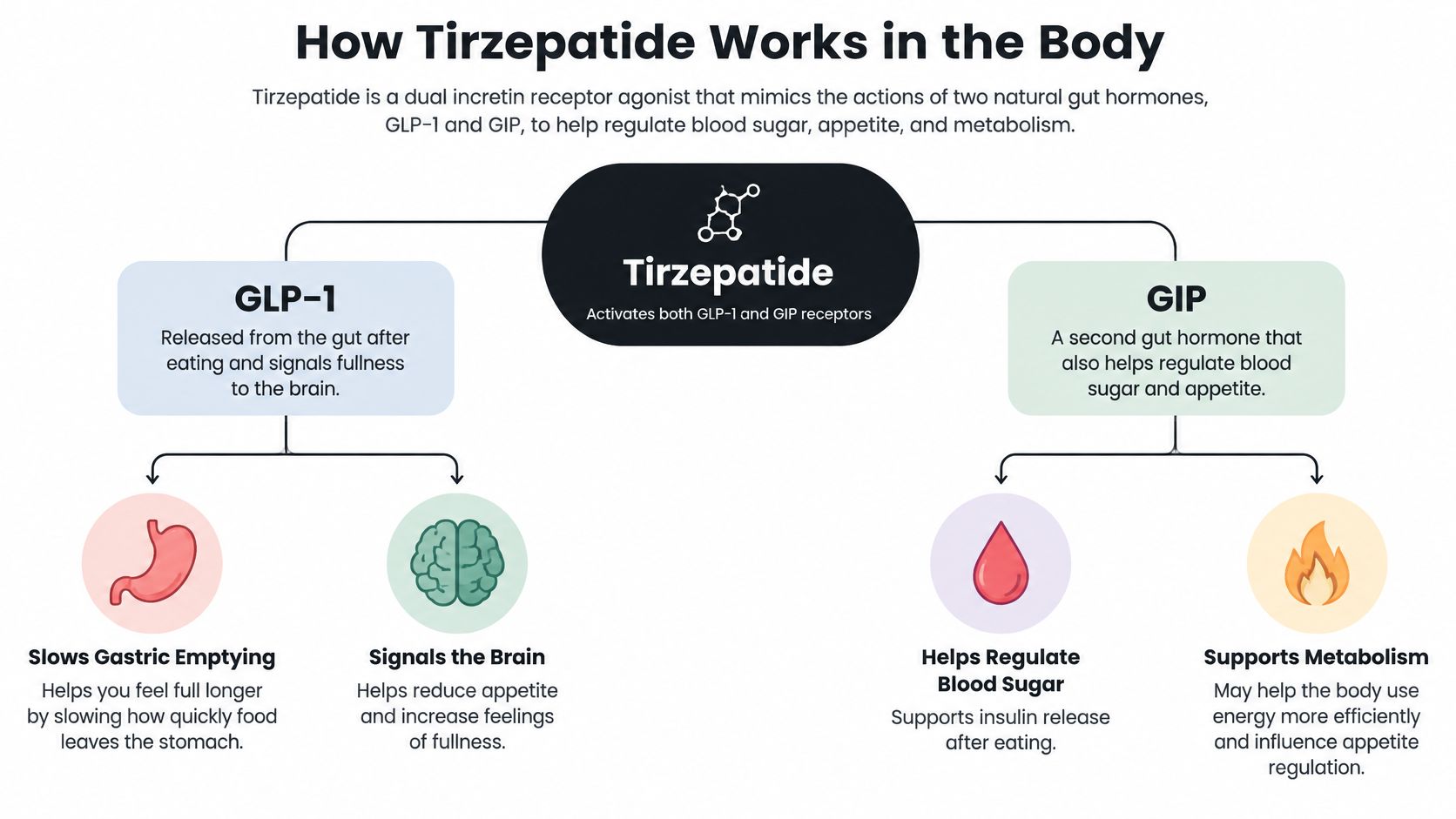
Tirzepatide works like a single key cut to fit two locks. One turn tells the meal to stop; the other tells the pancreas to release insulin when glucose is already high, not when it is low. That pairing is why one weekly shot can affect appetite and blood sugar together. It is a prescription hormone analogue, not a stimulant and not an over-the-counter fat burner. If you are sorting food, fiber, and non-prescription options while you wait on a clinician, evidence on blood sugar balance supplements offers a useful general contrast: such products are not designed to act on GIP and GLP-1 receptors the way this drug is.
What the two signals change
Combined signaling produces four effects.
Insulin only when glucose is up. Secretion rises in a glucose-dependent way, which is why the medicine is paired with meals and monitoring rather than used as a blanket insulin push.
Less glucagon when glucose is high. Glucagon tells the liver to release stored sugar. Turning that signal down helps keep a high reading from climbing further.
A quieter appetite. Many people notice smaller portions and fewer cravings before they notice a number on the scale. A plain walk-through of the single-hormone version of that fullness signal is in how GLP-1 works for weight loss. Tirzepatide adds the GIP receptor on top of that.
Slower gastric emptying. Food stays in the stomach longer, which can end a meal sooner. That slowing is strongest after the first dose and fades as weekly treatment continues. Early fullness is not the same sensation as later fullness.
Why one shot covers a week
The FDA label for tirzepatide describes a C20 fatty diacid on the peptide that sticks to albumin in the blood. That binding stretches the elimination half-life to about 5 to 6 days, which is why a subcutaneous dose can be weekly. Median time to peak concentration is about 24 hours. Mean absolute bioavailability is about 80%. Exposure rises in proportion to the dose, and steady state arrives after roughly four weeks of weekly dosing. Renal impairment doesn't materially change those pharmacokinetics.
Those same gut effects explain the nausea, diarrhea, vomiting, constipation, indigestion, abdominal pain, and lower appetite that show up most often while the dose is climbing. The biology that cuts intake is also the biology that upsets the stomach.
How Much Weight People Lose on Tirzepatide
How much weight can tirzepatide take off? The clearest answer comes from a trial that measured adults at a fixed point, not from a before-and-after photo.
SURMOUNT-1 followed adults with obesity or overweight who didn't have diabetes for 72 weeks. Everyone got lifestyle counseling, and the medicine was added to that foundation.
Read the table in two passes. The average column is the typical change for the whole group, not a personal guarantee. The other columns are milestones. They answer a different question: of 100 people on that dose, how many lost at least 5%, 10%, 15%, or 20%? A higher dose doesn't just move the average. It moves more people across the larger milestones.
| Group | Average weight loss | At least 5% loss | At least 10% loss | At least 15% loss | At least 20% loss |
|---|---|---|---|---|---|
| Placebo | 2.4% | 28% | 14% | 6% | 1.3% |
| Tirzepatide 5 mg | 16.0% | 89% | 73% | 50% | 32% |
| Tirzepatide 10 mg | 21.4% | 96% | 86% | 74% | 55% |
| Tirzepatide 15 mg | 22.5% | 96% | 90% | 78% | 63% |
Those averages, 16.0%, 21.4%, and 22.5% versus 2.4% on placebo, come from Lilly's report of the trial in the New England Journal of Medicine publication announcement. At least 5% loss reached 89% of people on 5 mg and 96% on both 10 mg and 15 mg, versus 28% on placebo. At least 20% loss reached 32%, 55%, and 63% across those three doses, versus 1.3% on placebo.
The placebo row is not zero
People on placebo still lost weight. In the table's analysis that average is 2.4%. That row is the comparison point: it shows what lifestyle counseling alone produced in this trial. The distance between the placebo row and each tirzepatide row is the added effect of the drug under the same conditions. Use the table when you want dose-by-dose milestone counts.
Pounds, not just percents
Say someone starts at 250 pounds. A 16% loss is about 40 pounds. A 22.5% loss is about 56 pounds. That is arithmetic on a round starting weight, not a trial average, and it assumes the person stays on treatment with counseling the way trial participants did. Responses still scatter widely around those means. Dose, months on therapy, and continued clinical follow-up all moved the outcome.
Set the range this way: treat the 5 mg row as a common result and the 15 mg row as the upper end of what this trial recorded, not as a promise your prescriber can dial in on day one.
The first month isn't in this table at all. Those percentages describe people who stayed with a full escalation and a long follow-up, not the starter dose.
Side Effects and When Tirzepatide Is Not Safe
The effects people most often call about are gastrointestinal, and they cluster while the dose is going up. Smaller meals, slower eating, and steady fluids won't erase them, but they often make the week tolerable. Most of this eases as the body adjusts. Severe symptoms are a reason to pause and call, not a test of willpower.
Common effects to expect:
- Nausea: often worst in the first days after a step up. Plain food and a smaller dinner help more than skipping meals.
- Diarrhea or vomiting: short runs are common. Prolonged losses of fluid are not something to wait out.
- Constipation: slower emptying can swing this way instead. Fluids and fiber still matter.
- Indigestion and abdominal pain: a burning or crampy discomfort that tracks with larger meals.
- Decreased appetite: this is part of how the medicine works, and it can also be the reason a dose feels like too much.
Symptoms that need urgent care
Separate "uncomfortable" from "unsafe."
- Severe or persistent abdominal pain, especially if it spreads to the back, can signal pancreatitis. That needs urgent care, not the next scheduled visit.
- Dehydration and kidney strain can follow days of vomiting or diarrhea. Dark urine, dizziness, or almost no urine is a same-day call.
- Gallbladder pain, often in the upper right abdomen, sometimes with fever or vomiting, needs an exam.
- Allergic reactions with swelling, trouble breathing, or a widespread severe rash are emergencies.
- Worsening vision in someone with diabetes should be reported promptly, not filed away until the next A1C.
Who should not start
- A personal or family history of medullary thyroid carcinoma, or multiple endocrine neoplasia type 2, is a reason this class is avoided. GLP-1 receptor agonists carry a boxed warning on thyroid C-cell tumors seen in rodents.
- A known allergy to tirzepatide rules it out.
- Type 1 diabetes is not the setting this medicine is recommended for. It doesn't replace insulin there.
Pregnancy is its own conversation, and it belongs before the first pen. Tirzepatide isn't recommended during pregnancy. If pregnancy is possible, say so at the visit. Oral hormonal contraceptives can be affected by the early slowing of the gut, so ask whether you need a backup method when you start or when the dose rises. Non-oral methods aren't affected the same way.
Report symptoms early. Don't push through severe pain, repeated vomiting, or signs of an allergic reaction to "stay on schedule."
What Happens to Your Weight If You Stop
Will the weight stay off if you stop? For many people, no. That isn't a character flaw, and it isn't proof the medicine "didn't work."
Zepbound's prescribing information describes tirzepatide as reducing excess weight and maintaining that reduction long term. Clinical reviews of the SURMOUNT-4 withdrawal trial tell the other half. People who stopped regained a substantial share of what they had lost. People who stayed on treatment maintained their losses or lost more. Obesity behaves like a chronic condition. Take away the ongoing signal that lowers intake, and appetite often returns.
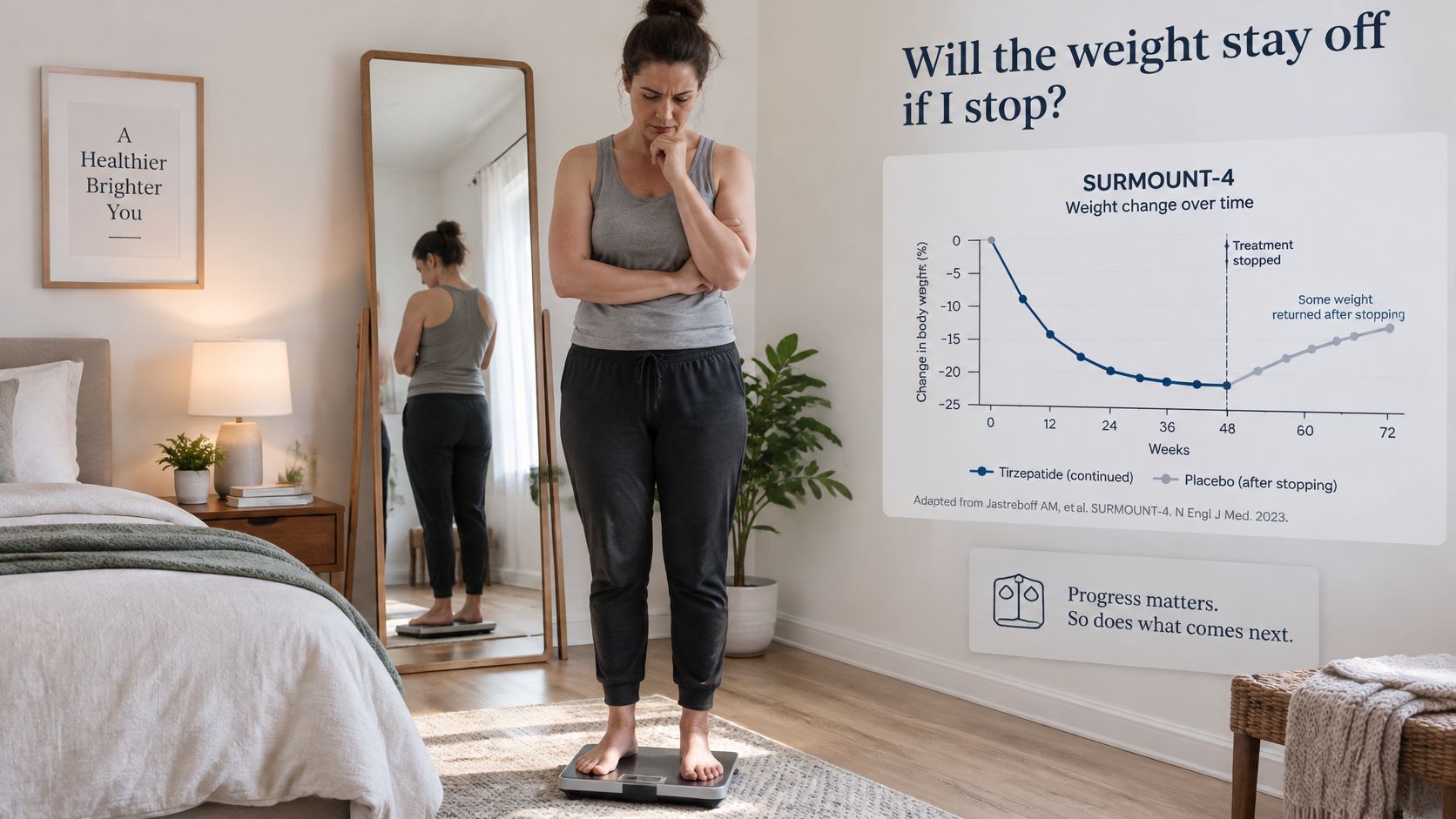
Say someone loses 20 pounds over six months, then stops because nausea has made eating miserable. Over the next year a portion of that loss comes back. That's a hypothetical, not a trial average. A plan made before the last injection could have changed the path: a slower taper discussion, a nutrition target for the weeks appetite returns, and a date to reassess rather than a silent stop. A fuller look at that pattern across this drug class is in what happens when you stop GLP-1 treatment.
What a maintenance plan actually includes
Build it while treatment is still going, not the week you quit.
- Nutrition and activity you can keep when hunger is louder than it is now.
- Follow-up visits with a named time to review weight, side effects, and labs.
- A written side-effect plan so a bad week doesn't become an unplanned stop.
- Cost, access, and pregnancy as explicit reasons you and the prescriber might pause, with a next step for each.
Established evidence supports regain after withdrawal and continued loss or maintenance when treatment continues. Very long-term outcomes, and some rare risks, are still being watched. Gastrointestinal effects during dose climbs are the known, common problem. They aren't a complete map of decade-long safety.
Stopping is a clinical decision to plan, not a graduation.
Ask, before you start, what the two of you will do if side effects, cost, pregnancy, or supply make continuation unrealistic.
Who Qualifies, Dosing and Next Steps
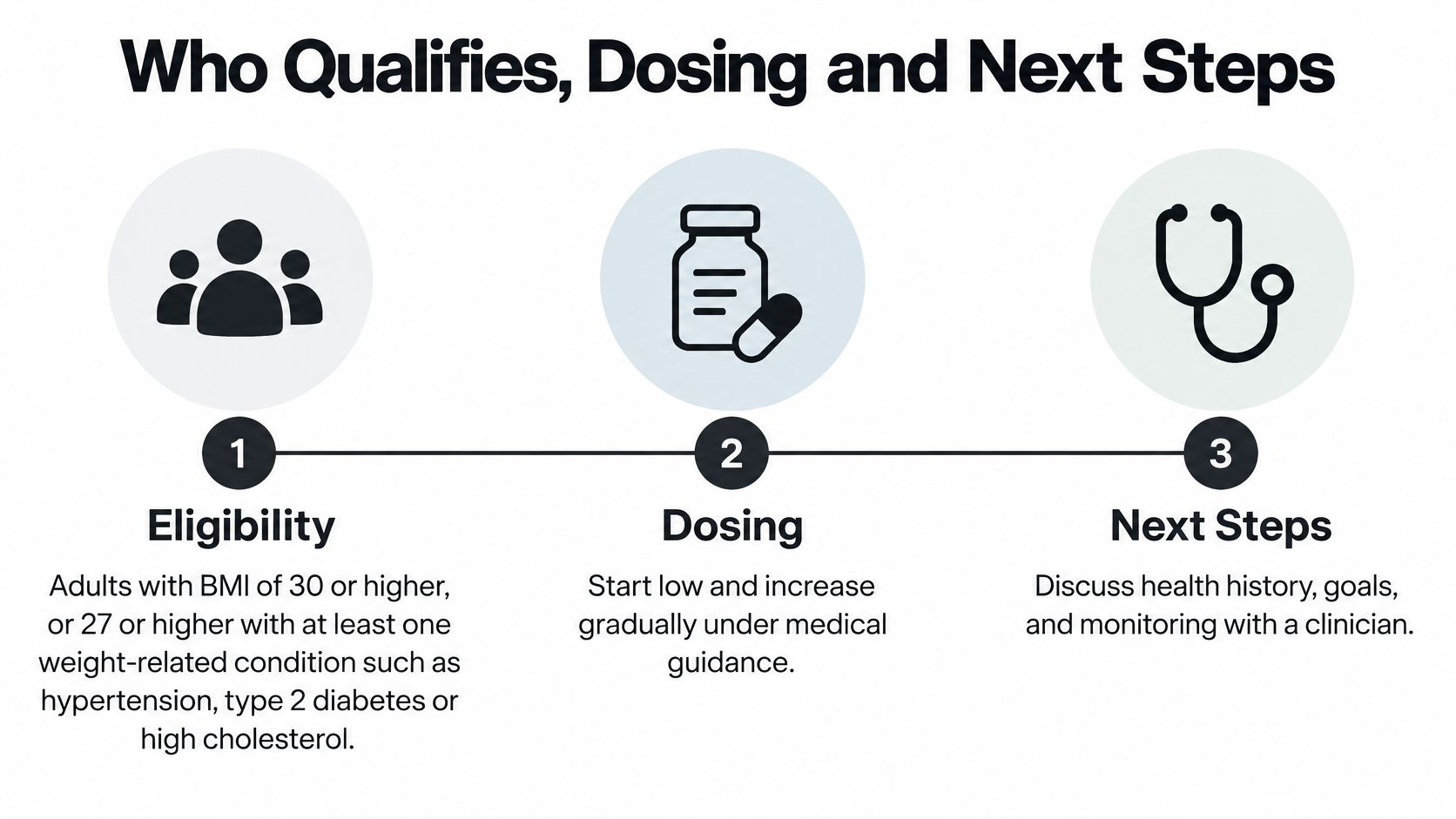
The weight-management use is for adults. Eligibility runs on a BMI of 30 or higher, or a BMI of 27 or higher with a qualifying condition such as hypertension, type 2 diabetes, or high cholesterol. A number on a calculator doesn't issue the prescription. A licensed provider chooses semaglutide or tirzepatide from BMI, medical history, and the response they expect, then manages the dose.
Dosing is a ladder, and tolerability sets the pace
The Zepbound prescribing information sets the obesity regimen at 2.5 mg weekly for four weeks, then 2.5 mg steps only after at least four weeks at the current dose, and only if you tolerate it. That first month is an initiation dose. It is not the dose the long-term averages describe. Mounjaro's diabetes schedule is its own label, so a diabetes pen and a weight-management pen can differ even when the ingredient matches. Tirzepatide here is a once-weekly injection, if prescribed, acting on GIP and GLP-1 receptors involved in appetite.
| Weekly dose | Time on this dose | Role in treatment |
|---|---|---|
| 2.5 mg | Weeks 1-4 | Starting dose; not the expected therapeutic dose |
| 5 mg | After at least 4 weeks on 2.5 mg | First step up; a maintenance option |
| 7.5 mg | After at least 4 weeks on 5 mg | Next 2.5 mg step, only if tolerated |
| 10 mg | After at least 4 weeks on 7.5 mg | Maintenance option |
| 12.5 mg | After at least 4 weeks on 10 mg | Next step, only if tolerated |
| 15 mg | After at least 4 weeks on 12.5 mg | Maximum dose identified by the FDA |
Say the first four weeks on 2.5 mg go fine. The next prescription is 5 mg. A headline that used the top dose doesn't make 15 mg your next step. If 5 mg brings vomiting that doesn't settle, the step up waits. Tolerability gates the climb, and the calendar alone doesn't.
Our dosing ladder runs 2.5, 5, 7.5, 10, 12.5, and 15 mg weekly. A licensed provider decides whether you move, and a quiz result can't make that call.
Questions worth writing down
- Check the cutoff that applies to you. Note a BMI of 30 or higher, or 27 or higher with a qualifying condition, and write the condition down. Our GLP-1 eligibility guide walks through how that screen is used.
- List medicines, diabetes status, and thyroid history. Include medullary thyroid carcinoma or MEN2 in the family, and any prior incretin medicine you stopped for side effects.
- Say if pregnancy is in the plan. That changes whether starting now makes sense.
- Ask four direct questions. Which brand fits this condition, what is the starting dose, which symptoms should trigger a call, and what is the plan if I stop?
You can take a 2-minute quiz to see whether you might qualify for GLP-1 treatment. The consultation is free and there's no commitment. Tirzepatide through that plan is $119 for the first month, then $329 per month, billed monthly, and you can cancel anytime. A licensed clinician still has to confirm that the medicine and the dose fit your history. A quiz can't do that.
Ozempic, Wegovy, Zepbound, Mounjaro, and Rybelsus are trademarks of their respective owners and aren't affiliated with Weight Method. Bring the brand question, the starter-dose question, and the stopping question to the visit. Those three keep the conversation on your condition instead of on a headline percentage.
Weight Method connects you with a licensed provider who can evaluate whether tirzepatide or semaglutide fits your BMI, history, and goals, then manage a gradual dose if a prescription is appropriate. The visit is virtual, the medicine ships to you, and follow-up covers side effects and dose changes rather than a one-time pen. If you want that reviewed against your own history, start at Weight Method.