Adults taking tirzepatide weekly for 72 weeks lost an average of 22.5% of body weight at the highest dose, compared with 2.4% on placebo. That evidence base supported FDA approval of Zepbound for chronic weight management on August 11, 2023.
But is the hardest part of tirzepatide weight loss online really getting started, or is it staying safe and consistently supplied after the first prescription? Online programs can make treatment look like a simple checkout process. In practice, the meaningful differences appear in clinical screening, dose management, pharmacy sourcing, follow-up, and what happens when access changes.
The right program doesn't just help you obtain medication. It helps you make informed decisions about eligibility, tolerability, continuity, and the difference between an FDA-approved product and an unapproved alternative. Here's how to evaluate the full treatment pathway.
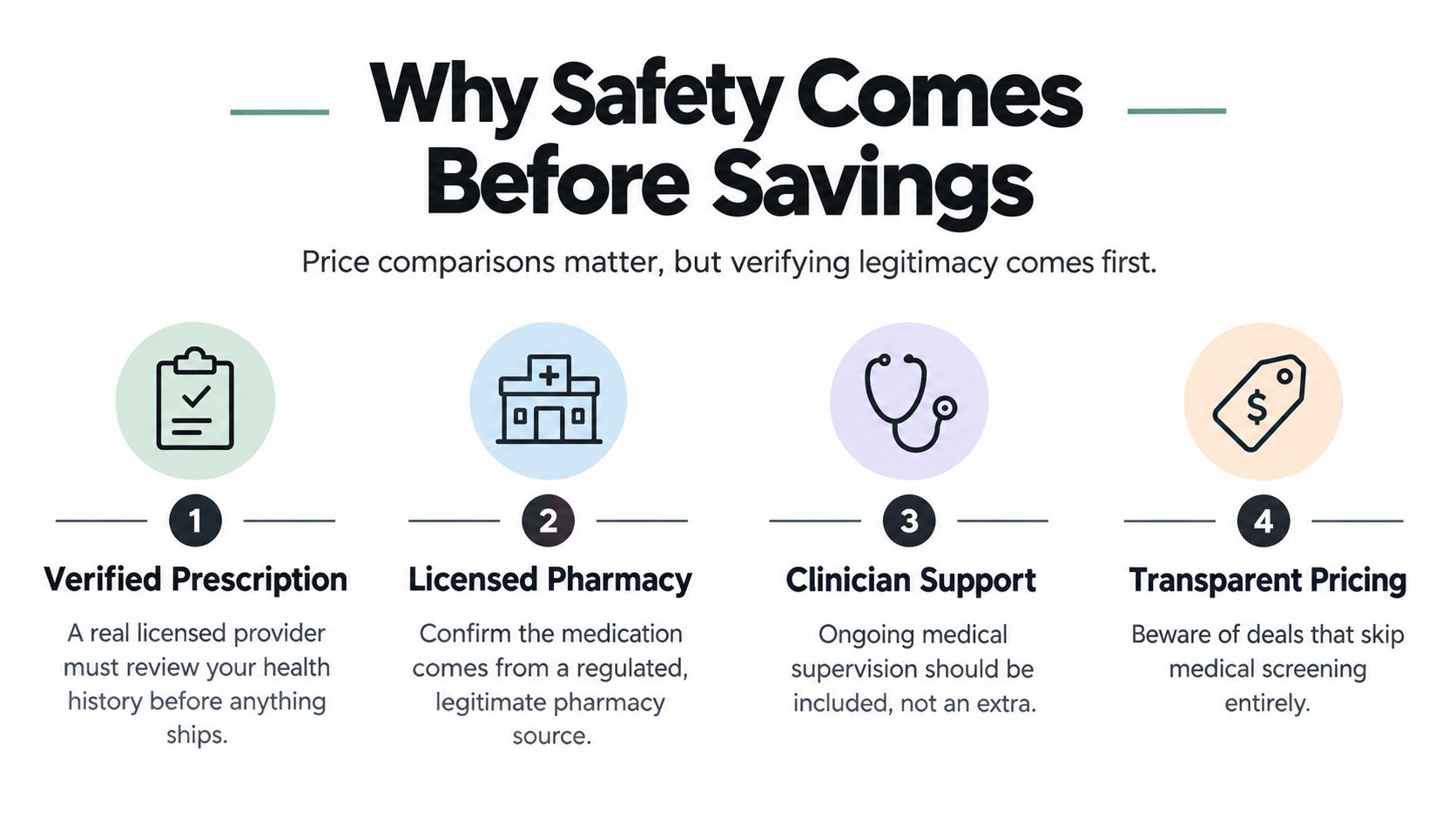
Why Safety Comes Before Savings
Searching for tirzepatide weight loss online often starts with a price comparison. That instinct is understandable, but it puts the least important question first. A low advertised price doesn't tell you whether a licensed clinician reviewed your history, whether the medication is FDA-approved, or whether you'll have meaningful support when side effects appear.
The clinical benchmark explains why the treatment attracts so much attention. The phase 3 SURMOUNT-1 trial enrolled 2,539 adults with obesity or overweight plus weight-related medical problems and treated them for 72 weeks. At the highest dose, participants lost an average of 22.5% of body weight, while placebo produced 2.4% loss, as reported in the FDA approval announcement for Zepbound. That evidence supported Zepbound's approval for chronic weight management on August 11, 2023.
The result is powerful, but it came from a structured clinical setting. Participants received defined doses, monitoring, and trial oversight. An online seller that offers a vial after a short form isn't automatically providing an equivalent care experience.
What legitimacy looks like
A credible telehealth pathway should make four things clear before you pay:
- Clinical assessment: A licensed provider reviews your medical history, current medications, relevant conditions, and weight-related health risks.
- Prescription identity: The service tells you whether it prescribes branded Zepbound, another approved product for an applicable indication, or a compounded preparation.
- Pharmacy details: You can identify the dispensing pharmacy and understand how the prescription is fulfilled.
- Continuing care: You know how to contact the clinical team for dose changes, side effects, missed doses, or supply problems.
You can use this guide to GLP-1 treatment online to understand the broader telehealth model, but you should still verify the details of any service directly. A polished website, testimonials, and a discount aren't substitutes for transparent medical processes.
Practical rule: If a provider avoids answering what product you'll receive, who prescribed it, or where it was dispensed, don't treat the offer as a bargain. Treat it as an unresolved safety question.
Choosing a Legitimate Telehealth Provider
A legitimate provider should withstand scrutiny before you submit payment or personal health information. Start with the clinical relationship, not the logo. You should be able to identify the licensed clinician responsible for evaluating you, understand whether that clinician can treat patients in your state, and learn how follow-up care works after the initial prescription.
A questionnaire can be useful for collecting background information, but it shouldn't be the entire medical assessment. The provider needs enough information to decide whether tirzepatide is appropriate, what risks require attention, and how to respond if you report persistent gastrointestinal symptoms or another concern.
Use a pre-purchase screening checklist
Ask these questions in writing if the website doesn't answer them clearly:
- Who evaluates me? Look for a real licensed provider and a clinical review, not an automatic approval after a short quiz.
- What exactly will I receive? Confirm the product name, formulation, dose instructions, and whether it's branded or compounded.
- Who dispenses it? Ask for the pharmacy's name and location, then verify that the pharmacy is legitimate through the relevant state or regulatory resources.
- How do follow-ups work? Confirm how you'll report symptoms, request a dose adjustment, and reach a clinician between scheduled visits.
- What will I pay? Look for a complete explanation of consultation, medication, shipping, follow-up, and cancellation charges.
- What happens if supply changes? A serious program should explain how it handles substitutions, delays, and interruptions without encouraging unsupervised changes.
A service that answers these questions directly is easier to assess than one that hides the prescription pathway behind a sales funnel. For additional background, the practical resource on whether Lilly.com is trustworthy shows the kind of source and website verification consumers should apply before trusting a medication-related site.
Red flags that deserve a hard stop
Be cautious when a provider promises approval without a meaningful health review, sells medication without naming the formulation, or treats ongoing supervision as an optional add-on. Other warning signs include unclear pharmacy information, pressure to pay before you can speak with a clinician, and instructions that tell you to adjust doses independently.
The phrase “doctor approved” also needs context. A responsible service explains who made the decision and what information informed it. If the platform won't provide that basic transparency, compare it with other telehealth options for weight-loss injections before proceeding.
Navigating the Online Prescription Workflow
A sound online prescription process follows the same clinical logic as an in-person visit, even though the appointment happens remotely. You provide health information, a licensed provider evaluates it, and a prescription is issued only if the treatment is appropriate for you.
The first stage is usually an intake questionnaire. Answer it accurately rather than trying to produce a desired result. Include current medications, previous weight-loss treatments, relevant diagnoses, allergies, pregnancy-related information where applicable, and any history that could affect prescribing decisions. Omitting information can lead to an unsuitable dose or a missed risk.
From intake to delivery
The typical sequence looks like this:
- Health intake: The service collects information about your weight, medical history, medications, and treatment goals.
- Clinical consultation: A licensed provider reviews the information and asks follow-up questions through video or another approved telehealth format.
- Eligibility decision: The provider decides whether tirzepatide is appropriate and explains alternatives or precautions when it isn't.
- Patient-specific prescription: If treatment is suitable, the provider writes instructions for the selected product and dose.
- Pharmacy fulfillment: A pharmacy dispenses the medication according to the prescription and ships it to you when the pathway supports direct delivery.
- Ongoing review: You report progress and symptoms, while the provider decides whether to maintain, delay, or adjust the dose.

Prepare for the consultation
Have a current medication list and a short record of your weight trend ready. Note when symptoms occur, what foods or drinks seem to worsen them, and whether you have missed or delayed an injection. A provider can make a safer decision with a specific account than with “I feel sick sometimes.”
Keep copies of the prescription instructions, pharmacy contact details, shipment information, and messages from the clinical team. If you move between services or pharmacies, these records help prevent duplicate dosing and make it easier for the next clinician to understand your treatment history.
The online visit should never be the end of the relationship. Before starting, make sure you know where to ask about a missed dose, a delayed shipment, persistent vomiting, severe abdominal pain, or a medication that arrived damaged. Convenience matters, but access to appropriate clinical judgment matters more.
Understanding Dosing, Side Effects, and Monitoring
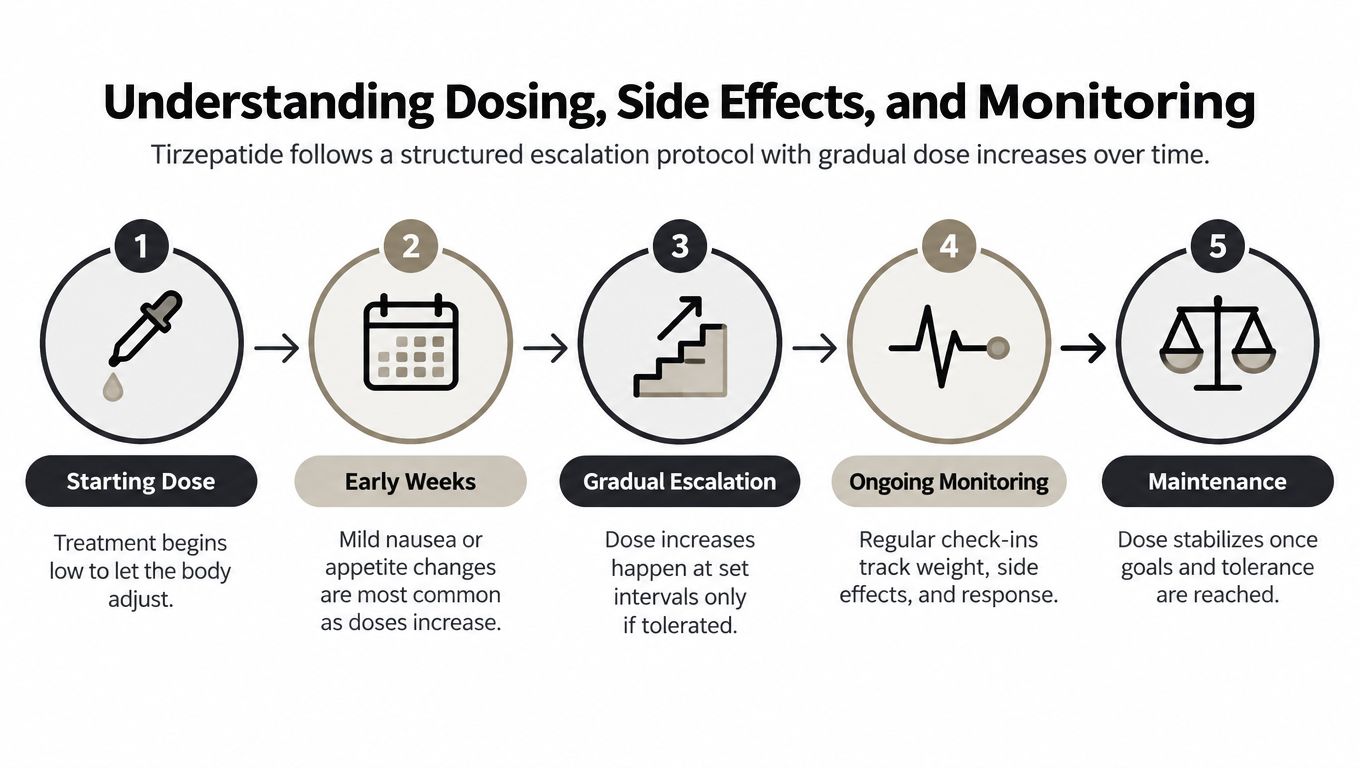
Tirzepatide is administered once weekly with stepwise escalation to 5 mg, 10 mg, or 15 mg in the SURMOUNT-1 obesity trial. The purpose of gradual escalation is to let your body adjust before the clinician considers a higher dose. The schedule should respond to tolerance, not to pressure to reach a target dose quickly.
The most common operational mistake is under-titration without a clinical reason, or stopping during the early adjustment period without discussing the problem. The strongest weight-loss response in the trial occurred after participants reached higher maintenance doses, so the first few weeks shouldn't be used to judge the full effect. At the same time, increasing while symptoms are uncontrolled is not a sign of disciplined treatment. It can make adherence harder.
What the safety data means in practice
Gastrointestinal events, including nausea, diarrhea, constipation, and vomiting, were more common with tirzepatide than placebo. In SURMOUNT-1, discontinuation because of adverse events occurred in 4.3% of participants at 5 mg, 7.1% at 10 mg, and 6.2% at 15 mg, compared with 2.6% with placebo, according to the reported trial safety data.
These figures don't predict exactly what will happen to one patient. They do support a practical conclusion: escalation deserves closer attention than a stable maintenance period. Smaller meals, adequate hydration, and timely communication with the provider can help, but don't use home strategies to mask symptoms that need medical assessment.
Track four things every week
Record the injection date, current dose, weight trend, and symptoms. Add notes about appetite, bowel changes, fluid intake, and whether a symptom affected normal activities. A weekly record gives the clinician useful context and can reveal whether a problem follows an escalation or appears unrelated to dosing.
A general weight-loss timeline guide can help set expectations about gradual change, but it shouldn't replace individualized medical advice. Your response may differ from another patient's, and a slower change doesn't automatically justify increasing the dose.
Use the tirzepatide dosing chart as a discussion aid, not as permission to alter treatment on your own. If you can't keep fluids down, develop severe or persistent abdominal symptoms, or feel unusually unwell, contact your clinician promptly and follow their urgent-care guidance.
Comparing Branded Therapy to Compounded Options
The decision between branded tirzepatide and a compounded option isn't only a price decision. It concerns regulatory status, product identity, pharmacy sourcing, prescribing oversight, and what protections are available if the medication or instructions are not what you expected.
FDA-approved branded therapy has gone through an approval process for its labeled use. Compounded tirzepatide is a different pathway. A compounder may prepare medication under specific conditions, but a compounded product itself hasn't received FDA approval. That distinction should appear plainly on the provider's website and in the prescribing conversation.
The post-shortage market makes verification especially important. The FDA declared the tirzepatide shortage resolved in October 2024, yet online clinics and med spas continued advertising compounded alternatives. A review of the post-shortage market reported that 86.7% of 75 clinics and med spas in two states offered compounded tirzepatide after shortages were resolved, even though those products had never received FDA approval, as described in the review of counterfeit and compounded GLP-1 products.
Compare the pathways directly
| Decision factor | FDA-approved branded pathway | Compounded pathway |
|---|---|---|
| Regulatory status | The branded product is FDA-approved for its labeled indication. | The compounded preparation itself hasn't received FDA approval. |
| Product identity | The name, packaging, concentration, and instructions should be defined by the manufacturer and dispensing pharmacy. | The provider must explain the formulation, concentration, labeling, and dispensing pharmacy clearly. |
| Dose discussion | The clinician prescribes an approved product according to the applicable prescribing information and patient needs. | The clinician must provide especially clear instructions because concentration and administration details can vary by preparation. |
| Pharmacy verification | You can ask which pharmacy dispenses the branded prescription and how it is fulfilled. | You should verify the compounding pharmacy, its licensing, and the exact product supplied. |
| Cost and coverage | Insurance or cash-pay access varies by plan, indication, and pharmacy. | The lower advertised price may reflect a different regulatory and fulfillment pathway, not an equivalent product. |
| Main safety question | Is the medication prescribed appropriately and obtained through a legitimate pharmacy? | Is the product legally and safely dispensed, accurately labeled, and clinically supervised? |
Don't assume “compounded” means counterfeit, and don't assume it means equivalent to Zepbound. Ask the provider to state the product's status in plain language. Request the pharmacy name before paying, confirm the concentration before injecting, and keep the dispensing label.
A responsible clinic won't object to these questions. It will understand that informed consent requires clarity, particularly when an online marketplace contains both approved and unapproved offerings.
Planning for Treatment Continuity and Access Gaps
Starting treatment is only one part of the clinical plan. A patient may lose access because a shipment is delayed, a pharmacy changes its inventory, an insurance decision changes, or an online provider stops offering a particular product. The response shouldn't be an improvised switch from one source to another.
Real-world continuity data show why this deserves attention. In a program involving 6,392 people, those with uninterrupted GLP-1 access reached 17.0% weight loss at 12 months and 20.1% at 24 months, while people with access issues reached 13.7% and 14.9%, respectively, according to the reported real-world findings on GLP-1 access. Both groups experienced meaningful weight loss, but the uninterrupted group achieved better results.
That gap isn't proof that every interruption produces the same outcome. It does show that logistics can affect treatment performance, particularly when missed doses lead to inconsistent use or an unsupervised restart.
Build a continuity plan before you need it
Ask your provider:
- What happens after a missed dose? Get instructions specific to your product and timing rather than relying on an internet comment.
- Who handles a delayed shipment? Save the clinical support and pharmacy contact details separately from the app.
- Can the provider coordinate a pharmacy change? Know whether the prescription can be transferred or renewed through another legitimate pharmacy.
- What happens after a longer interruption? Don't assume you can restart at your previous dose without clinical advice.
- What is the fallback plan? Discuss what you'll do if your current product is unavailable, including whether treatment should pause while the situation is assessed.
Supply problems can tempt patients toward copycat websites or products marketed as “the same medication.” That shortcut can replace a temporary access problem with a product-authenticity problem. Continuity means maintaining a documented clinical relationship, not finding another seller quickly.
Keep enough notice to contact the provider before the next injection is due, and report interruptions fully. A clinician can make a safer plan when they know exactly when the last dose was taken and what product you used.
Frequently Asked Questions About Online Tirzepatide
Is a prescription required for online tirzepatide?
Yes, a legitimate telehealth service should involve a licensed provider who evaluates you and issues a patient-specific prescription when appropriate. A quiz can collect information, but a checkout page shouldn't replace clinical judgment. If a website offers medication without a meaningful review, treat that as a warning sign rather than a convenient shortcut.
How can I verify the pharmacy?
Ask for the dispensing pharmacy's legal name, location, and licensing information before payment. Check the relevant state pharmacy resources and compare the details with the label you receive. The product name, concentration, patient name, prescriber, and directions should be clear and consistent with what the clinician explained.
Does a resolved shortage make every online offer legitimate?
No. A shortage resolution changes the market context, but it doesn't validate every seller or compounded product. Continue asking whether you are receiving branded Zepbound or a compounded preparation, who prescribed it, and which pharmacy dispensed it.
How much should online treatment cost?
There isn't one reliable monthly price for every patient. The total can depend on the product, consultation model, pharmacy, insurance coverage, eligibility for savings programs, and follow-up services. Compare the complete cost, including clinical visits, medication, shipping, and future dose changes, rather than choosing based on a headline offer.
Can I use FSA or HSA funds?
Eligibility depends on the rules of your plan and the type of expense. Ask the provider for an itemized receipt and confirm reimbursement requirements with your FSA or HSA administrator before assuming the expense qualifies.
What should I eat while taking tirzepatide?
Choose foods you tolerate and prioritize a balanced eating pattern that supports adequate hydration and nutrition. If you're looking for practical ideas, this guide to healthy cookie choices for dieters can help you evaluate treats without turning one food into a treatment plan. Persistent nausea, vomiting, or difficulty eating deserves a conversation with your clinician, not a stricter diet.
Is online treatment suitable for everyone?
No. A provider needs to review your medical history, current medicines, symptoms, and treatment goals before deciding whether tirzepatide is appropriate. The safest online programs also explain when remote care isn't enough and when you need an in-person evaluation.
Weight Method offers online intake, video consultations with licensed providers, prescription coordination, direct-to-door delivery, progress tracking, and ongoing support for adults considering GLP-1 treatment. Visit Weight Method to review the program and discuss whether its monitored approach fits your medical and access needs.