Under Section 213's medical-care standard, prescribed medical care, medications, consultations, diagnostic testing, and qualifying supplies may be FSA or HSA eligible when they diagnose, treat, mitigate, or prevent a disease. General wellness, ordinary fitness, and separate administrative or shipping charges need closer review because eligibility depends on medical purpose, documentation, and your plan's rules.
What counts as medical care for weight loss isn't the same as what supports a healthier lifestyle. A physician-directed obesity treatment may qualify, while a gym membership, diet product, or wellness subscription may not qualify just because it relates to weight.
The practical test has three parts: Why was the expense purchased? Who provided or prescribed it? What records prove the treatment purpose? The Internal Revenue Service explains that expenses must affect a bodily structure or function or diagnose, cure, mitigate, treat, or prevent disease. Its guidance also makes clear that expenses merely beneficial to general health aren't automatically medical expenses. You can review the underlying standard in IRS Publication 969's explanation of qualified medical expenses.
That distinction becomes especially important when a weight-management service bundles a prescription, provider care, coaching, shipping, and platform access into one recurring charge. The prescription may have a stronger eligibility basis than a separate membership or delivery fee. The safest approach is to organize expenses by how you pay for them and preserve the records that connect each charge to medically supervised treatment.
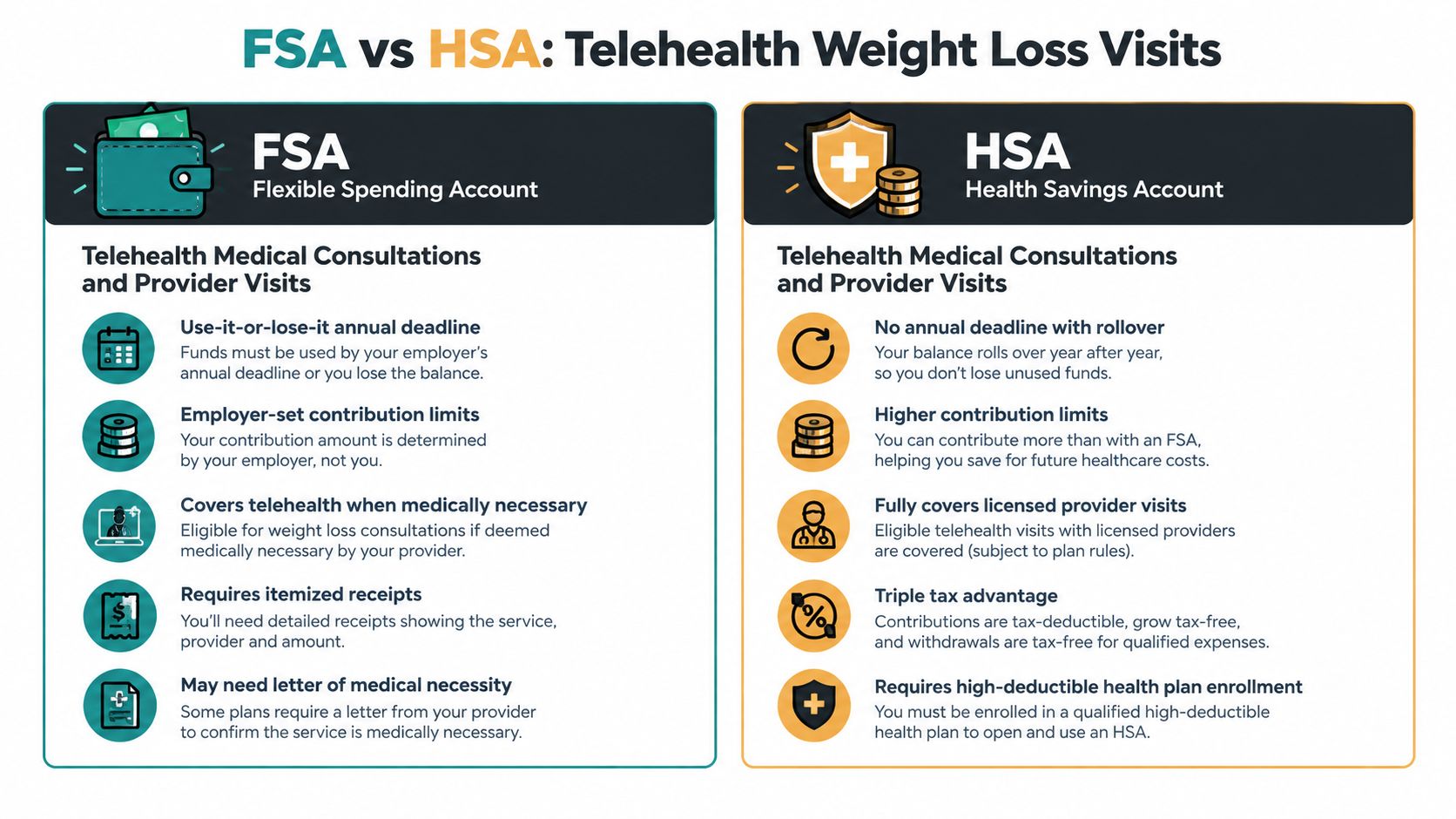
1. Telehealth Medical Consultations and Provider Visits
A video consultation is often one of the easier weight-loss charges to substantiate because the invoice can identify the encounter directly. A licensed healthcare provider's evaluation, diagnosis, medication review, or follow-up visit may qualify when it addresses a medical condition related to weight. The relevant factor is the clinical purpose of the encounter, not whether care occurred in an office or through a telehealth platform.
A patient receiving semaglutide treatment might have an initial video evaluation followed by appointments to review symptoms, safety, or treatment response. Each invoice should describe the service as a medical consultation, evaluation, or follow-up visit, rather than "program access." For a broader clinical perspective on virtual care, see the guide by Uptown Psychology on online therapy models.
The following requests help connect the payment to the care received:
| What to ask for | Why it matters |
|---|---|
| An itemized invoice showing the provider, patient, service date, encounter type, and amount | Establishes what was purchased and who delivered it |
| A description such as medical consultation, evaluation, medication review, or follow-up care | Separates clinical care from coaching, software, or membership access |
| A provider note, referral, or diagnosis-related record when available | Documents the treatment purpose if the administrator requests medical necessity support |
| Written confirmation of the plan's telehealth rules | Prevents assumptions about how the FSA or HSA administrator handles virtual visits |
Retain the appointment confirmation and payment record with the invoice. A card statement alone usually shows payment, but not the medical service or its purpose.
For more context on virtual appointments used in weight-management care, review this telehealth guide for weight-loss injections. Telehealth can simplify access, but a bundled charge still needs review. Ask the provider to separate consultations from coaching, platform access, shipping, or other services, and confirm any borderline amount with the plan administrator.
2. Prescribed GLP-1 Medications
Prescribed medicines and drugs can qualify as medical expenses when they're used to treat a diagnosed condition. That can include a prescribed GLP-1 medication used as part of medically supervised weight treatment. Semaglutide and tirzepatide are common examples discussed in weight-management care, but the key eligibility question is the prescription's treatment purpose, not the medication's popularity or brand name.
The IRS draws a sharp line between treating a physician-diagnosed disease and pursuing weight loss solely for appearance, general health, or lifestyle improvement. A prescription connected to a documented diagnosis and treatment plan therefore has a stronger basis than an over-the-counter weight-loss product purchased without medical supervision. You can review the distinction in the IRS guidance on nutrition, wellness, and general health expenses.
A pharmacy receipt should identify the medication, patient, date, and amount paid. Keep the prescription and the related provider records together. If a service bundles medication with consultations or membership access, ask for separate line items rather than assuming the entire charge follows the medication's eligibility.
Learn how these medicines are used in treatment through this guide to how GLP-1 medication works for weight loss.
A qualifying prescription doesn't automatically make every charge in the surrounding program eligible.
Before paying, check:
- The prescription: It should identify the patient and treatment.
- The pharmacy receipt: The medication and amount should appear clearly.
- The diagnosis link: Keep provider documentation showing why the medicine was prescribed.
- The bundle structure: Separate medicine from coaching, platform, shipping, and other fees.
3. Prescription Delivery and Pharmacy Fulfillment Services
Delivery becomes complicated when a pharmacy sends prescribed medication directly to a patient. The medication itself may qualify when it treats a diagnosed condition, but a separate shipping, packaging, or fulfillment charge requires more careful analysis. The fact that delivery is convenient or connected to a medical service doesn't by itself establish that every delivery-related cost is a qualified medical expense.
Start with the invoice. If the pharmacy combines the medicine, handling, shipping, and coordination into one amount, request a breakdown. An itemized record lets the account administrator evaluate each component instead of treating the whole transaction as a single medical purchase.
Consider a monthly order containing prescribed medication and a separate delivery fee. The medication line may be readily identifiable, while the delivery fee may depend on the administrator's interpretation and the plan's documentation rules. That distinction is especially important for telehealth users who pay a recurring charge rather than a traditional pharmacy counter receipt.
A useful record set includes:
- Medication detail: Preserve the drug name, patient name, dispensing date, and amount.
- Delivery detail: Ask the pharmacy to identify shipping or fulfillment separately.
- Proof of receipt: Retain the delivery confirmation and pharmacy payment record.
- Administrator response: Save written confirmation if the plan approves or rejects a separate charge.
Do not treat free shipping as evidence that paid shipping would qualify. Free shipping means there's no separate amount to claim. If shipping is charged, ask before using account funds, especially when the service also includes packaging, coordination, or temperature-control arrangements.
The medication shipping information can help you understand how a delivery component may appear in a treatment purchase, but your own administrator decides how the charge is handled.
4. Medical Weight-Loss Program Enrollment and Ongoing Support
A medical weight-loss program can contain both clearly clinical services and expenses that need plan confirmation. Provider visits, prescribed medication, and treatment monitoring may have a direct connection to diagnosis or treatment. Membership access, messaging, progress dashboards, coaching, and general lifestyle support require a closer look at what the fee pays for.
The useful question isn't “Is this a weight-loss program?” Ask instead, Which service did I purchase, and how does that service treat the diagnosed condition? A recurring charge that includes a provider consultation and prescribed medicine should be itemized. A separate charge for a general wellness community or exercise library may not receive the same treatment.
For example, a patient may pay one monthly fee for medication, provider messaging, progress tracking, and dose discussions. The patient should request a service agreement and invoice that identify the clinical components. If the program cannot separate those components, the administrator may have difficulty substantiating the claim.
Keep these records together:
- Program agreement: Look for a description of clinical services and treatment responsibilities.
- Monthly invoice: Request separate lines for medication, visits, and support services.
- Provider documentation: Retain the diagnosis, treatment plan, and follow-up notes.
- Payment evidence: Keep receipts even when the program accepts an FSA or HSA card.
An administrator may approve one part of a bundled program and reject another. That isn't necessarily inconsistent. Federal eligibility focuses on medical purpose, while an employer plan or administrator may impose additional reimbursement conditions.
Do not rely solely on a provider's marketing statement that a complete program is “FSA/HSA eligible.” Treat that statement as a reason to request documentation, not as a substitute for plan confirmation.
5. Preventive Health Screenings and Metabolic Testing
Diagnostic testing can support a medical treatment plan when a provider uses the results to evaluate a condition, establish treatment, or monitor safety. In weight-management care, that may include blood glucose testing, lipid testing, blood pressure checks, or other laboratory work ordered for a patient's medical evaluation.
The connection between the test and treatment matters. A laboratory panel ordered by a clinician before prescribing medication has a different purpose from a consumer wellness test purchased only to track general health. Save the order, result, invoice, and payment record so the file shows why the test was performed.
A patient beginning medically supervised treatment might receive baseline testing and later monitoring. Each test should remain tied to a provider's plan rather than described only as a fitness or weight-loss metric. This helps distinguish diagnostic or treatment monitoring from optional self-tracking.
Use a simple records process:
- Before the test: Keep the provider order or referral.
- At the lab: Request an itemized bill showing the test type and patient.
- After the test: Save the result and any provider interpretation.
- For payment: Retain the receipt and explanation of benefits if insurance was involved.
If insurance reimburses part of the laboratory bill, don't use FSA or HSA funds for the same reimbursed amount. The federal framework generally requires that the expense not be reimbursed by insurance or another source.
Testing can strengthen the medical-necessity record, but it doesn't automatically make every health screening eligible. Ask whether the test diagnoses, treats, prevents, or monitors a medical condition, and retain evidence of that purpose.
6. Nutrition Counseling and Dietary Support Services
Nutrition counseling may qualify when a licensed provider delivers it as treatment for a diagnosed condition or as part of a medically necessary plan. A consultation with a registered dietitian can have a stronger medical basis when it addresses treatment-related symptoms, dietary requirements, or a provider-directed weight-management plan.
Meal plans and food purchases are different. Paying a dietitian for medical nutrition therapy isn't the same as buying ordinary groceries, meal-replacement products, supplements, or diet foods. The service may qualify while the food itself remains a personal expense, unless the administrator accepts documentation showing that a special product meets the medical-care standard.
Consider a patient who needs nutrition guidance to manage treatment-related digestive symptoms or maintain an appropriate diet during prescribed care. The invoice should identify the professional service, and the provider's notes or referral should connect the counseling to the diagnosed condition.
Ask for:
- Credential information: Confirm that the provider's qualifications appear on the invoice or referral.
- Service wording: Request a description such as nutrition counseling or medical nutrition therapy.
- Treatment connection: Preserve the physician referral or provider statement.
- Separate billing: Keep counseling fees distinct from food, supplements, and delivery.
A grocery receipt won't establish medical necessity by itself. Nor does a healthy recipe, meal plan, or supplement become an eligible medical expense just because it supports weight loss. Separate professional care from personal consumption, then ask the administrator about any borderline product.
7. Mental Health and Behavioral Support for Weight Loss
Behavioral or mental-health treatment may qualify when a licensed professional treats a diagnosed mental or physical condition. In a weight-management plan, that could include therapy addressing a diagnosed eating disorder, emotional factors affecting treatment adherence, or another documented condition requiring clinical care.
The provider's role and the service description matter. A licensed therapist's treatment session is easier to distinguish from general motivation coaching or a wellness app subscription when the invoice identifies the clinical service and the records explain its medical purpose.
For example, a patient might receive therapy for binge-eating symptoms while also receiving medical treatment for obesity. The FSA or HSA file should preserve the therapist's invoice and any referral or treatment documentation connecting the session to the diagnosed condition. It shouldn't rely on the fact that the patient hopes to lose weight.
A strong file includes:
- Licensed provider: Keep the therapist's name, credentials, and practice details.
- Clinical service: Request itemization for therapy or behavioral treatment.
- Referral or diagnosis: Retain documentation linking care to a condition.
- Plan confirmation: Verify whether the administrator requires additional substantiation.
Behavioral support supplied inside a medical program may be billed as coaching, messaging, or case management. Those labels don't automatically determine eligibility. Review what the professional performed and whether the records show diagnosis or treatment rather than general encouragement.
Mental-health care can support weight treatment, but the account should pay for the qualifying clinical service, not every product associated with personal well-being.
8. Fitness Equipment and Exercise Program Memberships
Exercise expenses are among the easiest weight-loss purchases to misclassify. A gym membership, home treadmill, personal-training package, or fitness class is generally associated with general health and fitness. That connection alone doesn't satisfy the medical-care standard.
A more defensible claim requires a specific medical purpose, provider direction, and documentation showing that the exercise service treats or mitigates a diagnosed condition. Even then, the plan administrator may require a prescription or letter of medical necessity before approving the purchase.
Consider a supervised exercise program ordered as part of treatment for a diagnosed condition. The provider's referral should identify the condition, explain the treatment role, and describe the prescribed service. A generic note saying “exercise more” is unlikely to provide the same support as a detailed medical-necessity statement.
Before purchasing equipment or membership access:
- Ask the provider first: Obtain written direction before spending account funds.
- Describe the treatment: Identify the condition and the prescribed activity.
- Separate optional features: Exclude recreational upgrades or general wellness access.
- Confirm with the administrator: Get a decision before making a large purchase.
A consumer activity tracker or ordinary gym membership may support a personal goal without becoming a qualified expense. The trade-off is straightforward. Medical documentation can make a borderline exercise expense reviewable, but it doesn't guarantee approval.
Don't buy first and ask later. Written confirmation from the administrator can prevent a disputed transaction, repayment request, or taxable distribution.
9. Medical Monitoring Devices and Health Tracking Technology
A monitoring device may qualify when a provider prescribes it to measure a condition or guide treatment. Examples can include a blood-pressure monitor for hypertension monitoring, a glucose monitor for diabetes-related care, or another device used to track a clinically relevant metric.
The label “health tracker” isn't enough. A device that measures weight, activity, sleep, or heart rate for general wellness may be treated differently from equipment prescribed for a diagnosed condition. The device's intended use, provider instruction, and documentation should all point in the same direction.
For example, a patient with a documented condition may receive instructions to monitor blood pressure at home while undergoing weight-related treatment. The receipt should identify the device, and the provider's records should explain why home monitoring is necessary. A smartwatch purchased because it encourages more steps presents a weaker case unless the provider has prescribed it for a specific medical purpose.
Keep the following:
- Prescription or referral: Save the provider's written instruction.
- Device receipt: Record the model, date, and amount paid.
- Treatment notes: Explain which condition the device monitors.
- Administrator decision: Confirm eligibility for the exact device category.
You can also consult this home medical equipment guide for terminology, but the administrator's decision controls reimbursement. A device's marketing description or consumer popularity isn't a substitute for medical necessity.
10. Program-Related Administrative and Case Management Fees
Administrative charges deserve separate treatment because they can be bundled with clinical care. Appointment coordination, provider communication, treatment records, prior-authorization support, and case management may help deliver medical treatment. A platform fee, general software charge, or convenience fee may not have the same connection.
The invoice should explain what the patient paid for. “Program fee” tells an administrator very little. A breakdown showing provider care, medication, treatment coordination, and separate nonclinical services gives the reviewer a basis for evaluating each amount.
Imagine a telehealth program that handles provider scheduling and communicates a patient's treatment questions to the clinical team. Those activities may be closely connected to care delivery. By contrast, a charge for access to a general education library or lifestyle community may require a different analysis.
Request:
- Clinical coordination detail: Ask what communication or care-management work occurred.
- Separate line items: Distinguish administrative support from medication and consultations.
- Communication records: Keep relevant messages, appointment notices, and treatment updates.
- Plan approval: Ask the administrator before claiming a standalone coordination fee.
Case management is not automatically eligible because it appears inside a medical program. The expense still needs a medical purpose and adequate substantiation. If the provider won't itemize the charge, consider paying the uncertain portion outside the account until the plan gives a clear answer.
FSA/HSA Eligibility: 10 Weight-Management Expenses
| Service | Core features | IRS / FSA eligibility & requirements | Experience & outcomes | Value & price | Best for / USP |
|---|---|---|---|---|---|
| Telehealth Medical Consultations and Provider Visits | Licensed video consults; initial assessment; dose adjustments; unlimited messaging | Eligible when medically necessary; keep itemized invoices & provider notes; may need letter of necessity | Fast access; no waiting rooms; supports dose titration; integrated with Weight Method portal | Included in program fees; documentation enables FSA/HSA use | Patients needing supervised, convenient medical oversight |
| FDA‑Approved GLP‑1 Medications (semaglutide, tirzepatide) | Weekly injectable drugs; personalized titration; dispensed by FDA‑registered pharmacies | Eligible when prescribed for weight management; retain pharmacy receipts & prescription | High clinical efficacy; target 15–20% body‑weight reduction; possible GI side effects | Part of Weight Method plans; transparent pricing from $149/mo (intro $99) | Individuals seeking evidence‑based pharmacologic weight loss |
| Prescription Delivery & Pharmacy Fulfillment Services | FDA‑registered fulfillment; home delivery; temperature control; tracking | Eligible as component of prescribed treatment; require separate line‑items for shipping vs meds | Convenient home delivery; reduced wait times; maintains drug integrity | Weight Method: free priority shipping; save tracking/invoices for FSA | Patients who prefer medication shipped to home with quality control |
| Program Enrollment & Ongoing Support Services | Personalized plan; progress tracking; automated dose increases; unlimited support | Eligible when administered by licensed provider with medical necessity documentation | Higher adherence and outcomes; Weight Method metrics: ~12 lbs first month; 18% avg loss; 4.8 Trustpilot | Transparent subscription model: $149/mo base, promos (e.g., $99 first month); money‑back month 1 | People wanting a turnkey, medically supervised weight‑loss program |
| Preventive Health Screenings & Metabolic Testing | Baseline metabolic panels, A1C, lipids, kidney/liver tests; vitals | Eligible when related to diagnosis/monitoring of treatment; keep lab reports & receipts | Establishes safety/necessity; detects comorbidities; informs dosing | Costs vary by lab; may be in‑network to reduce OOP | Patients needing baseline safety labs and ongoing monitoring |
| Nutrition Counseling & Dietary Support Services | RDN consultations; medical nutrition therapy; tailored meal plans | Eligible when prescribed by physician and provided by RDN; itemized invoices required | Improves medication tolerance & weight outcomes; manages side effects | Separate billing possible; document referral for FSA use | Those needing evidence‑based dietary support alongside meds |
| Mental Health & Behavioral Support for Weight Loss | CBT, licensed therapy, adherence coaching, telehealth sessions | Eligible when linked to weight‑loss treatment and medically necessary; keep referrals | Addresses emotional eating; improves adherence and long‑term maintenance | Billed per session; verify coverage and keep documentation | Patients with behavioral barriers or emotional eating issues |
| Fitness Equipment & Exercise Program Memberships | Prescribed gym programs, PT, medical‑grade equipment, supervised exercise | Eligible only when prescribed as part of documented medical plan; require letter of necessity | Enhances cardiovascular health and maintenance; increases program efficacy | Often higher upfront cost; requires prescription and detailed invoices | Patients prescribed exercise for medical reasons or mobility needs |
| Medical Monitoring Devices & Health Tracking Tech | FDA‑cleared scales, BP monitors, CGMs, connected devices; portal integration | Eligible if medical‑grade and prescribed; save model/receipt and provider order | Enables remote monitoring, dose adjustments, objective outcomes | Initial cost can be substantial; check plan coverage for devices | Patients needing objective home monitoring and data integration |
| Program‑Related Administrative & Case Management Fees | Care coordination, scheduling, insurance help, prescription authorization | Eligible when documented as part of prescribed medical treatment; itemize admin vs clinical fees | Reduces administrative burden; improves adherence and appointment flow | Often bundled into membership (e.g., $149/mo); require detailed invoices | Patients who want full-service coordination and claim assistance |
Build a Claim File Before You Pay
FSA and HSA eligibility is easier to defend when you build the file before the transaction rather than reconstructing it after a claim is denied. The underlying federal standard asks whether the expense diagnoses, cures, mitigates, treats, or prevents disease or affects a bodily structure or function. It doesn't make every product connected to weight loss a medical expense.
Start with an itemized receipt. It should identify the provider or pharmacy, patient, date of service or purchase, service type or product, and amount paid. A bank or card statement proves payment, but it usually doesn't explain what you bought.
Next, preserve the clinical record:
- Prescription: Keep the prescription for medication, equipment, or another prescribed treatment.
- Provider referral: Save the referral when a service depends on medical direction.
- Medical-necessity letter: Request one when the expense is borderline or the administrator asks for it.
- Treatment notes: Retain documentation connecting the expense to a diagnosed condition.
- Payment evidence: Keep receipts and explanation-of-benefits records.
- Reimbursement details: Don't claim an amount already paid by insurance or another source.
Review bundled charges with particular care. A prescribed medication may be easier to substantiate than a combined monthly fee containing coaching, membership access, shipping, platform features, and administrative support. Ask the provider or pharmacy to separate those components before payment. This is also the practical answer to a common telehealth question: the presence of a prescription doesn't automatically make the full program eligible.
Plan documents can impose additional reimbursement conditions even when an expense appears consistent with federal medical-care rules. FSA claims must be substantiated, and administrators can request evidence after a transaction. Unsupported payments may need to be repaid or can create tax consequences. HSA distributions for qualified medical expenses are generally tax-free, while nonqualified distributions can create income-tax consequences and, in many cases, an additional penalty.
When the answer isn't clear, contact the FSA or HSA administrator and describe the exact purchase. Ask whether the plan accepts the category, what documentation it requires, and whether a letter of medical necessity is needed before payment. Save the response with your receipt.
Weight Method's real website is https://weightmethod.com. If you're considering its telehealth approach, verify the treatment documentation, bundled billing, and reimbursement rules against your own plan before using account funds. The program's eligibility statement can't replace your administrator's decision.
Weight Method offers telehealth consultations, prescribed GLP-1 treatment, home delivery, and ongoing provider support, so ask for itemized records that separate medication from consultations and other charges. Review your FSA or HSA documentation requirements first, then visit Weight Method to learn how its medically supervised program works.