Clinical trials show 14% to 22.5% average body-weight loss over roughly 72 weeks on GLP-1-based medications, but real-world outcomes depend heavily on treatment persistence and dose escalation. Some people lose less, while patients who stop early may see only modest change.
The more useful question isn't just, “How much weight can you lose on GLP-1?” It's how much weight can you lose while staying on treatment, tolerating dose increases, and maintaining access to medication? Trial results establish what these drugs can achieve under controlled conditions. Real-world evidence shows what happens when side effects, interruptions, cost, and incomplete dose escalation enter the picture.
Understanding Realistic GLP-1 Weight Loss Outcomes
A 22.5% average reduction in body weight over 72 weeks represents the upper end of the SURMOUNT-1 results, not a standard personal forecast. Across its tirzepatide doses, average loss ranged from 16.0% to 22.5%, compared with 2.4% with placebo. The trial also reported that 89% of participants taking 5 mg and 96% taking 10 mg or 15 mg lost at least 5% of their starting weight, according to Eli Lilly's trial results.
Clinical trials establish what these medications can achieve under defined conditions. Participants are screened for eligibility, followed on a schedule, supported during dose escalation, and given lifestyle guidance. Routine treatment is less controlled. Nausea may limit dose increases, a patient may switch products, or a shortage or coverage problem may interrupt treatment before a maintenance dose is reached.
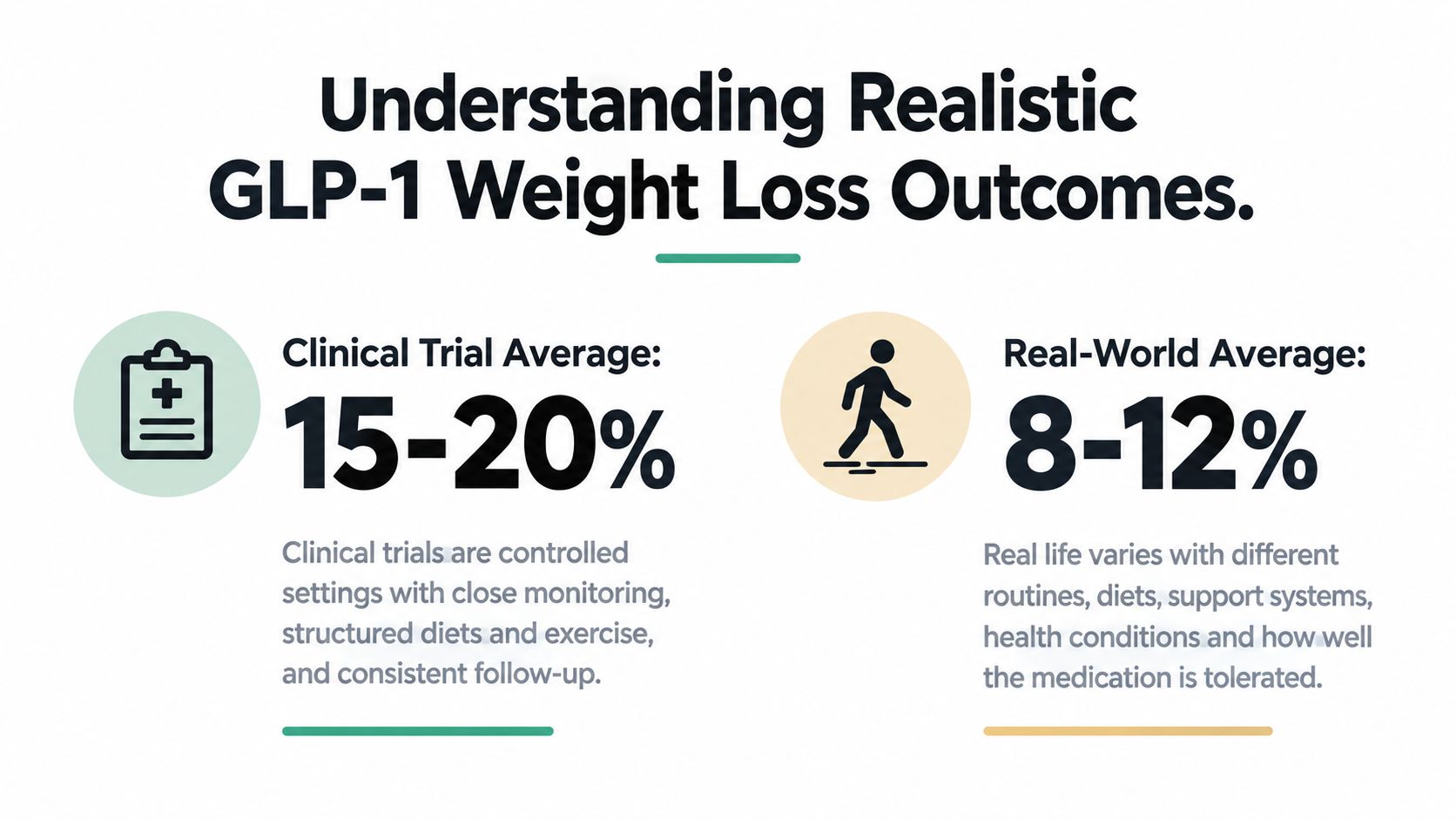
Trial averages aren't personal forecasts
A trial average describes the midpoint of a study population. It does not predict an individual result or imply a steady weekly rate. Some patients respond early, others lose weight gradually, and some do not reach the commonly used clinical threshold.
A practical expectation is a range rather than a single target. Semaglutide studies reported average losses of around 14% to 19%, while the tirzepatide results cited above reached 16.0% to 22.5%, depending on dose and study design. The semaglutide figures are reported in Novo Nordisk's semaglutide study results.
Practical rule: Use a trial percentage as a reference point, not a promise. Your result depends on the dose you can tolerate, the duration of treatment, and continued access.
Medication choice sets part of the potential range, while continuity determines how much of that range is reachable. Maintaining a tolerable regimen supports sustained progress. Stopping early, missing doses, or losing access can prevent a patient from reaching the treatment phase associated with larger average reductions.
Comparing Semaglutide and Tirzepatide Results
Semaglutide studies reported average weight loss from 14% to 19%, while tirzepatide studies reported 16.0% to 22.5%, depending on dose, duration, and study design. Those figures describe trial populations, not guaranteed personal outcomes. The difference between the headline result and an individual's result often comes down to tolerability, maintenance dosing, adherence, and continued access after supply disruptions.
Semaglutide activates the GLP-1 pathway. Tirzepatide acts on both GLP-1 and GIP pathways. Because the studies differed in participant characteristics, dosing schedules, treatment duration, and methods, their results support a useful comparison rather than a perfect head-to-head prediction.
One semaglutide study reported an average 14% loss at 64 weeks, compared with 2.4% for placebo, among 307 adults using a Wegovy pill. A later study of 1,407 adults using the Wegovy HD pen reported 19% average loss at 72 weeks, compared with 4% for placebo, according to Novo Nordisk's study announcement.
Tirzepatide showed a dose-related pattern in SURMOUNT-1. Average loss reached 16.0% at 5 mg, 21.4% at 10 mg, and 22.5% at 15 mg over 72 weeks, as reported by Eli Lilly.
| Medication | Average dose | Average weight loss | Timeframe |
|---|---|---|---|
| Semaglutide | Study-specific dosing | 14% | 64 weeks |
| Semaglutide | Wegovy HD pen study | 19% | 72 weeks |
| Tirzepatide | 5 mg | 16.0% | 72 weeks |
| Tirzepatide | 10 mg | 21.4% | 72 weeks |
| Tirzepatide | 15 mg | 22.5% | 72 weeks |
What the comparison can and can't tell you
Higher-dose tirzepatide produced greater average loss than the semaglutide result commonly associated with STEP 1. A higher trial result does not by itself make tirzepatide the right choice for a patient who cannot tolerate or consistently obtain it. The practical result depends on whether treatment can continue long enough to reach and maintain a tolerable dose.
STEP 1 offers another semaglutide benchmark. Participants receiving semaglutide 2.4 mg had mean weight change of -14.9% at 68 weeks, compared with -2.4% for placebo, and 86.4% achieved at least 5% loss, according to the American College of Cardiology trial summary. Clinically meaningful loss was common, but individual responses varied.
For broader background on treatment mechanisms and formats, consult this definitive peptide therapy resource. Readers evaluating the two medications can also review this tirzepatide versus semaglutide comparison.
Why Real-World Outcomes Differ From Clinical Trials
Clinical trials measure what a medication can achieve under structured conditions. Everyday outcomes reflect a longer chain of events, including dose escalation, side-effect management, follow-up, supply, coverage, and continued access. A strong trial result therefore sets an efficacy benchmark, not a guaranteed personal outcome.
A Cleveland Clinic cohort found that people who continued injectable obesity treatment lost an average of 11.9% of body weight after one year. Those who remained on high maintenance doses lost 13.7% with semaglutide and 18.0% with tirzepatide. Early discontinuers lost only 3.6% to 6.8%, according to Cleveland Clinic's real-world analysis.
Persistence changes the outcome distribution
The practical comparison is often between sustained treatment and early discontinuation, rather than semaglutide versus tirzepatide. A person who stops before reaching a stable regimen has less exposure than trial participants who continue through dose adjustment and longer follow-up. Their result should be interpreted as a different treatment pathway, not as evidence that the medication failed to match its headline efficacy.
Gastrointestinal symptoms can make continuation difficult. Follow-up delays, coverage changes, supply interruptions, and uncertainty about slower progress can also shorten treatment or prevent a patient from reaching the intended maintenance dose. After supply constraints ease, access still matters. A prescription that cannot be filled consistently cannot produce consistent exposure.
The question that matters in everyday care is not only which medication has the highest headline result. It is which treatment a patient can safely and consistently continue.
Dose escalation requires tolerance
Dose escalation is a clinical adjustment, not a race. Providers may change the pace according to symptoms, response, medical history, and the patient's ability to maintain treatment. Someone taking a lower dose may still benefit, but a higher-dose trial average should not be applied as though the exposure were identical.
The 18.0% high-maintenance-dose result for tirzepatide and the 13.7% result for semaglutide are useful because they connect weight change with sustained use at a high maintenance dose. They also show why headline trial efficacy and real-world persistence should be assessed together.
A realistic plan includes side-effect support, timely dose review, and a dependable way to maintain access. Those conditions help determine whether an individual's outcome remains closer to a lower real-world range or approaches results reported in longer, controlled studies.
The GLP-1 Treatment Timeline and Milestones
GLP-1 treatment unfolds through distinct milestones. Early weeks establish tolerability and dosing. Later months show whether appetite control and weight change persist. Long-term results depend on reaching an appropriate maintenance dose, staying on treatment, and reviewing the plan when progress changes.
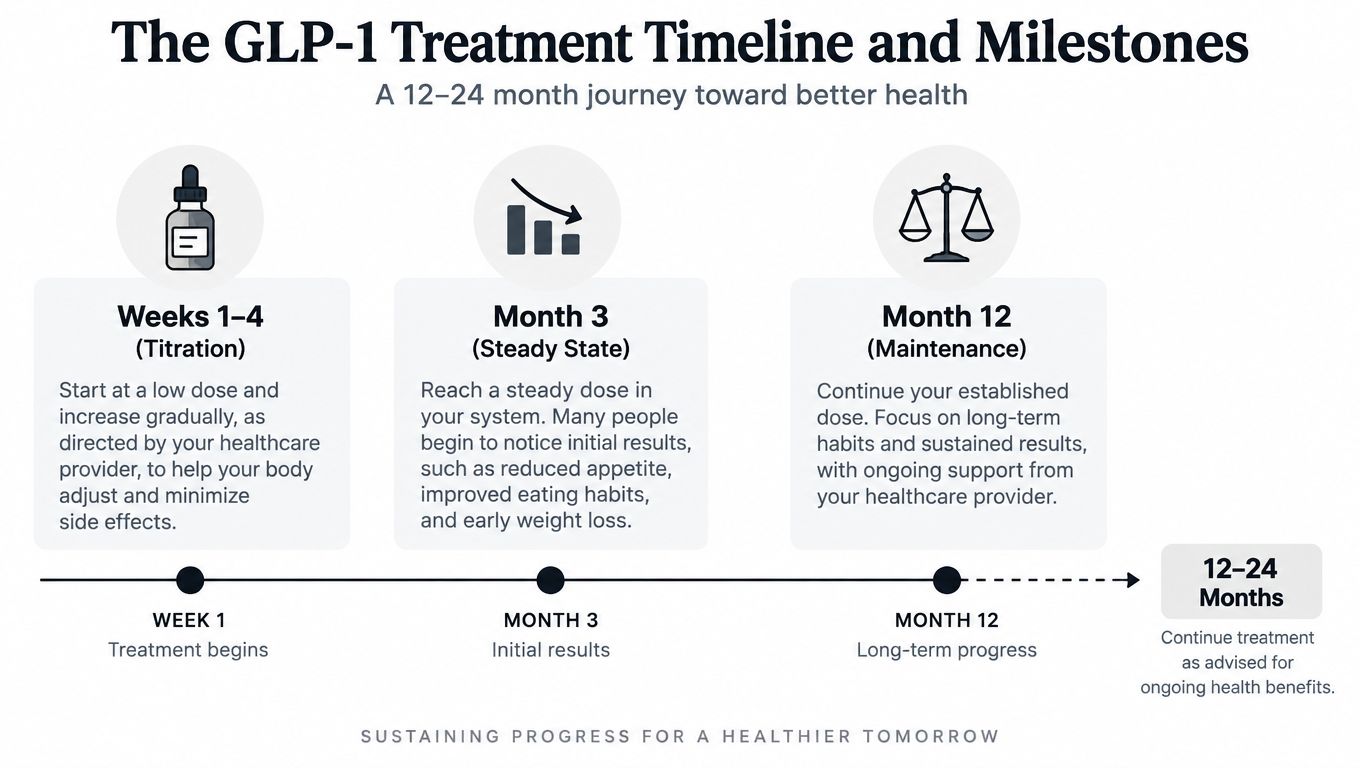
The early titration phase
At the start, the prescribing provider assesses how the patient responds before increasing the dose. Appetite may change before the scale shows a clear trend. Nausea, constipation, vomiting, or other gastrointestinal symptoms can affect whether the next increase occurs on schedule.
Semaglutide titration commonly begins at 0.25 mg and progresses toward 2.4 mg over roughly 17 weeks, although the actual pace may be adjusted for tolerance and clinical context. The GLP-1 weight-loss timeline guide provides a practical view of how escalation, maintenance, and longer-term outcomes fit together.
Early success therefore includes more than pounds lost. A patient who can eat adequately, stay hydrated, follow the dosing plan, and report side effects promptly is better positioned to continue treatment. Escalating faster than tolerated can create problems that interrupt the timeline.
Dose escalation and measurable progress
As doses change, the patient and provider can evaluate appetite control, side effects, and the direction of weight change. The STEP 1 result cited above represents a later treatment milestone, not an outcome that should be expected after the first few appointments.
Short-term changes can be uneven. A slower period may reflect the normal pace of treatment, an incomplete dose escalation, inconsistent access, or a need to reassess the plan. It should prompt clinical review rather than an unsupervised dose change. This distinction helps separate headline efficacy from the outcome a patient can realistically sustain.
Maintenance and long-term evaluation
Maintenance is the point at which treatment consistency becomes the main question. The provider reviews weight trend, appetite, side effects, health considerations, and whether the current dose remains suitable. Reaching a maintenance dose does not end monitoring. It establishes the exposure against which future progress and plateaus can be judged.
Useful milestones to record include:
- Dose changes: Note each increase, delay, and physical response.
- Treatment continuity: Record missed doses, interruptions, and pharmacy delays.
- Functional changes: Track appetite, mobility, energy, and daily activities alongside weight.
- Clinical review points: Report stalled progress or persistent side effects to the prescribing provider.
The meaningful endpoint is not a particular week when every patient reaches the same percentage. It is a treatment pattern that remains effective, tolerable, and available enough to support continued care.
Factors That Influence Your Weight Loss Results
GLP-1 medications do not produce a fixed result. Outcomes vary with starting weight, dose tolerance, treatment duration, health status, and whether medication remains available. A percentage is usually more useful for comparing results than a raw number of pounds, but neither measure predicts an individual response.
The practical question is which variables can be addressed with a clinician.

The controllable variables
Several factors can shift results toward the lower or higher end of the observed range:
- Treatment persistence: Take doses as prescribed and report interruptions early. Continued treatment gives the medication time to show its longer-term effect.
- Maintenance dose: Follow the planned titration schedule rather than treating the highest trial dose as a personal target. A dose must be both tolerated and clinically appropriate.
- Side-effect management: Ask your provider about anti-nausea timing, slower titration, hydration targets, constipation treatment, or changes to the plan before symptoms cause a missed dose.
- Lifestyle support: Build meals around adequate nutrition, add movement that fits your ability, protect sleep, and use behavioral support when available. These habits support treatment without turning them into a substitute for medication.
- Clinical context: Share current medicines, medical conditions, appetite changes, and new symptoms. These details can affect suitability, dosing, and response.
As shown in the real-world cohort discussed earlier, persistence and dose exposure help explain why observed outcomes may differ from trial headlines. The Cleveland Clinic analysis also reinforces why discontinuation should be treated as a clinical problem to address, not just as evidence that a medication has failed.
Access is now part of the clinical equation
Availability can shape results as directly as tolerability. FDA communications state that semaglutide shortages were resolved in 2025 and describe the winding down of mass-market compounded GLP-1 production. Compounded semaglutide and tirzepatide may therefore be unavailable except in rare individualized circumstances, as explained in the FDA communication on compounded GLP-1 policies.
Patients who built a plan around lower-cost compounded products may face a coverage or supply disruption. An interruption can delay dose progression, weaken appetite control, and make results less comparable with studies that assume consistent access.
The practical conclusion is that continuity may matter more than selecting the medication with the most impressive headline number. A treatment that remains available, tolerated, and clinically monitored may deliver more meaningful progress than an option that cannot be sustained.
Setting Realistic Expectations With a Telehealth Provider
A telehealth model can support the parts of GLP-1 treatment that trial averages don't capture. A licensed provider can review eligibility, monitor response, discuss side effects, and adjust the plan when the patient's experience differs from the expected trajectory. Messaging and scheduled consultations also give patients a place to raise problems before those problems lead to an avoidable interruption.
A sensible first-month discussion should cover:
- Medical suitability: The provider reviews health history, current medications, and whether semaglutide or tirzepatide is appropriate.
- Starting plan: The patient receives instructions for administration, nutrition, side-effect awareness, and follow-up.
- Response monitoring: Weight, appetite, symptoms, and adherence become part of the conversation.
- Next-step decisions: Dose changes happen through clinical guidance, not by treating a trial maximum as a personal target.
Patients researching complementary wellness products may also encounter information about berberine 500 mg for wellness routines. Such products shouldn't be treated as substitutes for prescribed GLP-1 therapy or combined with medication without discussing the plan with a qualified clinician.
The central benefit of supervision is not a promise of a particular percentage. It's the ability to respond when the patient experiences nausea, stalled progress, missed doses, or access problems. That support helps align real treatment conditions more closely with the persistence and dose monitoring present in clinical research.
Patient Success Stories and Final Takeaways
A responsible success story can't promise that every patient will match one member's result. The evidence supports a clearer narrative: people who continue treatment, tolerate dose escalation, and receive ongoing clinical support are more likely to approach the higher end of real-world outcomes. The before-and-after results should therefore be read as individual experiences, not guarantees.
GLP-1 medications can produce meaningful weight loss, but the percentage depends on persistence, maintenance dosing, tolerability, and access. Trial averages show potential. Real-world follow-through determines how much of that potential a patient can use.
Weight Method provides online medical evaluations, licensed-provider consultations, prescription semaglutide or tirzepatide when clinically appropriate, dose monitoring, and ongoing support. Visit Weight Method to review the telehealth process and discuss whether supervised GLP-1 treatment fits your health goals.